\n
## Diagram: Process Flow with Function Calls
### Overview
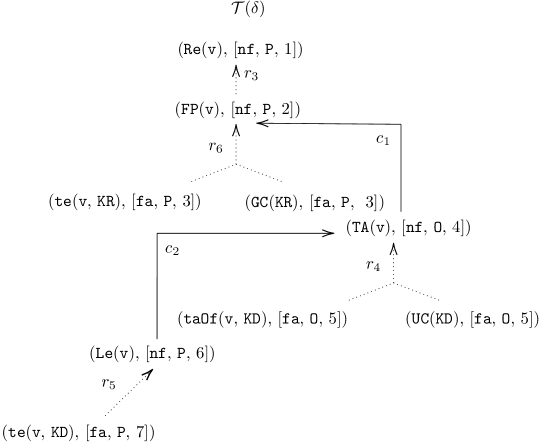
The image depicts a directed graph representing a process flow, likely a computational or logical sequence. The nodes represent function calls or states, and the arrows indicate transitions between them. Each node is labeled with a function name and associated data, enclosed in brackets. The diagram is titled "T(δ)" at the top-center.
### Components/Axes
The diagram consists of nodes and directed edges. The nodes are labeled with function names and data in the format: `function_name(arguments), [data_type, value, identifier]`. The edges are labeled with identifiers like `r3`, `c1`, `r6`, `c2`, `r4`, `r5`. There are no explicit axes or scales.
### Detailed Analysis or Content Details
Here's a breakdown of the nodes and transitions, moving from top to bottom:
1. **Top Node:** `Re(v), [nf, P, 1]`
2. **Transition:** `r3` leads to the next node.
3. **Second Node:** `FP(v), [nf, P, 2]`
4. **Transition:** `c1` splits into two paths.
5. **Third Node (Left Branch):** `te(v, KR), [fa, P, 3]`
6. **Fourth Node (Right Branch):** `GC(KR), [fa, P, 3]`
7. **Transition:** `c2` from `te(v, KR)` leads to the next node.
8. **Fifth Node:** `Le(v), [nf, P, 6]`
9. **Transition:** `r5` leads to the next node.
10. **Sixth Node:** `te(v, KD), [fa, P, 7]`
11. **Transition:** `r4` from `GC(KR)` splits into two paths.
12. **Seventh Node (Left Branch):** `TA(v), [nf, 0, 4]`
13. **Eighth Node (Right Branch):** `UC(KD), [fa, 0, 5]`
14. **Ninth Node:** `ta0f(v, KD), [fa, 0, 5]`
The data types appear to be:
* `nf`: Likely "not found" or a similar flag.
* `fa`: Likely "false" or a similar flag.
* `P`: A parameter or value.
* Numbers: Integer values.
The identifiers (1, 2, 3, 4, 5, 6, 7) likely represent step numbers or unique identifiers for each node.
### Key Observations
The diagram shows a branching process. The initial node `Re(v)` leads to `FP(v)`, which then splits into two parallel paths. One path involves `te(v, KR)` and `Le(v)`, ultimately leading to `te(v, KD)`. The other path involves `GC(KR)` and splits into `TA(v)` and `UC(KD)`, which then leads to `ta0f(v, KD)`. The diagram suggests a decision point at `FP(v)` and `GC(KR)`.
### Interpretation
This diagram likely represents a state machine or a workflow in a software system. The function calls suggest operations on variables `v`, `KR`, and `KD`. The data types and values indicate the status or results of these operations. The branching paths suggest conditional logic based on the outcomes of the function calls. The identifiers could be used for debugging or tracing the execution flow.
The diagram demonstrates a process that begins with `Re(v)` and proceeds through a series of function calls, potentially involving error handling (indicated by `nf`) and conditional branching. The final nodes `te(v, KD)` and `ta0f(v, KD)` suggest the process concludes with operations related to `KD`. The diagram is a visual representation of a complex algorithm or system behavior. It is not possible to determine the exact purpose of the process without further context.