TECHNICAL ASSET FINGERPRINT
246039c485266846d5713527
Click to view fullscreen
Press ESC or click to close
FOUND IN PAPERS
EXPERT: healer-alpha-free VERSION 1
RUNTIME: free/openrouter/healer-alpha
INTEL_VERIFIED
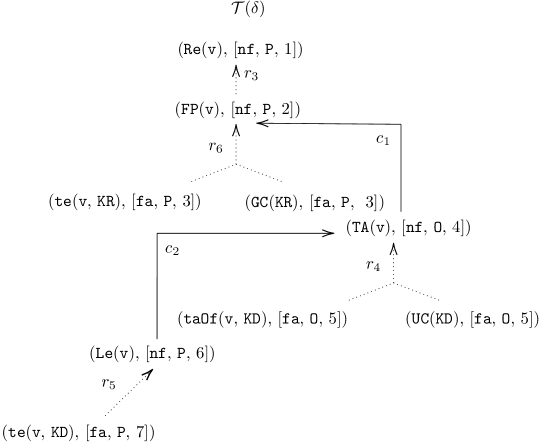
## Diagram: Formal Derivation or Transformation Tree (T(δ))
### Overview
The image displays a hierarchical, tree-like diagram titled "T(δ)" at the top center. It consists of nodes containing symbolic tuples connected by directed arrows (both solid and dotted) with labeled edges. The structure suggests a formal derivation, proof tree, or state transition diagram, likely from fields such as formal logic, computational linguistics, or theoretical computer science. The notation involves functions or predicates (e.g., Re, FP, te, GC) applied to variables (v, KR, KD) and lists of parameters (e.g., [nf, P, 1]).
### Components/Axes
* **Title:** `T(δ)` - Positioned at the top center. This likely denotes a transformation, function, or tree structure parameterized by δ.
* **Nodes:** Each node is a tuple of the form `(Symbol(Arguments), [List])`. The list contains what appear to be status flags (e.g., `nf`, `fa`), a symbol (`P`, `O`), and an integer index.
* **Edges:** Directed arrows connect the nodes. They are labeled with identifiers like `r3`, `c1`, `r6`, `c2`, `r4`, `r5`. The arrow styles differ:
* **Solid arrows:** Used for connections labeled `c1` and `c2`.
* **Dotted arrows:** Used for connections labeled `r3`, `r6`, `r4`, `r5`.
* **Spatial Layout:** The diagram flows generally from top to bottom, with some lateral connections. The main trunk descends from the top node, with branches extending left and right.
### Detailed Analysis / Content Details
**Node Transcription (from top to bottom, following connections):**
1. **Top Node (Root):** `(Re(v), [nf, P, 1])`
* *Position:* Top center.
* *Connection:* A dotted arrow labeled `r3` points downward to Node 2.
2. **Node 2:** `(FP(v), [nf, P, 2])`
* *Position:* Directly below Node 1.
* *Connections:*
* Receives dotted arrow `r3` from Node 1.
* A dotted arrow labeled `r6` points downward to a junction.
* A solid arrow labeled `c1` points leftward from this node to Node 4.
3. **Junction below Node 2:** The dotted arrow `r6` from Node 2 splits to point to two nodes:
* **Left Branch Node (Node 3a):** `(te(v, KR), [fa, P, 3])`
* **Right Branch Node (Node 3b):** `(GC(KR), [fa, P, 3])`
* *Note:* Both nodes share the same list index `3`.
4. **Node 4:** `(TA(v), [nf, O, 4])`
* *Position:* To the right of Node 3b, connected via solid arrow `c1` from Node 2.
* *Connections:*
* Receives solid arrow `c1` from Node 2.
* A dotted arrow labeled `r4` points downward to a junction.
* A solid arrow labeled `c2` points leftward from this node to Node 6.
5. **Junction below Node 4:** The dotted arrow `r4` from Node 4 splits to point to two nodes:
* **Left Branch Node (Node 5a):** `(ta0f(v, KD), [fa, O, 5])`
* **Right Branch Node (Node 5b):** `(UC(KD), [fa, O, 5])`
* *Note:* Both nodes share the same list index `5`.
6. **Node 6:** `(Le(v), [nf, P, 6])`
* *Position:* To the left of Node 5a, connected via solid arrow `c2` from Node 4.
* *Connections:*
* Receives solid arrow `c2` from Node 4.
* A dotted arrow labeled `r5` points downward to the final node.
7. **Bottom Node (Leaf):** `(te(v, KD), [fa, P, 7])`
* *Position:* Bottom left, connected via dotted arrow `r5` from Node 6.
**Edge Label Summary:**
* `r3`: Connects Node 1 -> Node 2 (dotted)
* `r6`: Connects Node 2 -> Junction (3a/3b) (dotted)
* `c1`: Connects Node 2 -> Node 4 (solid)
* `r4`: Connects Node 4 -> Junction (5a/5b) (dotted)
* `c2`: Connects Node 4 -> Node 6 (solid)
* `r5`: Connects Node 6 -> Node 7 (dotted)
### Key Observations
1. **Dual Connection Types:** The diagram uses two distinct arrow styles (dotted `r`-labeled and solid `c`-labeled), suggesting two different types of relationships or rules (e.g., "rewrite rules" vs. "control flow" or "coreference").
2. **Parameter Patterns:** The second element of each node's tuple follows a pattern: `[Status, Symbol, Index]`.
* **Status:** Alternates between `nf` (possibly "non-final" or "new fact") and `fa` (possibly "final" or "fact asserted"). Nodes on the main trunk (1, 2, 4, 6) have `nf`, while branch nodes (3a, 3b, 5a, 5b, 7) have `fa`.
* **Symbol:** Primarily `P`, with nodes 4 and 5a/b using `O`. This may indicate a change in property or type.
* **Index:** Sequential integers from 1 to 7, generally increasing down the tree, but with branches sharing the same index (3a/3b share 3; 5a/5b share 5).
3. **Structural Symmetry:** There is a mirrored sub-structure. Node 2 branches via `r6` to two nodes (3a, 3b). Similarly, Node 4 branches via `r4` to two nodes (5a, 5b). This suggests parallel or conjunctive operations.
4. **Variable Progression:** The arguments inside the functions change. `v` is a constant first argument. The second argument shifts from `KR` (in Node 3a, 3b) to `KD` (in Nodes 5a, 5b, 7), indicating a transformation of the knowledge representation or domain.
### Interpretation
This diagram, `T(δ)`, visually represents a formal derivation or transformation process. The root node `Re(v)` undergoes a series of rule applications (`r`-labeled edges) and control or coreference shifts (`c`-labeled edges).
* **Process Flow:** The derivation starts with `Re(v)` (perhaps "Reference of v"). It transforms into `FP(v)` ("Feature Path of v"?). From here, the process splits: one path (`r6`) generates two related assertions about `KR` ("Knowledge Resource"?), while another path (`c1`) shifts focus to `TA(v)` ("Type Assignment of v"?). This second path then generates assertions about `KD` ("Knowledge Domain"?). Finally, the process concludes with `Le(v)` ("Leaf of v"?) leading to a terminal assertion `te(v, KD)`.
* **Meaning of Labels:** The `r` rules seem to perform the core derivational steps, expanding or transforming expressions. The `c` connections appear to manage the flow of control or link related but distinct derivation threads. The change from `P` to `O` in the parameter list at Node 4 may signify a shift from a "Property" to an "Object" or "Operator" context.
* **Overall Purpose:** The tree maps the step-by-step breakdown of an initial concept (`Re(v)`) into a set of final, grounded assertions (`fa` status) about entities (`KR`, `KD`) and their relationships. The shared indices on branch nodes imply that those two outcomes are simultaneous or equivalent results of a single rule application. The diagram is a precise, formal record of this logical or computational process.
DECODING INTELLIGENCE...