## Visual Pattern Grid: 3x3 Matrix of Geometric Shapes
### Overview
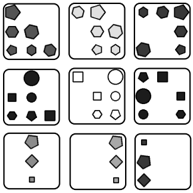
The image displays a 3x3 grid of nine square panels. Each panel contains a unique arrangement of simple geometric shapes (hexagons, circles, squares, and diamonds) in varying sizes and fill states (solid black or outlined in black on a white background). There is no textual information, labels, charts, or data present in the image. It appears to be a visual pattern or puzzle, possibly for cognitive testing, design inspiration, or a non-verbal reasoning exercise.
### Components/Axes
* **Grid Structure:** A 3x3 matrix of nine equal-sized square panels with thin black borders.
* **Shapes Present:**
* Hexagons
* Circles
* Squares
* Diamonds (rotated squares)
* **Shape Attributes:**
* **Fill:** Solid black or outlined (white interior).
* **Size:** At least two distinct sizes are used (e.g., large and small).
* **Position:** Shapes are placed in specific locations within each panel (e.g., corners, center, along edges).
### Detailed Analysis (Panel-by-Panel)
The grid is processed row by row, from top-left to bottom-right.
**Row 1:**
1. **Top-Left Panel:** Contains 7 shapes. A large outlined hexagon is in the top-left corner. A large solid hexagon is in the bottom-right corner. Five smaller solid circles are scattered in the remaining space.
2. **Top-Middle Panel:** Contains 7 shapes. A large outlined hexagon is in the top-left corner. A large outlined circle is in the bottom-right corner. Five smaller outlined circles are scattered in the remaining space.
3. **Top-Right Panel:** Contains 7 shapes. A large solid hexagon is in the top-left corner. A large solid square is in the bottom-right corner. Five smaller solid circles are scattered in the remaining space.
**Row 2:**
4. **Middle-Left Panel:** Contains 7 shapes. A large solid circle is in the top-left corner. A large solid square is in the bottom-right corner. Five smaller solid squares are scattered in the remaining space.
5. **Center Panel:** Contains 7 shapes. A large outlined square is in the top-left corner. A large outlined circle is in the bottom-right corner. Five smaller outlined circles are scattered in the remaining space.
6. **Middle-Right Panel:** Contains 7 shapes. A large solid circle is in the top-left corner. A large solid square is in the bottom-right corner. Five smaller solid squares are scattered in the remaining space.
**Row 3:**
7. **Bottom-Left Panel:** Contains 3 shapes arranged vertically in the center. A large outlined hexagon at the top, a medium outlined diamond in the middle, and a small outlined square at the bottom.
8. **Bottom-Middle Panel:** Contains 3 shapes arranged vertically in the center. A large solid hexagon at the top, a medium solid diamond in the middle, and a small solid square at the bottom.
9. **Bottom-Right Panel:** Contains 3 shapes arranged vertically in the center. A small solid square at the top, a medium solid diamond in the middle, and a large solid hexagon at the bottom.
### Key Observations
* **Pattern in Rows 1 & 2:** The first two rows follow a consistent pattern. Each panel contains exactly seven shapes. The shape in the top-left corner and the shape in the bottom-right corner are larger than the others. The five smaller shapes are of a single type (all circles or all squares) and share the same fill state as the two larger corner shapes.
* **Pattern in Row 3:** The third row breaks the previous pattern. Each panel contains only three shapes, arranged in a vertical column in the center. The shapes are of three different types (hexagon, diamond, square) and three different sizes (large, medium, small). The fill state is consistent within each panel (all outlined or all solid).
* **Fill State Alternation:** There is a loose alternation between panels with solid shapes and panels with outlined shapes, though it is not a perfect checkerboard pattern.
* **Shape Progression:** The bottom row introduces a clear vertical size progression (large to small or small to large) within each panel, which is not a feature of the upper rows.
### Interpretation
This image does not contain factual data or measurable trends. It is a visual composition. The structure suggests it could be:
1. **A Pattern Recognition Test:** The shift in rules between the top two rows and the bottom row is a common feature in abstract reasoning tests, where the test-taker must deduce the underlying logic.
2. **A Design or Icon Set Exploration:** It could be a study in visual consistency, variation, and the use of a limited shape vocabulary to create distinct groupings.
3. **A Non-Verbal Puzzle:** The arrangement invites the viewer to find relationships, such as which panel doesn't belong, or to predict what a tenth panel might look like based on the observed rules.
The primary relationship is between the **consistent internal logic of a panel** (e.g., "two large corner shapes of type A and B, plus five small shapes of type C, all sharing a fill state") and the **variation of that logic across the grid**. The anomaly is the complete change of compositional rule in the final row, moving from a scattered 7-shape layout to a centered, ordered 3-shape column.