\n
## Bar Chart: Theorems Proved by COPRA and ReProver
### Overview
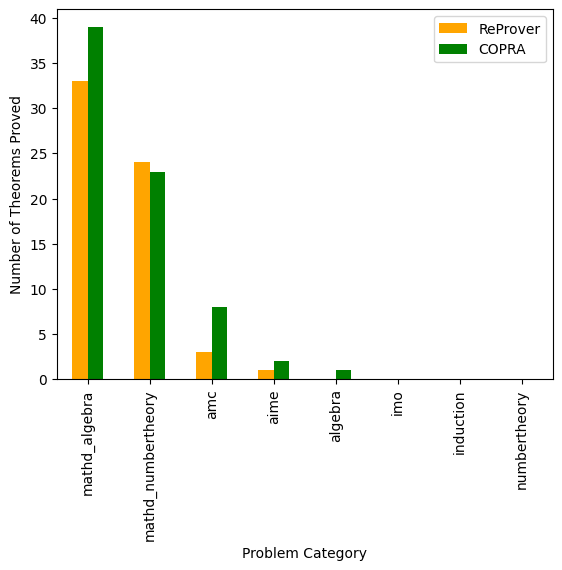
This bar chart compares the number of theorems proved by two automated theorem provers, COPRA and ReProver, across several problem categories. The x-axis represents the problem category, and the y-axis represents the number of theorems proved. Each problem category has two bars, one for COPRA (green) and one for ReProver (orange).
### Components/Axes
* **X-axis Title:** Problem Category
* **Y-axis Title:** Number of Theorems Proved
* **X-axis Categories:** mathd\_algebra, mathd\_numbertheory, amc, aime, algebra, imo, induction, numbertheory
* **Legend:**
* Orange: ReProver
* Green: COPRA
### Detailed Analysis
The chart displays the number of theorems proved for each category by each prover.
* **mathd\_algebra:** COPRA proves approximately 39 theorems, while ReProver proves approximately 32 theorems.
* **mathd\_numbertheory:** COPRA proves approximately 24 theorems, while ReProver proves approximately 26 theorems.
* **amc:** COPRA proves approximately 9 theorems, while ReProver proves approximately 3 theorems.
* **aime:** COPRA proves approximately 2 theorems, while ReProver proves approximately 1 theorem.
* **algebra:** COPRA proves approximately 2 theorems, while ReProver proves approximately 1 theorem.
* **imo:** COPRA proves 0 theorems, while ReProver proves 0 theorems.
* **induction:** COPRA proves 0 theorems, while ReProver proves 0 theorems.
* **numbertheory:** COPRA proves 0 theorems, while ReProver proves 0 theorems.
### Key Observations
* COPRA consistently proves more theorems than ReProver in the categories where both provers have proven theorems.
* COPRA demonstrates a significant advantage in the 'mathd\_algebra' category.
* Both provers fail to prove any theorems in the 'imo', 'induction', and 'numbertheory' categories.
* The 'aime' and 'algebra' categories have very low theorem counts for both provers.
### Interpretation
The data suggests that COPRA is generally more effective than ReProver at proving theorems in the tested categories. The large difference in 'mathd\_algebra' suggests that COPRA may have specific strengths in this area. The failure of both provers to solve problems in 'imo', 'induction', and 'numbertheory' indicates that these categories may be particularly challenging for current automated theorem proving techniques, or that the test set for these categories was particularly difficult. The low counts in 'aime' and 'algebra' might indicate that these categories are less amenable to automated proof, or that the test sets were small. The chart provides a comparative performance assessment of the two theorem provers, highlighting their relative strengths and weaknesses across different mathematical problem domains.