## Grouped Bar Chart: Theorem Proving Performance by System and Problem Category
### Overview
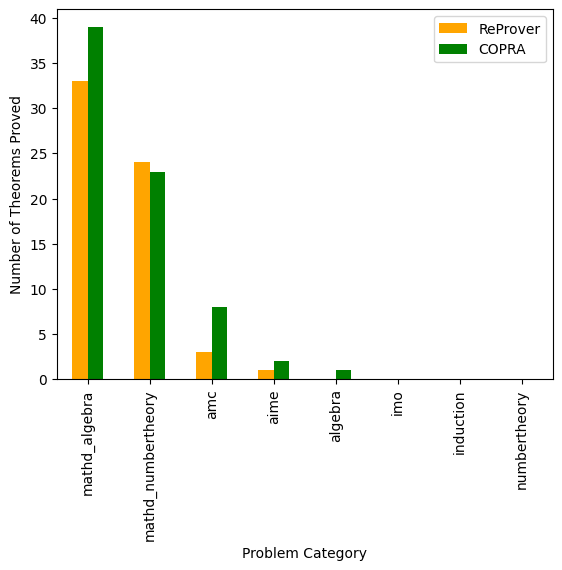
The image displays a grouped bar chart comparing the performance of two automated theorem proving systems, **ReProver** and **COPRA**, across eight different mathematical problem categories. The chart quantifies the number of theorems each system successfully proved within each category.
### Components/Axes
* **Chart Type:** Grouped (clustered) vertical bar chart.
* **X-Axis (Horizontal):**
* **Label:** "Problem Category"
* **Categories (from left to right):** `mathd_algebra`, `mathd_numbertheory`, `amc`, `aime`, `algebra`, `imo`, `induction`, `numbertheory`.
* **Y-Axis (Vertical):**
* **Label:** "Number of Theorems Proved"
* **Scale:** Linear, ranging from 0 to 40, with major tick marks at intervals of 5 (0, 5, 10, 15, 20, 25, 30, 35, 40).
* **Legend:**
* **Position:** Top-right corner of the chart area.
* **ReProver:** Represented by orange bars.
* **COPRA:** Represented by green bars.
### Detailed Analysis
The following table reconstructs the approximate data points from the chart. Values are estimated based on bar height relative to the y-axis scale.
| Problem Category | ReProver (Orange) - Approx. Theorems Proved | COPRA (Green) - Approx. Theorems Proved |
| :--- | :--- | :--- |
| **mathd_algebra** | ~33 | ~39 |
| **mathd_numbertheory** | ~24 | ~23 |
| **amc** | ~3 | ~8 |
| **aime** | ~1 | ~2 |
| **algebra** | 0 | ~1 |
| **imo** | 0 | 0 |
| **induction** | 0 | 0 |
| **numbertheory** | 0 | 0 |
**Trend Verification per Category:**
* **mathd_algebra:** Both systems perform best here. COPRA's green bar is visibly taller than ReProver's orange bar.
* **mathd_numbertheory:** This is the only category where ReProver's orange bar is slightly taller than COPRA's green bar.
* **amc & aime:** COPRA (green) shows a clear, though smaller, lead over ReProver (orange).
* **algebra, imo, induction, numbertheory:** Performance is very low to non-existent for both systems. Only COPRA shows a minimal result in `algebra`.
### Key Observations
1. **Dominant Performance Domain:** Both systems achieve their highest success rates in the `mathd_algebra` and `mathd_numbertheory` categories, suggesting these are more tractable problem sets for the tested provers.
2. **System Comparison:** COPRA outperforms ReProver in 5 out of the 8 categories (`mathd_algebra`, `amc`, `aime`, `algebra`). ReProver holds a narrow lead only in `mathd_numbertheory`.
3. **Performance Cliff:** There is a dramatic drop-off in the number of proved theorems after the first four categories. The systems struggle significantly with `imo`, `induction`, and `numbertheory` problems, recording zero successes.
4. **Scale of Difference:** The performance gap between the two systems is most pronounced in the `mathd_algebra` category (a difference of ~6 theorems) and the `amc` category (a difference of ~5 theorems).
### Interpretation
The data suggests that **COPRA is generally the more effective theorem prover** across this specific benchmark suite of mathematical problems, demonstrating particular strength in algebraic and competition-style (`amc`, `aime`) problems. **ReProver's performance is more specialized**, showing competitive ability only in number theory problems from the `mathd` dataset.
The near-zero results for categories like `imo` (International Mathematical Olympiad), `induction`, and general `numbertheory` indicate these problem types represent a significant challenge frontier for both automated reasoning systems. The stark contrast between the high success in `mathd_algebra` and the failure in general `algebra` might imply the `mathd` dataset contains more structured or simpler instances within those domains.
**Peircean Investigative Reading:** The chart acts as an *index* pointing to the relative capabilities of the two AI systems. It is also a *symbol* representing the current state of automated mathematical reasoning, where progress is highly domain-specific. The absence of data for the hardest categories is itself a critical data point, highlighting the boundaries of current technology and directing future research toward these unsolved problem types.