## Diagram: ML & Physics Integration Framework
### Overview
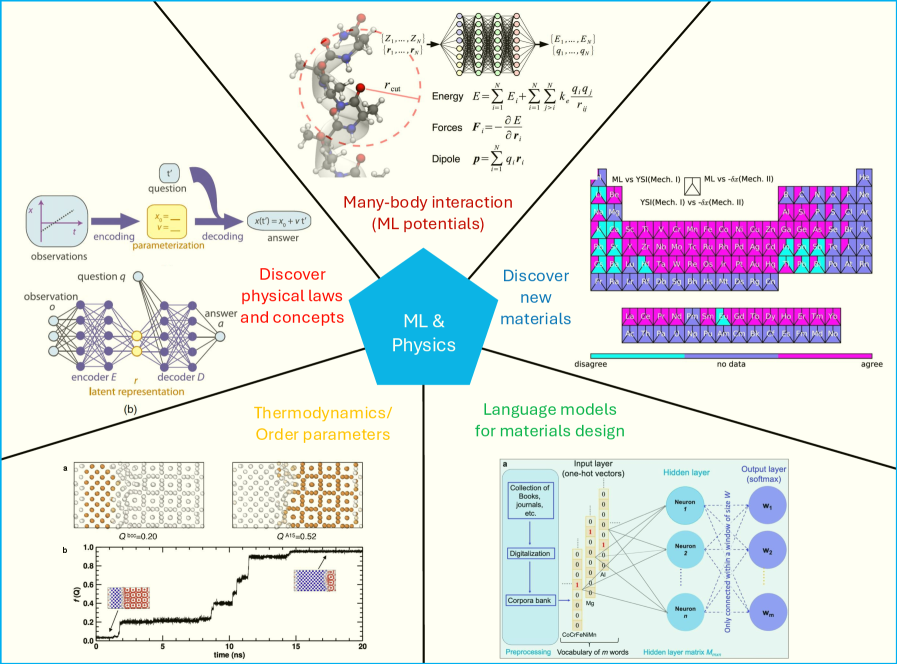
The diagram illustrates the intersection of machine learning (ML) and physics, organized around a central hexagon labeled "ML & Physics." Six radiating sections connect to specialized domains, each represented by diagrams and text. The layout emphasizes bidirectional relationships between ML techniques and physical principles.
### Components/Axes
1. **Central Hexagon**:
- Label: "ML & Physics" (white text on blue background)
- Position: Center of the diagram
2. **Radiating Sections**:
- **Top**: Molecular structure with equations for energy, forces, and dipole moments
- **Top-Right**: Periodic table-like chart with color-coded cells (pink, blue, purple)
- **Bottom-Right**: Flowchart for language models in materials design
- **Bottom**: Thermodynamics/order parameters graph with insets
- **Bottom-Left**: Neural network architecture for Q&A systems
- **Top-Left**: Many-body interaction diagram with parameterization steps
3. **Key Text Elements**:
- "Discover physical laws and concepts" (top-left)
- "Discover new materials" (top-right)
- "Thermodynamics/Order parameters" (bottom)
- "Language models for materials design" (bottom-right)
- "Many-body interaction (ML potentials)" (top)
4. **Legend**:
- Horizontal bar with gradient from blue ("no data") to purple ("agree")
- Position: Bottom of periodic table section
### Detailed Analysis
1. **Molecular Section**:
- Equations:
- Energy: $ E = \sum_{i=1}^N E_i + \sum_{i=1}^N \sum_{j>i}^N k_e \frac{q_i q_j}{r_{ij}} $
- Forces: $ F_i = -\frac{\partial E}{\partial r_i} $
- Dipole: $ p = \sum_{i=1}^N q_i r_i $
- Visual: 3D molecular structure with red dashed circle highlighting $ r_{cut} $
2. **Periodic Table Section**:
- Color-coded cells:
- Pink: Elements with "no data" (e.g., B, C, N)
- Blue: Elements with "disagree" (e.g., Al, Si, P)
- Purple: Elements with "agree" (e.g., He, Ne, Ar)
- Notable: Transition metals (Fe, Co, Ni) show mixed agreement
3. **Thermodynamics Graph**:
- X-axis: Time (ns)
- Y-axis: $ f(Q) $ (0-1 scale)
- Insets:
- Left: Phase transition at $ Q_{max} = 0.20 $
- Right: Atomic arrangement at $ Q_{A19} = 0.52 $
4. **Neural Network Diagram**:
- Architecture: Encoder-Decoder with latent representation
- Labels:
- Input: Observations
- Output: Answer
- Hidden: Latent representation
5. **Many-Body Interaction**:
- Visual: Molecular dynamics simulation
- Text: "ML potentials" with parameterization steps (encoding → parameterization → decoding)
### Key Observations
1. **Color Coding**:
- Blue/purple gradient in legend correlates with data confidence (blue = no data, purple = agree)
- Periodic table shows ML predictions align best with noble gases (He, Ne, Ar)
2. **Temporal Dynamics**:
- Thermodynamics graph shows phase transition at 5 ns ($ Q_{max} = 0.20 $)
- Atomic arrangement changes at 15 ns ($ Q_{A19} = 0.52 $)
3. **ML Architecture**:
- Encoder-Decoder structure mirrors traditional NLP models but applied to physical systems
### Interpretation
This diagram demonstrates how ML accelerates physical discovery through:
1. **Material Design**: Language models process scientific literature to predict material properties
2. **Quantum Mechanics**: ML potentials replace classical force fields for many-body interactions
3. **Thermodynamics**: Neural networks model phase transitions and atomic arrangements
4. **Periodic Table Analysis**: ML identifies elements where predictions align with experimental data
The central hexagon acts as a conceptual bridge, showing that ML enhances physics through:
- Improved parameterization of molecular interactions
- Faster discovery of new materials
- Better understanding of thermodynamic systems
- More accurate predictions of material properties
Notably, the periodic table's color coding suggests ML performs best with noble gases, possibly due to their simpler electronic structures. The temporal graph indicates ML can predict phase transitions with high temporal resolution (ns scale), suggesting applications in ultrafast material science.