\n
## Diagram: Network Graph with Black and White Nodes
### Overview
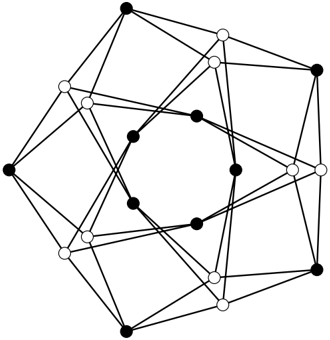
The image displays a complex, symmetric network graph composed of nodes (circles) and connecting edges (lines). There is no embedded text, numerical data, labels, or axes. The diagram is purely structural, illustrating connections between two distinct sets of nodes differentiated by color.
### Components/Axes
* **Nodes:** There are 16 circular nodes in total.
* **Black Nodes:** 8 solid black circles.
* **White Nodes:** 8 solid white circles with a black outline.
* **Edges:** Straight black lines connect the nodes. Each node is connected to multiple others, forming a dense web.
* **Legend/Labels:** None present. Node differentiation is solely by color (black vs. white).
* **Axes/Scale:** None. This is a topological graph, not a plot with quantitative axes.
### Content Details
The graph exhibits a high degree of symmetry and appears to be a specific type of mathematical or computational graph structure.
* **Spatial Layout & Connectivity:**
* The nodes are arranged in a roughly circular or spherical projection.
* There is a clear pattern of connectivity: each black node appears to be connected to several white nodes, and vice-versa. There are no visible direct connections between nodes of the same color (black-to-black or white-to-white), suggesting this may be a **bipartite graph**.
* The connections create a complex, interwoven pattern with a central, denser region of overlapping edges.
* The overall structure is highly regular and symmetric, implying it represents an idealized or theoretical network rather than a random or organic one.
* **Node Placement (Approximate):**
* **Outer Ring:** 8 nodes (4 black, 4 white) form an approximate outer octagon.
* **Inner Structure:** The remaining 8 nodes (4 black, 4 white) are positioned inside this ring, connected to both outer nodes and each other, creating layered depth.
### Key Observations
1. **Bipartite Nature:** The strict separation of connections between black and white node sets is the most prominent structural feature.
2. **High Symmetry:** The graph possesses rotational and reflective symmetry, indicating a designed, non-random structure.
3. **High Connectivity:** Each node has a relatively high degree (number of connections), resulting in a dense network.
4. **Absence of Textual or Quantitative Data:** The diagram conveys information purely through topology and node categorization. No metrics, labels, or titles are provided.
### Interpretation
This diagram is a visual representation of a **bipartite graph**, a fundamental concept in graph theory and network science. In such a graph, nodes are divided into two disjoint sets (here, black and white), and edges only connect nodes from different sets.
* **What it Demonstrates:** It visually encodes relationships or interactions between two distinct classes of entities. For example, it could model:
* Users and the items they purchase.
* Authors and the papers they cite.
* Tasks and the machines capable of processing them.
* Any scenario where connections only exist between different types of things.
* **Underlying Structure:** The specific symmetric pattern suggests this might be a well-known graph from mathematics or computer science, such as a **Heawood graph**, **Moore graph**, or a representation of a **hypercube** or other polytope. Without labels, the exact identity is uncertain, but its properties (bipartite, symmetric, regular) are clear.
* **Purpose:** The image serves as an abstract, technical illustration of network connectivity principles. Its value lies in showing the pattern and density of relationships between two categorized groups, not in presenting empirical data. To extract specific meaning, contextual labels (e.g., "Server," "Client," "Product," "User") would be required.