## Bar Chart: Accuracy Comparison of Generation vs. Multiple-choice Methods Across AI Models
### Overview
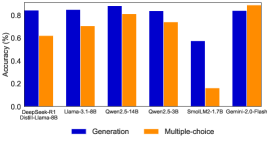
The chart compares the accuracy of two methods—**Generation** (blue bars) and **Multiple-choice** (orange bars)—across six AI models. Accuracy is measured in percentage, with values ranging from 0% to 0.9%. The legend at the bottom distinguishes the two methods by color.
### Components/Axes
- **X-axis**: AI models (categories):
- DeepSeek-R1
- Llama-3-1-8B
- Qwen2-5-14B
- Qwen2.5-3B
- SmolLM2-1.7B
- Gemini-2.0-Flash
- **Y-axis**: Accuracy (%) with a scale from 0.0 to 0.9.
- **Legend**:
- Blue = Generation
- Orange = Multiple-choice
- **Spatial Grounding**:
- Legend is positioned at the bottom center.
- Bars are grouped by model, with blue (Generation) on the left and orange (Multiple-choice) on the right for each category.
### Detailed Analysis
1. **DeepSeek-R1**:
- Generation: ~0.85% (blue)
- Multiple-choice: ~0.62% (orange)
2. **Llama-3-1-8B**:
- Generation: ~0.87% (blue)
- Multiple-choice: ~0.71% (orange)
3. **Qwen2-5-14B**:
- Generation: ~0.90% (blue)
- Multiple-choice: ~0.81% (orange)
4. **Qwen2.5-3B**:
- Generation: ~0.84% (blue)
- Multiple-choice: ~0.75% (orange)
5. **SmolLM2-1.7B**:
- Generation: ~0.58% (blue)
- Multiple-choice: ~0.15% (orange)
6. **Gemini-2.0-Flash**:
- Generation: ~0.85% (blue)
- Multiple-choice: ~0.90% (orange)
### Key Observations
- **Trend Verification**:
- Generation (blue) consistently outperforms Multiple-choice (orange) across all models except **Gemini-2.0-Flash**, where Multiple-choice slightly exceeds Generation.
- The largest gap between methods occurs in **SmolLM2-1.7B**, where Generation is ~0.58% vs. Multiple-choice at ~0.15%.
- The highest accuracy for Generation is **Qwen2-5-14B** (~0.90%), while the highest for Multiple-choice is **Gemini-2.0-Flash** (~0.90%).
### Interpretation
- **Method Effectiveness**:
- Generation methods generally achieve higher accuracy, suggesting they are better suited for tasks requiring nuanced or open-ended responses.
- Multiple-choice methods lag significantly in smaller models (e.g., SmolLM2-1.7B), indicating potential limitations in handling complex reasoning without predefined options.
- **Model-Specific Anomalies**:
- **Gemini-2.0-Flash** is the only model where Multiple-choice surpasses Generation, possibly due to its architecture being optimized for structured tasks.
- Larger models (e.g., Qwen2-5-14B) show diminishing returns in the Generation vs. Multiple-choice gap, implying scalability benefits for both methods.
- **Practical Implications**:
- For high-stakes applications (e.g., medical diagnosis), Generation methods may be preferred for their adaptability.
- Multiple-choice could be viable for resource-constrained environments if accuracy thresholds are met (e.g., Gemini-2.0-Flash).
### Uncertainties
- Values are approximate due to the lack of precise numerical labels on the bars.
- The chart does not specify the dataset or task type, which could influence the observed trends.