## Mathematical Expressions and Code Snippets
### Overview
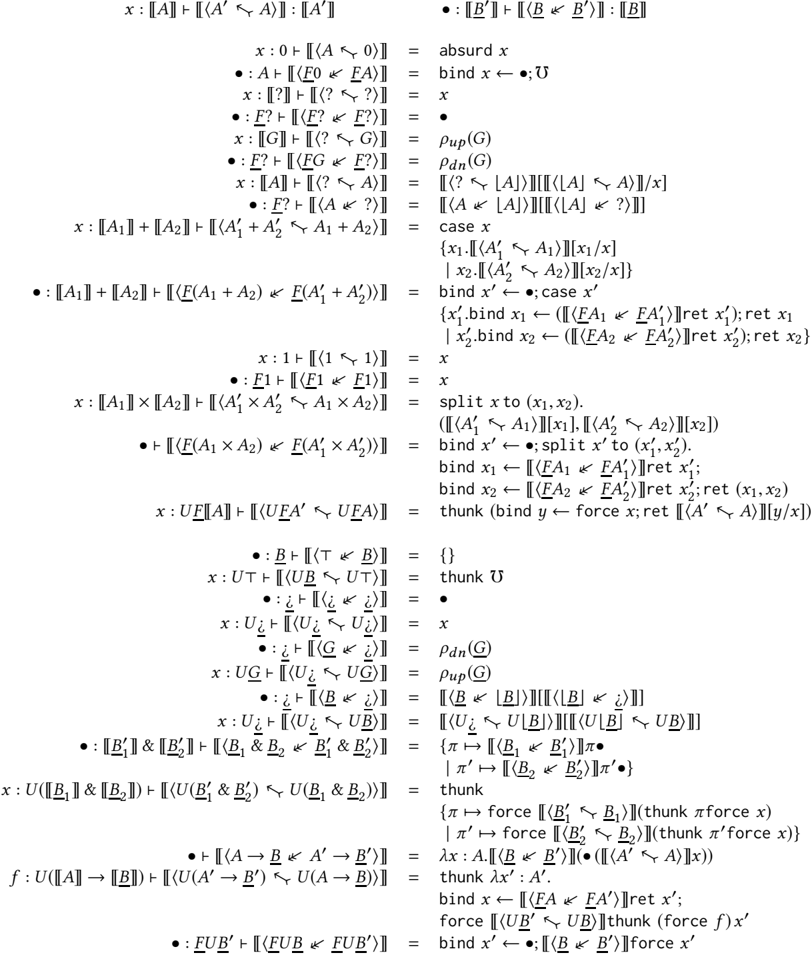
The image contains a collection of mathematical expressions and code snippets, likely related to functional programming or type theory. The expressions involve symbols, functions, and data structures, presented in a formal notation.
### Components/Axes
The image is divided into two columns of expressions. Each expression typically consists of a variable assignment (e.g., `x: ... = ...`) or a function definition (e.g., `f: ... = ...`). The expressions use symbols like `[[ ]]`, `+`, `×`, `→`, `&`, and various Greek letters. There are also keywords like `absurd`, `bind`, `case`, `split`, `thunk`, `force`, and `ret`.
### Detailed Analysis or Content Details
Here's a transcription of the expressions, organized by column:
**Left Column:**
1. `x: [[A]] + [[(A' ⋈ A)]] : [[A']]`
2. `x: 0 ⊢ [[(A ⋈ 0)]] = absurd x`
3. `•: A ⊢ [[(F0 ⋈ FA)]] = bind x ← •; U`
4. `x: [[?]] ⊢ [[(<? ⋈ ?>)]] = x`
5. `•: F? ⊢ [[(F? ⋈ F?)]] = ρup(G)`
6. `x: [[G]] ⊢ [[(<? ⋈ G)]] = ρdn(G)`
7. `•: F? ⊢ [[(FG ⋈ F?)]] = [[<? ⊢ [[A]] ⊢ [[(<? ⋈ A)]] = [[<A ⊢ [[A]] ⊢ [[(<? ⋈ ?>)]]/x]`
8. `: F? ⊢ [[(A ⋈ ?)]] = case x`
9. `x: [[A1]] + [[A2]] ⊢ [[(A'1 + A'2 ⋈ A1 + A2)]] = {x1.[[(A'1 ⋈ A1)]][x1/x] | x2.[[(A'2 ⋈ A2)]][x2/x]}`
10. `: [[A1]] + [[A2]] ⊢ [[(F(A1 + A2) ⋈ F(A'1 + A'2))]] = bind x' ← •; case x' {x'1.bind x1 ← [[(FA1 ⋈ FA'1)]]ret x'1; ret x1 | x'2.bind x2 ← [[(FA2 ⋈ FA'2)]]ret x'2; ret x2}`
11. `x: 1 ⊢ [[(1 ⋈ 1)]] = x`
12. `: F1 ⊢ [[(F1 ⋈ F1)]] = split x to (x1, x2).`
13. `x: [[A1]] × [[A2]] ⊢ [[(A'1 × A'2 ⋈ A1 × A2)]] = ([[(A'1 ⋈ A1)]][x1], [[(A'2 ⋈ A2)]][x2])`
14. `⊢ [[(F(A1 × A2) ⋈ F(A'1 × A'2))]] = bind x' ← •; split x' to (x'1, x'2). bind x1 ← [[(FA1 ⋈ FA'1)]]ret x'1; bind x2 ← [[(FA2 ⋈ FA'2)]]ret x'2; ret (x1, x2)`
15. `x: UF[[A]] ⊢ [[(UFA' ⋈ UFA)]] = thunk (bind y ← force x; ret [[(A' ⋈ A)]][y/x])`
16. `: B ⊢ [[(T ⋈ B)]] = {}`
17. `x: UT ⊢ [[(UB ⋈ UT)]] = thunk U`
18. `: ¿ ⊢ [[(¿ ⋈ ¿)]] = •`
19. `x: U¿ ⊢ [[(U¿ ⋈ U¿)]] = x`
20. `: ¿ ⊢ [[(G ⋈ ¿)]] = ρdn(G)`
21. `x: UG ⊢ [[(U¿ ⋈ UG)]] = ρup(G)`
22. `: ¿ ⊢ [[(B ⋈ ¿)]] = [[B ⋈ |B]]`
23. `x: U¿ ⊢ [[(U¿ ⋈ UB)]] = [[U¿ ⋈ U[B]] ⊢ [[(U[B] ⋈ UB)]]`
24. `•: [[B'1]] & [[B'2]] ⊢ [[(B1 & B2 ⋈ B'1 & B'2)]] = {π ⊢ [[(B1 ⋈ B'1)]]π. | π' ⊢ [[(B2 ⋈ B'2)]]π'•}`
25. `x: U([[B1]] & [[B2]]) ⊢ [[(U(B'1 & B'2) ⋈ U(B1 & B2))]] = thunk {π ⊢ force [[(B'1 ⋈ B1)]] (thunk π force x) | π' ⊢ force [[(B'2 ⋈ B2)]] (thunk π'force x)}`
26. `f: U([[A]] → [[B]]) ⊢ [[(U(A' → B') ⋈ U(A → B))]] = λx: A.[[B ⋈ B']](([[A' ⋈ A]]x))`
27. `: FUB' ⊢ [[(FUB ⋈ FUB')]] = thunk λx': A'. bind x ← [[(FA ⋈ FA')]]ret x'; force [[(UB' ⋈ UB)]] thunk (force f) x'`
28. `: FUB' ⊢ [[(FUB ⋈ FUB')]] = bind x' ← •; [[(B ⋈ B')]] force x'`
**Right Column:**
1. `•: [[B' ⋈ B]] ⊢ [[(B ⋈ B')]] : [[B]]`
### Key Observations
* The expressions use a combination of mathematical notation and programming constructs.
* The `⋈` symbol seems to represent some kind of relation or operation between terms.
* The `⊢` symbol likely represents a type assignment or a logical entailment.
* The `[[ ]]` notation might represent a semantic interpretation or a type environment.
* The code snippets involve concepts like binding, case analysis, and thunking, which are common in functional programming.
### Interpretation
The image likely presents a formal system for reasoning about types and programs. The expressions define rules for type checking, evaluation, or transformation of programs. The system seems to involve concepts from type theory, logic, and functional programming. The specific meaning of the symbols and expressions would require more context or a formal definition of the system.