\n
## Mathematical Notation & Definitions
### Overview
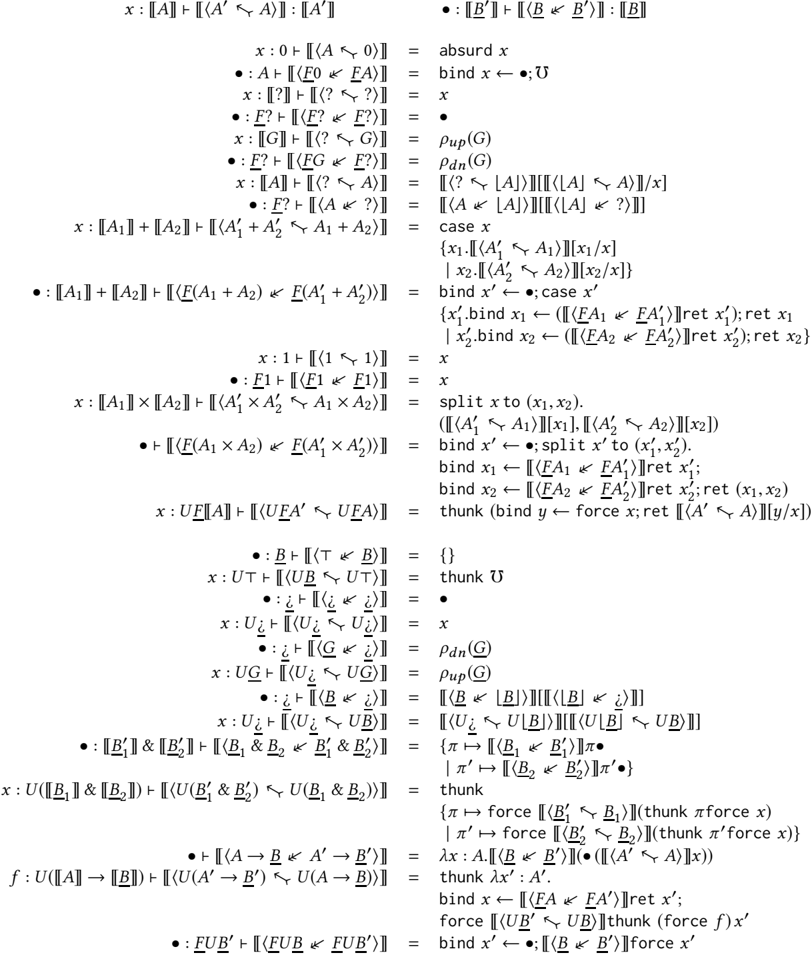
The image presents a collection of mathematical notations, definitions, and symbolic expressions, seemingly related to formal logic, type theory, or a similar field. The notations are densely packed and utilize a variety of symbols, including lambda notation, logical operators, and set-like expressions. The layout is not structured as a traditional chart or diagram, but rather as a series of independent definitions and equations.
### Components/Axes
There are no axes or traditional chart components. The image consists entirely of mathematical expressions. The expressions are arranged in a roughly columnar fashion, but without clear headings or organization beyond visual grouping. There is no legend.
### Detailed Analysis or Content Details
The image contains a large number of mathematical expressions. Here's a transcription, grouped by approximate visual location, with attempts to interpret the symbols. Due to the complexity and potential ambiguity of the notation, some interpretations are tentative.
**Left Column (Top)**
* `x : 0 + |[A <-> A']| : A'`
* `x : A + |{E0 < EA}|`
* `x : E¹ + |{E¹ < ?}|`
* `x : E² + |{E² < E²}|`
* `x : [G] + |{G < G}|`
* `x : E² + |{EG < E²}|`
* `x : [A] + |{? < A}|`
* `x : E² + |{A < A²}|`
* `x : [A₁] + [A₂] + |{A₁ < A₂ < A₁ + A₂}|`
**Left Column (Middle)**
* `x : [A₁] + [A₂] + |{E([A₁ + A₂]) < E([A₁ + A₂])}|`
* `x : 1 + |{1 < 1}|`
* `x : [A₁] + [A₂] + |{A₁ < A₂ < A₁ + A₂}|`
* `x : [A₁] + [A₂] + |{E([A₁ + A₂]) < E([A₁ + A₂])}|`
**Left Column (Bottom)**
* `x : UE[A] + |{UEA < UEA}|`
* `x : B + |{T < B}|`
* `x : UT + |{UB < UT}|`
* `x : U₂ + |{U₂ < U₂}|`
* `x : U₂ + |{U₂ < U₂}|`
* `x : UG + |{U < UG}|`
* `x : U + |{U < U}|`
* `x : [B] + |{B < B}|`
* `x : [B] + |{B < B}|`
* `x : [B] + |{B < B}|`
* `x : [B] + |{B < B}|`
* `x : f : U → U + |{f(A) < f(A)}|`
* `x : [A] + [B] + |{A < B}|`
* `x : [A] + [B] + |{A < B}|`
**Right Column (Top)**
* `absurd x`
* `bind x ← : U`
* `Pup(G)`
* `Pan(G)`
* `[[< ? [A]]][[[[A < A]]/x]]`
* `[[A < A]]][[[[A < ?]]]`
* `case x`
* `[x₁ : [A₁ < A₁]][x₁/x]`
* `[x₂ : [A₂ < A₂]][x₂/x]`
* `bind x' ← : case x`
* `[x' : bind x₁ ← [[EA₁ < EA₁]]; ret x₁]`
* `x₂ : bind x₂ ← [[EA₂ < EA₂]]; ret x₂; ret x₁`
**Right Column (Middle)**
* `x`
* `split x to (x₁, x₂)`
* `([[A₁ < A₁]][x₁], [[A₂ < A₂]][x₂])`
* `bind x' ← : split x to (x₁, x₂)`
* `bind x₁ ← [[EA₁ < EA₁]]; ret x₁`
* `bind x₂ ← [[EA₂ < EA₂]]; ret x₂; ret (x₁, x₂)`
* `thunk (bind y ← force x; ret [[A' < A]]/y)`
* `{}`
* `thunk U`
**Right Column (Bottom)**
* `Pan(G)`
* `Pup(G)`
* `[[< ]][B]][[[[B < B]]/x]]`
* `[[B < B]][[[[B < ?]]]`
* `π₁ ← [B, B]; π₁ ← π₁`
* `π₂ ← [B, B]; π₂ ← π₂`
* `thunk`
* `bind x' ← : force x`
* `bind x₂ ← [[EA₁ < EA₂]]; ret x₂`
* `bind x₁ ← [[EA₂ < EA₁]]; ret x₁`
* `thunk U`
* `bind x' ← : U; bind x₂ ← force x'`
* `bind x₁ ← [[EA₁ < EA₁]]; ret x₁`
**Note:** The symbols `<` and `>` appear frequently, potentially representing inequalities or some form of ordering relation. The notation `[A]` and `{E}` likely represent some kind of type or environment. The `bind` keyword suggests a functional programming context.
### Key Observations
* The expressions on the left column share a common structure: `x : [something] + |{something < something}| : [something]`. This suggests a definition of a variable `x` based on a type or context, along with a condition involving an inequality.
* The right column contains more complex expressions involving `bind`, `case`, `split`, `thunk`, and `force`, which are common constructs in functional programming and type theory.
* The repeated use of `[[A < A]]` and similar patterns suggests a focus on self-referential or reflexive properties.
* The presence of `π₁` and `π₂` suggests projection operators, potentially used for extracting components from pairs or tuples.
### Interpretation
The image appears to be a collection of definitions and equations related to a formal system, likely a type theory or a logic programming language. The expressions on the left seem to define variables based on types and inequalities, while the expressions on the right describe operations for manipulating and evaluating these variables.
The frequent use of `bind` and `thunk` suggests a lazy evaluation strategy, where expressions are only evaluated when their values are needed. The `split` operation indicates the ability to decompose complex expressions into simpler components.
The overall purpose of these definitions is not immediately clear without further context. However, they likely form part of a larger system for reasoning about types, values, and computations. The repeated patterns and self-referential expressions suggest a focus on foundational principles and the properties of the system itself.
The image is not a data visualization in the traditional sense, but rather a representation of abstract mathematical concepts. It requires a deep understanding of formal logic and type theory to fully interpret its meaning.