## Diagram: Neural-Symbolic Integration
### Overview
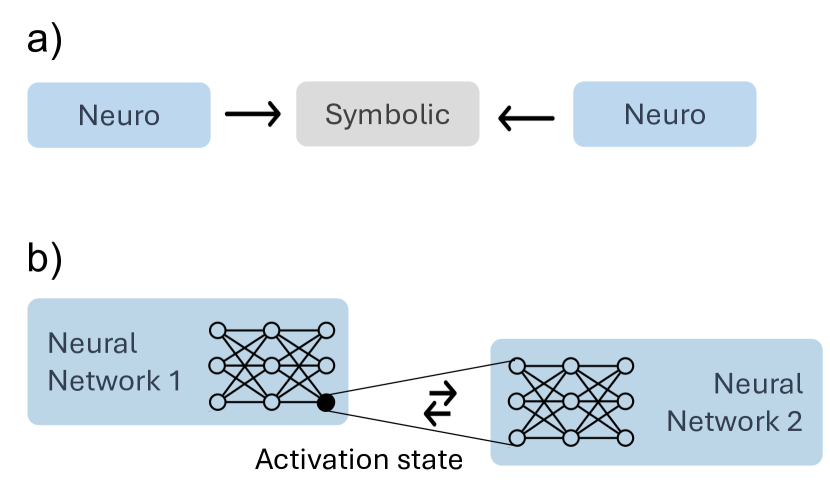
The image presents two diagrams illustrating different approaches to neural-symbolic integration. The first diagram (a) shows a high-level flow between "Neuro" and "Symbolic" components. The second diagram (b) depicts the interaction between two neural networks via their activation states.
### Components/Axes
**Diagram a):**
* **Title:** a)
* **Components:**
* "Neuro" (left): A blue rounded rectangle containing the word "Neuro".
* "Symbolic" (center): A gray rounded rectangle containing the word "Symbolic".
* "Neuro" (right): A blue rounded rectangle containing the word "Neuro".
* **Flow:**
* A right-pointing arrow from the left "Neuro" component to the "Symbolic" component.
* A left-pointing arrow from the right "Neuro" component to the "Symbolic" component.
**Diagram b):**
* **Title:** b)
* **Components:**
* "Neural Network 1" (left): A blue rounded rectangle containing the text "Neural Network 1". Inside the rectangle is a simplified representation of a neural network with 3 layers of 3 nodes each, fully connected. One node in the bottom layer is filled in black, representing an "Activation state".
* "Neural Network 2" (right): A blue rounded rectangle containing the text "Neural Network 2". Inside the rectangle is a simplified representation of a neural network with 3 layers of 3 nodes each, fully connected.
* **Flow:**
* A line connects the filled node ("Activation state") in "Neural Network 1" to "Neural Network 2".
* A double arrow (bidirectional) is placed on the connecting line, indicating a two-way interaction.
* "Activation state": Text label below the connecting line and double arrow.
### Detailed Analysis or ### Content Details
**Diagram a):**
The diagram illustrates a bidirectional flow between neural and symbolic systems. Information flows from "Neuro" to "Symbolic" and vice versa.
**Diagram b):**
The diagram shows two neural networks interacting through their activation states. The filled node in "Neural Network 1" represents a specific activation state that influences "Neural Network 2", and vice versa. The neural networks are represented as having 3 layers of 3 nodes each.
### Key Observations
* Diagram a) presents a high-level abstraction of neural-symbolic integration.
* Diagram b) provides a more detailed view of how two neural networks can interact through their activation states.
* The "Activation state" is highlighted as a key point of interaction between the two neural networks.
### Interpretation
The image illustrates two different perspectives on neural-symbolic integration. Diagram a) emphasizes the high-level flow of information between neural and symbolic systems, suggesting a hybrid approach where both systems contribute to the overall functionality. Diagram b) delves into a more specific mechanism, showing how neural networks can interact directly through their activation states, potentially enabling more complex and nuanced integration. The bidirectional arrow in diagram b) suggests that the interaction is not simply a one-way transfer of information, but rather a dynamic exchange that allows both networks to influence each other.