## Diagram: Neuro-Symbolic System Architecture and Neural Network Interaction
### Overview
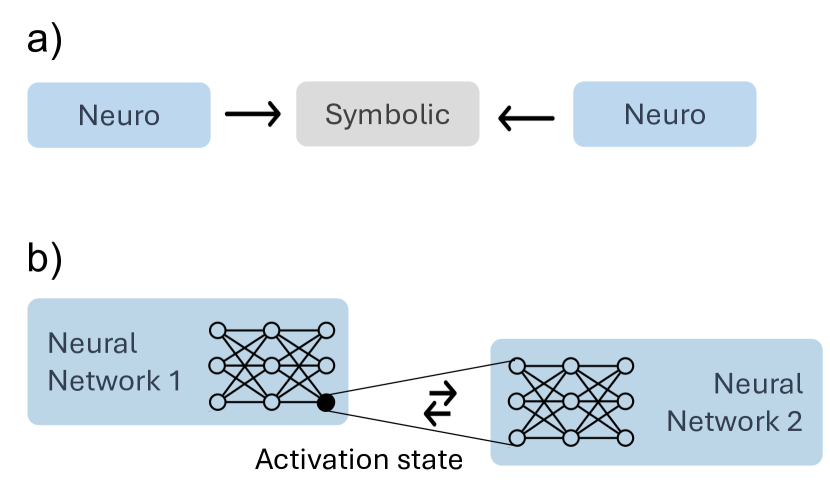
The image presents two distinct diagrams illustrating a neuro-symbolic system architecture and neural network interactions. Diagram a) shows a bidirectional flow between "Neuro" and "Symbolic" components, while diagram b) depicts two interconnected neural networks exchanging activation states.
### Components/Axes
**Diagram a):**
- **Left Box**: Labeled "Neuro" (blue background)
- **Center Box**: Labeled "Symbolic" (gray background)
- **Right Box**: Labeled "Neuro" (blue background)
- **Arrows**: Bidirectional arrows connect "Neuro" (left) ↔ "Symbolic" ↔ "Neuro" (right)
**Diagram b):**
- **Left Panel**: Labeled "Neural Network 1" (blue background)
- Contains a grid of interconnected nodes (circles) with lines representing synaptic connections
- A black dot highlights a specific node in the lower-right quadrant
- **Right Panel**: Labeled "Neural Network 2" (blue background)
- Similar grid structure with interconnected nodes
- **Activation State**: Labeled "Activation state" with bidirectional arrows connecting the two networks
### Detailed Analysis
**Diagram a) Analysis:**
- The bidirectional flow between "Neuro" and "Symbolic" suggests a hybrid system where neural networks (Neuro) and symbolic reasoning (Symbolic) interact reciprocally.
- The repetition of "Neuro" on both ends implies the system may start and end with neural processing, with symbolic reasoning as an intermediate step.
**Diagram b) Analysis:**
- **Neural Network 1**: The black dot in the lower-right quadrant likely represents a specific activation state or output node.
- **Activation State**: The bidirectional arrows indicate that activation states from Network 1 can influence Network 2 and vice versa, suggesting collaborative processing or knowledge sharing between networks.
- **Network Structure**: Both networks use identical grid-like architectures with dense interconnections, implying similar computational roles or modular design.
### Key Observations
1. **Bidirectional Flow**: Both diagrams emphasize reciprocal interactions (Neuro↔Symbolic, Network1↔Network2).
2. **Color Coding**: Blue consistently represents neural components, while gray denotes symbolic elements.
3. **Activation State Specificity**: The black dot in Network 1 suggests a focal point for state transfer or processing.
4. **Modular Design**: Identical network structures imply standardized components for scalability or interchangeability.
### Interpretation
This diagram illustrates a neuro-symbolic AI framework where:
1. **Hybrid Reasoning**: Neural networks (Neuro) interface with symbolic systems (Symbolic) to combine data-driven learning with rule-based logic.
2. **Neural Collaboration**: Two neural networks exchange activation states, potentially enabling:
- Distributed learning across modules
- Cross-network knowledge transfer
- Ensemble-like decision-making
3. **Modular Architecture**: The identical network structures suggest a scalable system where additional networks could be added for specialized tasks.
The system appears designed for complex problem-solving requiring both pattern recognition (neural) and logical inference (symbolic), with network collaboration enabling more sophisticated cognitive tasks than isolated components.