\n
## Heatmap: Attention Weights - English & German
### Overview
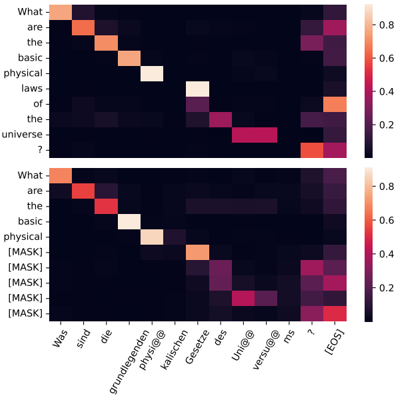
The image presents two heatmaps, likely representing attention weights between words in English and German sentences. The top heatmap displays attention weights for the English sentence "What are the basic physical laws of the universe?". The bottom heatmap displays attention weights for a German sentence, with some words masked as "[MASK]". Both heatmaps use a color scale to represent the strength of the attention, ranging from dark purple (low attention) to bright yellow/red (high attention).
### Components/Axes
* **Y-axis (Vertical):** Represents the words in the sentences.
* Top Heatmap: "What", "are", "the", "basic", "physical", "laws", "of", "the", "universe?".
* Bottom Heatmap: "What", "are", "basic", "physical", "[MASK]", "[MASK]", "[MASK]".
* **X-axis (Horizontal):** Represents the words in the German sentence.
* "Was", "sind", "die", "grundlegenden", "physikali@schen", "kalischen", "Gesetze", "des", "Universums", "?", "[EOS]".
* **Color Scale (Legend):** Located on the right side of both heatmaps.
* Dark Purple: ~0.0
* Light Yellow: ~0.2
* Orange: ~0.4
* Red: ~0.6
* Bright Yellow/Red: ~0.8 - 1.0
### Detailed Analysis or Content Details
**Top Heatmap (English):**
* The strongest attention appears between "What" and "are" (~0.8).
* "What" also shows strong attention to "the" (~0.6).
* "are" shows strong attention to "the" (~0.7) and "basic" (~0.5).
* "basic" shows strong attention to "physical" (~0.7).
* "physical" shows strong attention to "laws" (~0.6).
* "laws" shows strong attention to "of" (~0.5).
* "universe?" shows attention to "the" (~0.4) and "of" (~0.3).
* Generally, attention decreases as you move further away from the beginning of the sentence.
**Bottom Heatmap (German):**
* The strongest attention appears between "What" and "Was" (~0.8).
* "What" also shows strong attention to "sind" (~0.6).
* "are" shows strong attention to "sind" (~0.7) and "die" (~0.5).
* "basic" shows strong attention to "grundlegenden" (~0.6).
* "physical" shows strong attention to "physikali@schen" (~0.7).
* The "[MASK]" tokens show varying degrees of attention to different German words, but generally lower than the unmasked words.
* The attention weights are generally lower in the bottom heatmap compared to the top heatmap.
**German Text Transcription & Translation:**
* "Was" - What
* "sind" - are
* "die" - the
* "grundlegenden" - basic/fundamental
* "physikali@schen" - physical (with a typo "@schen")
* "kalischen" - likely a typo, potentially related to "kalisch" (calcium) or a grammatical form.
* "Gesetze" - laws
* "des" - of the
* "Universums" - universe
* "?" - question mark
* "[EOS]" - End of Sentence
### Key Observations
* The heatmaps suggest a strong alignment between the English and German sentences, particularly in the initial words.
* The masking in the bottom heatmap disrupts the attention patterns, leading to lower overall attention weights.
* The typo in "physikali@schen" might affect the attention weights.
* The attention weights generally decrease with distance between words, indicating a focus on local context.
* The attention is not perfectly symmetrical, suggesting that the model doesn't treat the English and German words as perfectly equivalent.
### Interpretation
These heatmaps likely represent the attention weights of a machine translation model. The model is attempting to align the English and German sentences, and the attention weights indicate how much each word in one sentence "attends" to each word in the other sentence. The strong attention between corresponding words suggests that the model is successfully identifying the relationships between the two languages. The masking in the bottom heatmap demonstrates how the model's performance is affected when information is missing. The lower attention weights in the masked heatmap indicate that the model relies on the complete sentence to establish accurate alignments. The presence of typos in the German sentence could also impact the model's ability to accurately translate the sentence. The heatmaps provide insights into the inner workings of the machine translation model, revealing how it processes and aligns text in different languages.