\n
## Diagram: Lattice Representation of a Modular System
### Overview
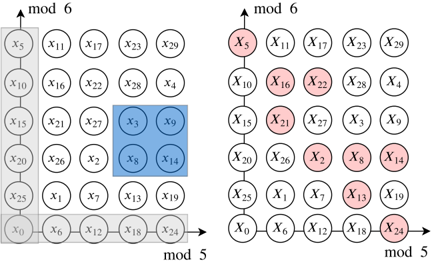
The image presents two lattice diagrams, side-by-side, representing a modular system. Each diagram consists of a grid of circles, labeled with variables 'x' followed by a number. The axes are labeled "mod 6" (vertical) and "mod 5" (horizontal). The left diagram shows a subset of circles highlighted in blue, while the right diagram highlights a different subset in red. The diagrams visually represent a mapping or transformation between the two highlighted sets.
### Components/Axes
* **Axes:**
* Vertical Axis: "mod 6" - representing values modulo 6 (0, 1, 2, 3, 4, 5).
* Horizontal Axis: "mod 5" - representing values modulo 5 (0, 1, 2, 3, 4).
* **Grid Elements:** Circles labeled x₀ to x₂₉.
* **Highlighting:**
* Left Diagram: Blue highlighting indicates a specific subset of circles.
* Right Diagram: Red highlighting indicates a different subset of circles.
### Detailed Analysis / Content Details
The left diagram shows the following circles highlighted in blue:
* x₃
* x₈
* x₉
* x₁₀
* x₁₅
* x₁₆
* x₁₇
* x₂₁
* x₂₂
* x₂₇
The right diagram shows the following circles highlighted in red:
* x₅
* x₁₀
* x₁₆
* x₂₁
* x₂₂
* x₂₄
* x₁₉
* x₁₈
* x₁₇
* x₂₉
The grid is organized as follows:
* Row 0: x₀, x₁, x₂, x₃, x₄
* Row 1: x₅, x₆, x₇, x₈, x₉
* Row 2: x₁₀, x₁₁, x₁₂, x₁₃, x₁₄
* Row 3: x₁₅, x₁₆, x₁₇, x₁₈, x₁₉
* Row 4: x₂₀, x₂₁, x₂₂, x₂₃, x₂₄
* Row 5: x₂₅, x₂₆, x₂₇, x₂₈, x₂₉
### Key Observations
The red highlighted set in the right diagram appears to be a transformation of the blue highlighted set in the left diagram. There is no immediately obvious simple arithmetic relationship between the indices of the blue and red sets. The highlighted sets do not have an obvious pattern or symmetry.
### Interpretation
The diagrams likely represent a mapping between two modular spaces (mod 5 and mod 6). The blue set on the left represents an initial selection of elements, and the red set on the right represents the result of applying some transformation to those elements. The transformation is not a simple shift or scaling, as the indices do not follow a consistent pattern. This could represent a more complex function or operation within the modular arithmetic system. The diagrams are likely illustrating a concept in number theory, cryptography, or coding theory, where modular arithmetic is frequently used. The specific meaning of the transformation would require additional context.