\n
## Table: Multiplication Table Fragment
### Overview
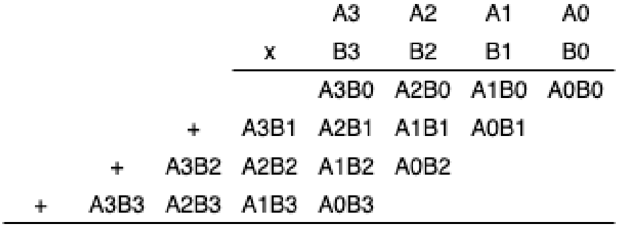
The image presents a fragment of a multiplication table. It displays the products of values from A0 to A3 and B0 to B3. The table is constructed using addition, showing how multiplication can be expressed as repeated addition.
### Components/Axes
The table has two implicit axes: one representing the values A0 through A3 (top row) and the other representing the values B0 through B3 (left column). The table is organized with the products of each A and B combination displayed in the corresponding cell. The table is constructed using the '+' operator to show the addition of terms.
### Content Details
The table is structured as follows:
* **Row 0 (x):** A3B0, A2B0, A1B0, A0B0
* **Row 1 (+):** A3B1, A2B1, A1B1, A0B1
* **Row 2 (+):** A3B2, A2B2, A1B2, A0B2
* **Row 3 (+):** A3B3, A2B3, A1B3, A0B3
The values within the table are combinations of 'A' and 'B' with indices ranging from 0 to 3. The table demonstrates the distributive property of multiplication over addition.
### Key Observations
The table systematically shows the products of all possible combinations of A and B values from 0 to 3. The table is not a standard multiplication table showing the final product, but rather the breakdown of the product into a sum of terms.
### Interpretation
This table illustrates a fundamental concept in arithmetic: that multiplication can be understood as repeated addition. Each entry in the table represents the result of multiplying a value from the 'A' series by a value from the 'B' series, but instead of directly stating the product, it shows how that product can be achieved by adding appropriate terms. This is a pedagogical tool to help understand the underlying principles of multiplication. The table is a fragment, suggesting it is part of a larger demonstration or explanation. The use of 'A' and 'B' instead of numerical values suggests a more abstract or generalized approach to the concept of multiplication.