## Diagram: Vision-Language Model Architecture for Image Question Answering
### Overview
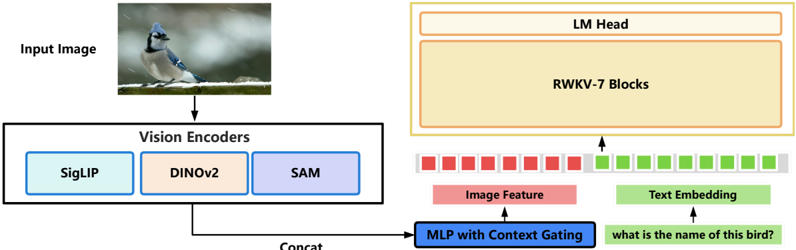
The diagram illustrates a vision-language model architecture designed to process an input image and answer a textual question about it. The system integrates multiple vision encoders, a language model head, and a context-gating mechanism to combine visual and textual features for question answering.
### Components/Axes
1. **Left Side (Input Processing):**
- **Input Image**: A photograph of a blue jay on a snowy surface.
- **Vision Encoders**: Three parallel modules:
- SigLIP (cyan box)
- DINOv2 (peach box)
- SAM (purple box)
- **Concat**: A block merging outputs from all vision encoders.
2. **Right Side (Language Modeling):**
- **LM Head**: A language model head (orange box).
- **RWKV-7 Blocks**: A transformer-like architecture with 7 blocks (beige box).
- **Image Feature**: Red squares representing visual features extracted from the input image.
- **Text Embedding**: Green squares representing the textual question "what is the name of this bird?" encoded as embeddings.
- **MLP with Context Gating**: A multi-layer perceptron integrating image features and text embeddings.
### Detailed Analysis
- **Vision Encoders**: Three distinct models (SigLIP, DINOv2, SAM) process the input image independently, capturing different aspects of visual information (e.g., object detection, segmentation, or general feature extraction).
- **Concat**: Combines multi-modal features from the three encoders into a unified representation.
- **RWKV-7 Blocks**: A recurrent transformer architecture (RWKV) processes the concatenated features alongside text embeddings. The 7 blocks suggest a depth of 7 layers for sequential processing.
- **MLP with Context Gating**: A non-linear integration mechanism that selectively combines image and text features, likely using attention or gating to prioritize relevant information for the question.
### Key Observations
- **Multi-Modal Fusion**: The system explicitly separates visual and textual processing streams before merging them in the MLP.
- **Architectural Depth**: The RWKV-7 Blocks indicate a moderately deep model for handling complex interactions between vision and language.
- **Question-Specific Processing**: The text embedding directly encodes the question, enabling the model to focus on task-relevant visual features.
### Interpretation
This architecture demonstrates a hybrid approach to visual question answering (VQA), leveraging multiple vision encoders to capture diverse visual cues and a language model to reason about the question. The context gating in the MLP suggests an emphasis on dynamic feature weighting, allowing the model to adaptively prioritize image regions or textual tokens relevant to the query. The use of RWKV-7 Blocks (a transformer variant with recurrent properties) may improve efficiency compared to standard transformers while maintaining contextual awareness. The absence of explicit numerical values or performance metrics implies this is a conceptual diagram rather than an empirical result.