## Flowchart: Learning System (LS) Architecture and Observation Categories
### Overview
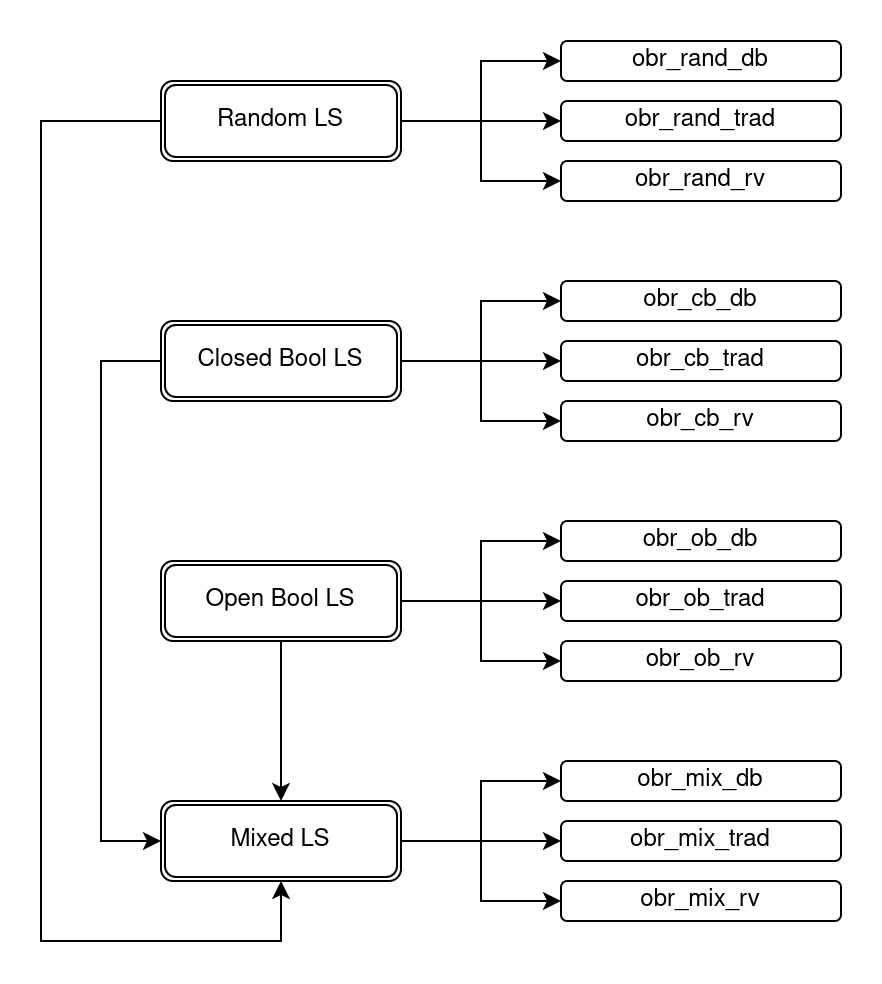
The diagram illustrates a hierarchical structure of four learning system (LS) types connected to observation categories. Arrows indicate directional relationships between LS types and their associated observation types. The Mixed LS node serves as a central integration point with feedback loops.
### Components/Axes
**Nodes (LS Types):**
1. **Random LS** (Top)
2. **Closed Bool LS** (Middle-left)
3. **Open Bool LS** (Middle-right)
4. **Mixed LS** (Bottom)
**Observation Categories (Right-side boxes):**
- **Random LS Observations:**
- `obr_rand_db` (Database)
- `obr_rand_trad` (Traditional)
- `obr_rand_rv` (Revised)
- **Closed Bool LS Observations:**
- `obr_cb_db`
- `obr_cb_trad`
- `obr_cb_rv`
- **Open Bool LS Observations:**
- `obr_ob_db`
- `obr_ob_trad`
- `obr_ob_rv`
- **Mixed LS Observations:**
- `obr_mix_db`
- `obr_mix_trad`
- `obr_mix_rv`
**Connections:**
- **Mixed LS** has:
- Incoming arrow from **Open Bool LS**
- Self-loop (feedback)
- Outgoing arrow to **Random LS**
### Detailed Analysis
1. **Random LS** feeds into three observation categories with "rand" prefixes, suggesting randomized data collection or processing.
2. **Closed Bool LS** and **Open Bool LS** each connect to three observation types with "cb" (Closed Bool) and "ob" (Open Bool) prefixes, respectively.
3. **Mixed LS** integrates observations from **Open Bool LS** and generates its own category, with a feedback loop implying iterative refinement.
4. The bidirectional arrow between **Mixed LS** and **Random LS** suggests cyclical interaction between mixed and randomized approaches.
### Key Observations
- All LS types share a consistent observation structure (`_db`, `_trad`, `_rv` suffixes), indicating standardized evaluation metrics.
- **Mixed LS** acts as a meta-system, combining inputs from **Open Bool LS** and influencing both **Random LS** and itself.
- The self-loop in **Mixed LS** implies continuous optimization or adaptation.
### Interpretation
This architecture demonstrates a layered approach to learning systems:
1. **Hierarchical Specialization:** Each LS type focuses on specific observation categories (randomized, closed/open boolean, mixed).
2. **Integration Mechanism:** **Mixed LS** synthesizes Open Bool observations while maintaining autonomy through self-regulation.
3. **Cyclical Optimization:** The feedback loop in **Mixed LS** and its connection to **Random LS** suggest an adaptive system where mixed approaches inform and refine randomized methods.
4. **Standardized Evaluation:** The uniform observation suffixes (`_db`, `_trad`, `_rv`) across all LS types indicate a common framework for assessing different learning strategies.
The diagram emphasizes modular LS design with clear observational outputs, while **Mixed LS** serves as a bridge between specialized systems and iterative improvement.