TECHNICAL ASSET FINGERPRINT
25c3b45b3a9f674ae340506a
Click to view fullscreen
Press ESC or click to close
FOUND IN PAPERS
EXPERT: gemini-2.0-flash VERSION 1
RUNTIME: nugit/gemini/gemini-2.0-flash
INTEL_VERIFIED
## Combined Chart: Energy Landscape Analysis
### Overview
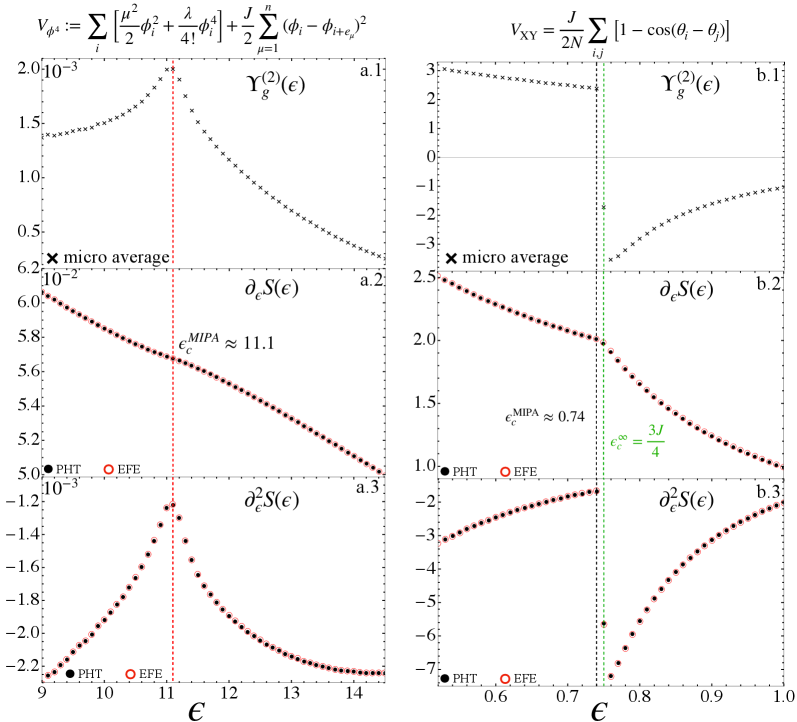
The image presents six plots arranged in two columns (left and right), each containing three subplots (top, middle, bottom). The plots depict the energy landscape analysis, showing the relationships between energy (epsilon) and various functions related to the system's state. The left column (a.1, a.2, a.3) focuses on one set of parameters, while the right column (b.1, b.2, b.3) focuses on another. Each subplot displays data points from two methods, PHT (solid black circles) and EFE (open red circles), along with a "micro average" (black x markers). Vertical lines indicate critical energy values.
### Components/Axes
**General Layout:**
* Two columns of plots, labeled 'a' (left) and 'b' (right).
* Each column has three subplots, labeled '1', '2', and '3' from top to bottom.
* Each subplot contains data from two methods: PHT (black filled circles) and EFE (red open circles).
* Each subplot contains data from "micro average" (black x markers).
* Legend: PHT (black filled circle), EFE (red open circle), micro average (black x marker)
**Left Column (a):**
* X-axis (all subplots): ε (epsilon), ranging from approximately 9 to 14.
* a.1: Y-axis: γg(2)(ε), ranging from 0 to 2.0 x 10^-3.
* a.2: Y-axis: ∂εS(ε), ranging from 5.0 x 10^-2 to 6.2 x 10^-2.
* a.3: Y-axis: ∂ε2S(ε), ranging from -2.2 x 10^-3 to -1.2 x 10^-3.
* Vertical dashed red line at εcMIPA ≈ 11.1.
**Right Column (b):**
* X-axis (all subplots): ε (epsilon), ranging from approximately 0.6 to 1.0.
* b.1: Y-axis: γg(2)(ε), ranging from -3 to 3.
* b.2: Y-axis: ∂εS(ε), ranging from 1.0 to 2.5.
* b.3: Y-axis: ∂ε2S(ε), ranging from -7 to -2.
* Vertical dashed green line at εc∞ = 3J/4, approximately at ε ≈ 0.74.
* Horizontal line at y = 0 in b.1
**Equations (Top of Image):**
* Left: Vφ4 := Σi [μ2/2 φi2 + λ/4! φi4] + J/2 Σμ=1n (φi - φi+eμ)2
* Right: VXY = J/2N Σij [1 - cos(θi - θj)]
### Detailed Analysis
**Left Column (a):**
* **a.1: γg(2)(ε):** The "micro average" data (black x markers) initially decreases slightly from ε = 9 to approximately ε = 10.5, then sharply increases to a peak near the vertical red line (ε ≈ 11.1), and then decreases steadily as ε increases to 14.
* **a.2: ∂εS(ε):** Both PHT (black filled circles) and EFE (red open circles) data points form a single line. The line slopes downward linearly from approximately (9, 0.062) to (14, 0.050). The value of εcMIPA is indicated as approximately 11.1.
* **a.3: ∂ε2S(ε):** Both PHT (black filled circles) and EFE (red open circles) data points form a single line. The line starts at approximately -2.2 x 10^-3 at ε = 9, rises sharply to a peak near the vertical red line (ε ≈ 11.1), and then decreases steadily as ε increases to 14, approaching -2.2 x 10^-3.
**Right Column (b):**
* **b.1: γg(2)(ε):** The "micro average" data (black x markers) starts at approximately 3 at ε = 0.6, decreases to a minimum near ε = 0.8, and then increases as ε approaches 1.0.
* **b.2: ∂εS(ε):** Both PHT (black filled circles) and EFE (red open circles) data points form a single line. The line slopes downward linearly from approximately (0.6, 2.5) to (1.0, 1.1). The value of εcMIPA is indicated as approximately 0.74, and εc∞ = 3J/4 is indicated by a vertical green line.
* **b.3: ∂ε2S(ε):** Both PHT (black filled circles) and EFE (red open circles) data points form a single line. The line starts at approximately -7 at ε = 0.6, rises sharply to a peak near the vertical green line (ε ≈ 0.74), and then decreases steadily as ε increases to 1.0, approaching -2.
### Key Observations
* The plots show the behavior of different functions with respect to energy (epsilon).
* The vertical lines in both columns indicate critical energy values (εcMIPA and εc∞).
* The PHT and EFE methods produce nearly identical results for ∂εS(ε) and ∂ε2S(ε).
* The "micro average" data (black x markers) in γg(2)(ε) shows distinct trends in both columns.
* The functions ∂εS(ε) show a linear decrease with increasing epsilon in both columns.
* The functions ∂ε2S(ε) show a peak near the critical energy values in both columns.
### Interpretation
The data presented in these plots likely represents a theoretical analysis of a physical system, possibly related to phase transitions or critical phenomena. The functions γg(2)(ε), ∂εS(ε), and ∂ε2S(ε) likely represent different physical quantities or derivatives of a physical quantity with respect to energy. The critical energy values (εcMIPA and εc∞) indicate points where the system undergoes a significant change in behavior. The agreement between the PHT and EFE methods suggests that these methods are consistent in their predictions. The trends observed in the plots provide insights into the system's behavior near the critical points. The peaks in ∂ε2S(ε) near the critical energy values suggest that the system's sensitivity to energy changes is highest at these points.
DECODING INTELLIGENCE...
EXPERT: gemini-3.1-flash-lite-preview-free VERSION 1
RUNTIME: google-free/gemini-3.1-flash-lite-preview
INTEL_VERIFIED
## [Chart/Diagram Type]: Comparative Analysis of $V_{\phi^4}$ and $V_{XY}$ Models
### Overview
The image presents a comparative analysis of two physical models, $V_{\phi^4}$ (left column) and $V_{XY}$ (right column), across three different metrics (rows). Each column displays three vertically stacked plots showing the behavior of specific functions ($Y_g^{(2)}$, $\partial_\epsilon S$, and $\partial_\epsilon^2 S$) relative to a parameter $\epsilon$. The plots illustrate critical phenomena, likely phase transitions, with specific critical values ($\epsilon_c$) highlighted by vertical lines.
### Components/Axes
**Top Formulas:**
* **Left:** $V_{\phi^4} := \sum_i [\frac{\mu^2}{2}\phi_i^2 + \frac{\lambda}{4!}\phi_i^4] + \frac{J}{2}\sum_{\mu=1}^n (\phi_i - \phi_{i+e_\mu})^2$
* **Right:** $V_{XY} = \frac{J}{2N} \sum_{i,j} [1 - \cos(\theta_i - \theta_j)]$
**Plot Structure:**
* **Left Column (a.1, a.2, a.3):** X-axis represents $\epsilon$ ranging from 9 to 14.
* **Right Column (b.1, b.2, b.3):** X-axis represents $\epsilon$ ranging from 0.55 to 1.0.
* **Legends:**
* **a.1/b.1:** "x micro average" (represented by black 'x' markers).
* **a.2/a.3/b.2/b.3:** "PHT" (black filled circle) and "EFE" (red open circle).
* **Annotations:**
* **a.2:** $\epsilon_c^{MIPA} \approx 11.1$ (indicated by a red dashed vertical line).
* **b.2:** $\epsilon_c^{MIPA} \approx 0.74$ (indicated by a black dashed vertical line) and $\epsilon_c^\infty = \frac{3J}{4}$ (indicated by a green dashed vertical line).
### Detailed Analysis
#### Left Column: $V_{\phi^4}$
* **a.1 ($Y_g^{(2)}(\epsilon)$):**
* **Trend:** The data points (black 'x') form a sharp peak. The values increase from $\approx 1.4 \times 10^{-3}$ at $\epsilon=9$ to a maximum of $\approx 2.0 \times 10^{-3}$ at $\epsilon \approx 11.1$, then decrease sharply to $\approx 0.2 \times 10^{-3}$ at $\epsilon=14.5$.
* **a.2 ($\partial_\epsilon S(\epsilon)$):**
* **Trend:** The data (PHT/EFE) shows a smooth, monotonically decreasing curve.
* **Values:** Starts at $\approx 6.05 \times 10^{-2}$ at $\epsilon=9$ and decreases to $\approx 5.0 \times 10^{-2}$ at $\epsilon=14.5$.
* **Note:** The PHT and EFE data points are perfectly superimposed.
* **a.3 ($\partial_\epsilon^2 S(\epsilon)$):**
* **Trend:** The data (PHT/EFE) shows a sharp cusp/peak at $\epsilon \approx 11.1$.
* **Values:** Increases from $\approx -2.2 \times 10^{-3}$ at $\epsilon=9$ to a peak of $\approx -1.2 \times 10^{-3}$ at $\epsilon \approx 11.1$, then decreases back to $\approx -2.2 \times 10^{-3}$ at $\epsilon=14.5$.
#### Right Column: $V_{XY}$
* **b.1 ($Y_g^{(2)}(\epsilon)$):**
* **Trend:** The data (black 'x') shows a discontinuity at $\epsilon \approx 0.74$.
* **Values:** Decreases from $\approx 3.0$ at $\epsilon=0.55$ to $\approx 2.5$ at $\epsilon \approx 0.74$. Immediately after the discontinuity, the value drops to $\approx -3.5$ and then increases towards $\approx -1.0$ at $\epsilon=1.0$.
* **b.2 ($\partial_\epsilon S(\epsilon)$):**
* **Trend:** The data (PHT/EFE) shows a discontinuity at $\epsilon \approx 0.74$.
* **Values:** Decreases from $\approx 2.5$ at $\epsilon=0.55$ to $\approx 2.0$ at $\epsilon \approx 0.74$. After the discontinuity, it drops to $\approx 1.5$ and continues to decrease to $\approx 1.0$ at $\epsilon=1.0$.
* **b.3 ($\partial_\epsilon^2 S(\epsilon)$):**
* **Trend:** The data (PHT/EFE) shows a sharp discontinuity at $\epsilon \approx 0.74$.
* **Values:** Increases from $\approx -3.2$ at $\epsilon=0.55$ to $\approx -1.5$ at $\epsilon \approx 0.74$. After the discontinuity, it drops sharply to $\approx -6.5$ and then increases towards $\approx -2.0$ at $\epsilon=1.0$.
### Key Observations
* **Data Superposition:** In all plots containing both PHT and EFE markers (a.2, a.3, b.2, b.3), the red open circles (EFE) and black filled circles (PHT) are perfectly aligned, indicating identical results from both methods.
* **Critical Behavior:** The vertical lines denote critical values ($\epsilon_c$).
* The left column ($V_{\phi^4}$) exhibits continuous behavior with a peak/cusp at $\epsilon_c$.
* The right column ($V_{XY}$) exhibits a clear discontinuity (jump) at $\epsilon_c$, characteristic of a first-order phase transition.
* **Consistency:** The "micro average" data points (black 'x') are consistent with the trends observed in the PHT/EFE data series.
### Interpretation
The data demonstrates the behavior of two distinct physical systems near critical points.
* **$V_{\phi^4}$ (Left):** The continuous nature of the derivatives suggests a second-order (continuous) phase transition. The peak in $Y_g^{(2)}$ and the cusp in $\partial_\epsilon^2 S$ at $\epsilon \approx 11.1$ are hallmarks of critical fluctuations.
* **$V_{XY}$ (Right):** The sharp discontinuities in all three metrics at $\epsilon \approx 0.74$ strongly suggest a first-order (discontinuous) phase transition. The system undergoes a sudden change in state at this critical value.
* **Methodology:** The perfect overlap between PHT (likely Perturbative Hartree) and EFE (likely Effective Field Theory/Equation) suggests that both theoretical frameworks are in excellent agreement for these specific models. The inclusion of $\epsilon_c^\infty = \frac{3J}{4}$ in plot b.2 provides an analytical reference point for the observed numerical discontinuity.
DECODING INTELLIGENCE...
EXPERT: nemotron-free VERSION 1
RUNTIME: free/nvidia/nemotron-nano-12b-v2-vl:free
INTEL_VERIFIED
## Chart/Diagram Type: Dual-Axis Graphs with Subplots
### Overview
The image contains two side-by-side graphs (labeled **a** and **b**), each divided into three subplots (a.1, a.2, a.3 and b.1, b.2, b.3). These graphs depict mathematical functions and their derivatives as functions of a parameter **ε** (epsilon). Key elements include legends, vertical dashed lines, and annotations for critical points.
---
### Components/Axes
#### Left Graph (a):
- **a.1**:
- **X-axis**: **ε** (epsilon), ranging from 9 to 14.
- **Y-axis**: **V_φ4** (top plot), **Γ_g^(2)(ε)** (middle plot), **δ_εS(ε)** (bottom plot).
- **Legend**:
- **PHT**: Black dots (bottom-left corner).
- **EFE**: Red circles (bottom-left corner).
- **Annotations**:
- Vertical red dashed line at **ε_c^MIPA ≈ 11.1**.
- Micro average marked with a cross (x) at **ε ≈ 10.5**.
- **a.2**:
- **X-axis**: **ε** (epsilon), same range as a.1.
- **Y-axis**: **δ_εS(ε)** (top plot), **δ²_εS(ε)** (bottom plot).
- **a.3**:
- **X-axis**: **ε** (epsilon), same range as a.1.
- **Y-axis**: **δ²_εS(ε)** (bottom plot).
#### Right Graph (b):
- **b.1**:
- **X-axis**: **ε** (epsilon), ranging from 0.6 to 1.0.
- **Y-axis**: **V_XY** (top plot), **Γ_g^(2)(ε)** (middle plot).
- **Legend**:
- **PHT**: Black dots (bottom-left corner).
- **EFE**: Red circles (bottom-left corner).
- **Annotations**:
- Vertical green dashed line at **ε_c^∞ = 3J/4**.
- Micro average marked with a cross (x) at **ε ≈ 0.75**.
- **b.2**:
- **X-axis**: **ε** (epsilon), same range as b.1.
- **Y-axis**: **δ_εS(ε)** (top plot), **δ²_εS(ε)** (bottom plot).
- **b.3**:
- **X-axis**: **ε** (epsilon), same range as b.1.
- **Y-axis**: **δ²_εS(ε)** (bottom plot).
---
### Detailed Analysis
#### Left Graph (a):
1. **a.1**:
- **V_φ4**: Peaks near **ε ≈ 10.5**, then declines.
- **Γ_g^(2)(ε)**: Dips sharply at **ε ≈ 10.5**, then rises.
- **δ_εS(ε)**: Decreases monotonically from **ε = 9** to **ε = 14**.
- **δ²_εS(ε)**: Shows a sharp minimum at **ε ≈ 10.5**, with values dropping to **-2.2**.
2. **a.2**:
- **δ_εS(ε)**: Decreases from **6.0** at **ε = 9** to **5.0** at **ε = 14**.
- **δ²_εS(ε)**: Peaks at **ε ≈ 10.5** (value ~-1.6), then declines.
3. **a.3**:
- **δ²_εS(ε)**: Minimum at **ε ≈ 10.5** (value ~-2.2), with a secondary minimum at **ε ≈ 14**.
#### Right Graph (b):
1. **b.1**:
- **V_XY**: Peaks at **ε ≈ 0.7**, then declines.
- **Γ_g^(2)(ε)**: Rises sharply at **ε ≈ 0.7**, then plateaus.
- **δ_εS(ε)**: Decreases from **2.5** at **ε = 0.6** to **1.0** at **ε = 1.0**.
- **δ²_εS(ε)**: Peaks at **ε ≈ 0.7** (value ~-5), then declines.
2. **b.2**:
- **δ_εS(ε)**: Decreases from **2.5** at **ε = 0.6** to **1.0** at **ε = 1.0**.
- **δ²_εS(ε)**: Peaks at **ε ≈ 0.7** (value ~-5), then declines.
3. **b.3**:
- **δ²_εS(ε)**: Minimum at **ε ≈ 0.7** (value ~-5), with a secondary minimum at **ε ≈ 1.0**.
---
### Key Observations
1. **Critical Points**:
- Left graph: **ε_c^MIPA ≈ 11.1** (red dashed line) marks a phase transition or critical threshold.
- Right graph: **ε_c^∞ = 3J/4** (green dashed line) indicates a theoretical limit.
2. **Micro Averages**:
- Crosses (x) in both graphs highlight averaged values at **ε ≈ 10.5** (left) and **ε ≈ 0.75** (right).
3. **Function Behavior**:
- **V_φ4** and **V_XY** exhibit peaks near their respective critical points.
- **δ²_εS(ε)** in both graphs shows minima at critical points, suggesting stability or optimal conditions.
4. **Legend Consistency**:
- **PHT** (black dots) and **EFE** (red circles) are consistently placed in the bottom-left corner of all subplots.
---
### Interpretation
The graphs likely represent a physical or mathematical model where **ε** governs system behavior. The critical points (**ε_c^MIPA** and **ε_c^∞**) demarcate distinct regimes:
- **Left Graph (a)**: Dominated by **V_φ4** and **Γ_g^(2)(ε)**, with **δ²_εS(ε)** minima indicating stability at **ε ≈ 10.5**.
- **Right Graph (b)**: Governed by **V_XY** and **Γ_g^(2)(ε)**, with **δ²_εS(ε)** minima at **ε ≈ 0.7**, suggesting a phase transition or optimal parameter range.
The equations embedded in the plots (e.g., **V_φ4 = Σ[μ²φ_i²/2 + λ/4!φ_i⁴] + J/2 Σ(φ_i - φ_{i+ε})²**) imply interactions between variables, possibly in a lattice or network model. The **PHT** and **EFE** markers may represent different experimental or theoretical datasets, with **EFE** showing sharper transitions near critical points.
The **δ²_εS(ε)** minima in both graphs highlight regions of minimal variance, critical for understanding system stability or phase behavior. The **micro averages** (crosses) suggest averaged trends over a range of **ε**, contrasting with the detailed data points (dots and circles).
This analysis underscores the interplay between **ε**, critical thresholds, and system stability, with potential applications in statistical mechanics, material science, or complex systems theory.
DECODING INTELLIGENCE...