\n
## Heatmap: Textual Instruction Generation Control
### Overview
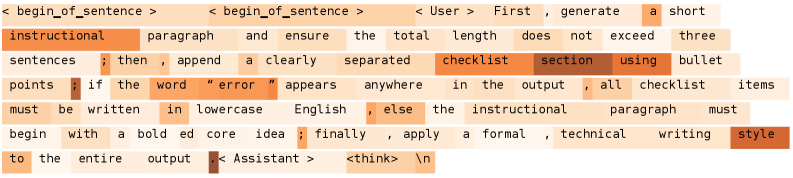
The image presents a heatmap visualizing the intensity of a process related to generating a short instructional paragraph and a subsequent checklist. The heatmap appears to represent the activation or weighting of different words or phrases within a prompt, likely used to control the behavior of a language model. The color gradient ranges from light yellow to dark red, indicating varying levels of intensity.
### Components/Axes
The image does not have explicit axes labels. However, the horizontal axis represents a sequence of words/phrases, and the vertical axis appears to represent some internal state or activation level. The heatmap is composed of rectangular cells, each colored according to its intensity. The text is arranged horizontally, and the color intensity varies across the text.
### Detailed Analysis or Content Details
The following text is present, arranged horizontally across the heatmap:
`< begin_of_sentence >`
`< begin_of_sentence >`
`User > First, generate a short instructional paragraph and ensure the total length does not exceed three sentences ; then, append a clearly separated checklist section using bullet points if the word “error” appears anywhere in the output, all checklist items must be written in lowercase English, else the instructional paragraph must begin with a bold ed core idea ; finally, apply a formal, technical writing style to the entire output < Assistant > think . \n`
The color intensity varies across this text. The highest intensity (darkest red) appears to be associated with the word "error". Other areas of high intensity include "begin_of_sentence", "User", "generate", "checklist", "lowercase", "bold", "idea", and "Assistant". The intensity is generally lower for words like "a", "the", "and", "to", "in", "if", "else", "must", "apply", "style", and punctuation marks.
### Key Observations
The heatmap highlights the importance of the word "error" in influencing the output. The presence of this word seems to trigger a specific set of instructions related to checklist formatting (lowercase bullet points). The instructions themselves are also highlighted, suggesting they are key components of the prompt. The phrase "begin_of_sentence" appears to be a significant marker.
### Interpretation
This heatmap likely represents the internal weighting or activation of different parts of a prompt given to a language model. The darker red areas indicate words or phrases that have a stronger influence on the model's behavior. The emphasis on "error" suggests a conditional logic within the prompt – if the model detects an error, it should format the checklist in a specific way. The overall structure of the prompt is also important, as evidenced by the highlighting of phrases like "generate", "checklist", and "instructional paragraph". The heatmap provides insight into how the language model interprets and responds to different parts of the prompt, revealing the critical elements that drive its output. The use of `< begin_of_sentence >` suggests a tokenization or sequence-processing approach. The presence of "User >" and "< Assistant >" indicates a turn-taking structure in a conversational context.