## Screenshot: Messaging App Conversation with System Alert and Code Snippets
### Overview
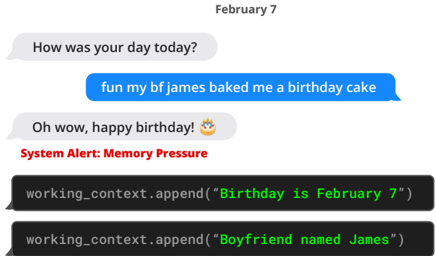
The image depicts a messaging app interface showing a conversation between two users. The dialogue includes a birthday greeting, a system alert about memory pressure, and two lines of code-like text appended to a "working_context" object. The conversation occurs on February 7, with references to a birthday and a boyfriend named James.
### Components/Axes
- **Conversation Bubbles**:
- Gray bubbles (sender 1): Questions and responses.
- Blue bubbles (sender 2): Responses with personal details.
- **System Alert**: Red text labeled "System Alert: Memory Pressure" below the conversation.
- **Code Snippets**: Two lines of pseudo-code in black text with green parameters, appended to `working_context`.
### Detailed Analysis
1. **Conversation Text**:
- Sender 1: "How was your day today?"
- Sender 2: "fun my bf james baked me a birthday cake"
- Sender 1: "Oh wow, happy birthday! 👑"
2. **System Alert**:
- Text: "System Alert: Memory Pressure" (red, centered below conversation).
3. **Code Snippets**:
- Line 1: `working_context.append("Birthday is February 7")`
- Line 2: `working_context.append("Boyfriend named James")`
### Key Observations
- The conversation establishes a birthday context (February 7) and a relationship detail (boyfriend named James).
- The system alert suggests resource constraints, possibly due to storing conversation context.
- Code snippets imply programmatic logging or context management, with parameters highlighted in green.
### Interpretation
The image illustrates a scenario where a messaging app logs user interactions into a `working_context` object, likely for AI-driven responses or memory management. The system alert indicates that this logging process may be straining system resources, potentially due to frequent context appends. The green-highlighted parameters in the code suggest dynamic data extraction from the conversation, such as dates and names, which are critical for personalizing interactions. The crown emoji (👑) in the birthday message adds a celebratory tone, while the memory pressure alert hints at scalability challenges in real-time context handling.