\n
## Diagram: Inscribed Triangle in a Circle
### Overview
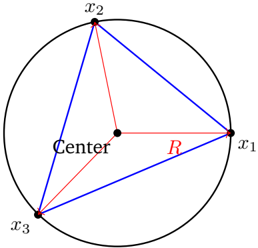
The image depicts a triangle inscribed within a circle. The triangle's vertices are labeled x1, x2, and x3. A line segment connects the center of the circle to vertex x1, and is labeled "R". The center of the circle is explicitly labeled "Center".
### Components/Axes
- **Circle:** A black circular shape.
- **Triangle:** A blue triangle with vertices x1, x2, and x3.
- **Center:** A black dot representing the center of the circle.
- **R:** A red line segment connecting the center of the circle to vertex x1.
- **Labels:**
- x1
- x2
- x3
- Center
- R
### Detailed Analysis or Content Details
- The triangle is inscribed within the circle, meaning all three vertices lie on the circumference of the circle.
- The line segment labeled "R" represents the radius of the circle. It extends from the center of the circle to vertex x1.
- The triangle appears to be scalene, meaning all three sides have different lengths.
- The vertices are positioned as follows:
- x1 is in the bottom-right quadrant.
- x2 is in the top-center quadrant.
- x3 is in the bottom-left quadrant.
- The lines forming the triangle are blue.
- The line representing the radius is red.
### Key Observations
- The diagram illustrates a fundamental geometric relationship between a circle and an inscribed triangle.
- The label "R" explicitly identifies the radius of the circle.
- The diagram does not provide any numerical data regarding the lengths of the sides of the triangle or the radius of the circle.
### Interpretation
The diagram demonstrates the concept of an inscribed triangle within a circle. The radius "R" is a key element, defining the circle's size and its relationship to the triangle. The diagram is likely used to illustrate geometric principles or to set up a problem involving the calculation of angles, side lengths, or the area of the triangle, given the radius of the circle. The lack of numerical values suggests it's a conceptual illustration rather than a specific problem with a defined solution. The diagram could be used to explain trigonometric relationships or the properties of cyclic quadrilaterals.