## Geometric Diagram: Inscribed Triangle with Center and Radius
### Overview
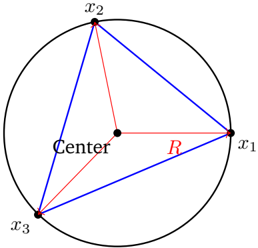
The image is a technical geometric diagram illustrating a circle with an inscribed triangle. The diagram highlights the relationship between the circle's center, its radius, and the vertices of the triangle placed on the circle's circumference. The visual uses color-coding to distinguish between different geometric elements.
### Components
The diagram consists of the following labeled components:
* **Circle**: A black outline forming the primary boundary.
* **Triangle**: A triangle with vertices labeled **x₁**, **x₂**, and **x₃**. The sides of the triangle are drawn in **blue**.
* **Center Point**: A black dot at the geometric center of the circle, labeled **Center**.
* **Radius**: A line segment drawn in **red** connecting the **Center** to vertex **x₁**. This segment is labeled **R**.
* **Additional Radii**: Two other **red** line segments connect the **Center** to vertices **x₂** and **x₃**, though these are not explicitly labeled with text.
**Spatial Grounding:**
* The **Center** point is located at the approximate geometric center of the circle.
* Vertex **x₁** is positioned on the right side of the circle's circumference.
* Vertex **x₂** is positioned at the top of the circle's circumference.
* Vertex **x₃** is positioned at the bottom-left of the circle's circumference.
* The label **"Center"** is placed to the left of the central dot.
* The label **"R"** is placed directly above the red radius line connecting the Center to **x₁**.
### Detailed Analysis
The diagram is a pure geometric construction without numerical data or axes. The analysis focuses on the relationships between the components.
* **Color-Coding Logic**:
* **Blue Lines**: Represent the sides of the inscribed triangle (connecting x₁-x₂, x₂-x₃, x₃-x₁).
* **Red Lines**: Represent radii of the circle (connecting Center-x₁, Center-x₂, Center-x₃).
* **Geometric Relationships**:
* All three vertices (**x₁, x₂, x₃**) lie on the circumference of the circle.
* The **Center** is equidistant from all three vertices, as shown by the three red radii.
* The labeled radius **R** (from Center to x₁) defines the circle's radius. By geometric definition, the lengths of the other two red radii (Center to x₂ and Center to x₃) are also equal to **R**.
* The triangle formed by the blue lines is therefore *inscribed* within the circle.
### Key Observations
1. **Visual Hierarchy**: The use of black for the primary circle and center point, blue for the triangle, and red for the radii creates a clear visual distinction between the different geometric constructs.
2. **Implicit Information**: While only one radius is labeled **R**, the diagram's symmetry and the properties of a circle imply that all three red segments are radii of equal length.
3. **Triangle Type**: Based on the visual positioning, the triangle appears to be acute (all angles less than 90 degrees), as the center point lies inside the triangle.
### Interpretation
This diagram serves as a fundamental visual proof or illustration of the relationship between a circle and an inscribed polygon. It demonstrates the core geometric principle that the vertices of an inscribed triangle are all equidistant from the circle's center, with that distance being the radius (**R**).
The color separation is pedagogically effective: it allows a viewer to instantly differentiate between the *inscribed shape* (blue triangle) and the *defining properties of the circumscribing circle* (red radii from the black center). The diagram could be used to introduce concepts such as circumscribed circles, central angles, or the relationship between a triangle's vertices and the center of its circumcircle. The absence of specific numerical values indicates its purpose is to convey a general geometric concept rather than a specific calculation.