## Diagram: Geometric Circle with Inscribed Points
### Overview
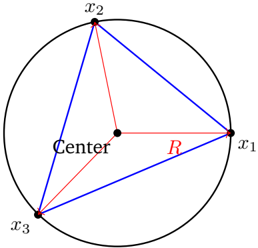
The image depicts a circle with three labeled points (`x1`, `x2`, `x3`) on its circumference, connected to a central point labeled "Center." A radius labeled `R` extends from the center to `x1`. The diagram emphasizes geometric relationships between the center, radius, and peripheral points.
### Components/Axes
- **Circle**: Unlabeled boundary enclosing the diagram.
- **Center**: Central point labeled "Center," serving as the origin for all radii.
- **Points on Circumference**:
- `x1`: Labeled point on the circle, connected to the center via radius `R`.
- `x2`: Labeled point on the circle, connected to the center (line unlabeled).
- `x3`: Labeled point on the circle, connected to the center (line unlabeled).
- **Radius**: Segment from "Center" to `x1`, explicitly labeled `R`.
### Detailed Analysis
- **Geometric Structure**:
- The circle’s radius `R` is defined by the distance from "Center" to `x1`.
- Lines from "Center" to `x2` and `x3` are implied radii but not labeled.
- The three points (`x1`, `x2`, `x3`) form a triangle inscribed within the circle.
- **Spatial Relationships**:
- All points (`x1`, `x2`, `x3`) are equidistant from the center (assuming standard circle properties).
- The radius `R` is the only explicitly quantified measurement.
### Key Observations
- The diagram lacks numerical values for angles or arc lengths, focusing instead on positional labels.
- The unlabeled lines to `x2` and `x3` suggest symmetry or equal importance to `x1` in the context of the diagram.
- The absence of a legend or scale implies the diagram is schematic rather than data-driven.
### Interpretation
This diagram likely illustrates foundational concepts in geometry, such as:
1. **Radius Definition**: The radius `R` establishes the circle’s scale.
2. **Inscribed Triangle**: The points `x1`, `x2`, `x3` may represent vertices of a triangle, potentially equilateral if equally spaced (though spacing is not confirmed).
3. **Central Angles**: Lines from the center to the points could subtend central angles, relevant to calculations of arc lengths or sector areas.
The diagram serves as a visual aid for problems involving circular motion, trigonometry, or coordinate geometry, where the center and radius are critical references. The lack of numerical data suggests it is a conceptual tool rather than a quantitative representation.