## Diagram: Audio Processing System Architecture
### Overview
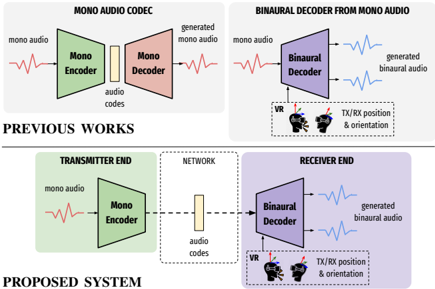
The image compares two audio processing systems: "PREVIOUS WORKS" and "PROPOSED SYSTEM". Both involve encoding/decoding audio, but the proposed system introduces spatial and virtual reality (VR) context for binaural audio generation.
### Components/Axes
#### PREVIOUS WORKS
1. **MONO AUDIO CODEC**
- **Mono Encoder**: Converts mono audio to audio codes.
- **Mono Decoder**: Reconstructs mono audio from audio codes.
- **Flow**: Mono audio → Mono Encoder → Audio codes → Mono Decoder → Generated mono audio.
2. **BINAURAL DECODER FROM MONO AUDIO**
- **Binaural Decoder**: Converts mono audio to binaural audio.
- **Inputs**:
- Mono audio.
- VR (virtual reality) context.
- TX/RX position & orientation (transmitter/receiver spatial data).
- **Output**: Generated binaural audio.
#### PROPOSED SYSTEM
1. **TRANSMITTER END**
- **Mono Encoder**: Same as previous works.
- **Flow**: Mono audio → Mono Encoder → Audio codes → Network.
2. **NETWORK**
- Transmits audio codes between transmitter and receiver.
3. **RECEIVER END**
- **Binaural Decoder**: Uses audio codes, VR context, and TX/RX position/orientation to generate binaural audio.
- **Output**: Generated binaural audio.
### Detailed Analysis
- **Color Coding**:
- Green: Mono Encoder (both systems).
- Purple: Binaural Decoder (proposed system).
- Red: Mono audio signals.
- Blue: Binaural audio signals.
- **Key Differences**:
- Previous works lack spatial/VR context in decoding.
- Proposed system integrates TX/RX position/orientation and VR to enhance binaural audio generation.
### Key Observations
1. The proposed system adds spatial awareness (TX/RX position/orientation) and VR context to the decoding process, enabling more immersive audio.
2. The network acts as a neutral intermediary for audio codes in both systems.
3. Binaural audio generation in the proposed system depends on both audio codes and environmental/spatial data.
### Interpretation
The proposed system advances audio processing by incorporating spatial and VR context into binaural decoding. This suggests a shift from generic mono-to-binaural conversion to context-aware audio rendering, which could improve realism in applications like VR/AR. The integration of TX/RX position/orientation implies dynamic adaptation to the listener’s environment, a feature absent in prior work.