## Legal Evidence Flowchart: Evidence Evaluation for Determining Innocence
### Overview
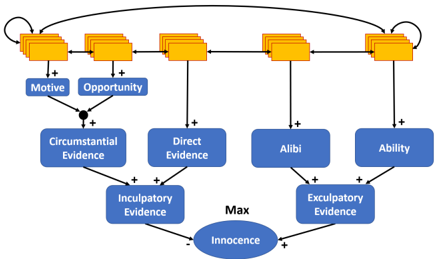
The image is a flowchart diagram illustrating a conceptual model for how different types of legal evidence contribute to the assessment of a suspect's innocence. The flow moves from initial factors at the top, through categories of evidence, to a final evaluation of "Innocence" at the bottom. The diagram uses color-coded boxes and directional arrows with plus (+) and minus (-) signs to indicate positive or negative contributions to the subsequent stage.
### Components/Axes
The diagram is structured hierarchically with the following components, described from top to bottom:
| Row | Color | Element(s) | Labels/Details |
| :--- | :--- | :--- | :--- |
| **Top Row** | Yellow | Five rectangular boxes with icons (resembling documents or files) | Specific text labels are not legible in the provided image. |
| **Second Row** | Blue | Six rectangular boxes | Leftmost: "Motive"<br>Second from Left: "Opportunity"<br>Center: "Circumstantial Evidence"<br>Second from Right: "Direct Evidence"<br>Rightmost: "Alibi"<br>Far Right (offset slightly): "Ability" |
| **Third Row** | Blue | Two rectangular boxes | Left: "Inculpatory Evidence"<br>Right: "Exculpatory Evidence" |
| **Bottom Element** | Blue | A single oval | Labeled "Innocence". The word "Max" is written in small text directly above it. |
### Arrows and Connectors
* Black arrows connect the boxes, indicating the flow of influence.
* Plus signs (`+`) are placed next to arrowheads to indicate a positive contribution.
* A minus sign (`-`) is placed next to the arrowhead from "Inculpatory Evidence" to "Innocence".
* A plus sign (`+`) is placed next to the arrowhead from "Exculpatory Evidence" to "Innocence".
* A curved arrow loops from the far-right yellow box back to the far-left yellow box at the top.
### Detailed Analysis
The flow of logic and relationships depicted is as follows:
* **From Top Factors to Evidence Categories:**
* "Motive" and "Opportunity" both have arrows pointing to "Circumstantial Evidence", each marked with a `+`. This indicates that motive and opportunity are positive contributors to building circumstantial evidence.
* An arrow from the central yellow box points to "Direct Evidence" with a `+`.
* Arrows from the fourth and fifth yellow boxes point to "Alibi" and "Ability" respectively, each with a `+`.
* **From Evidence Categories to Inculpatory/Exculpatory Evidence:**
* "Circumstantial Evidence" and "Direct Evidence" both have arrows pointing to "Inculpatory Evidence", each marked with a `+`. This shows that both types of evidence contribute to forming the case against a suspect.
* "Alibi" and "Ability" both have arrows pointing to "Exculpatory Evidence", each marked with a `+`. This indicates that an alibi and lack of ability (to commit the act) contribute to evidence supporting the suspect.
* **Final Assessment of Innocence:**
* "Inculpatory Evidence" points to "Innocence" with a `-`. This signifies that evidence pointing to guilt negatively impacts the assessment of innocence.
* "Exculpatory Evidence" points to "Innocence" with a `+`. This signifies that evidence clearing the suspect positively impacts the assessment of innocence.
* The label "Max" above "Innocence" suggests the goal is to maximize this state.
### Key Observations
1. **Symmetrical Structure:** The diagram presents a balanced, almost symmetrical model. On the left, factors building a case *against* a suspect (Motive, Opportunity → Circumstantial → Inculpatory) are mirrored on the right by factors building a case *for* a suspect (Alibi, Ability → Exculpatory).
2. **Central Role of Evidence Types:** "Circumstantial Evidence" and "Direct Evidence" are positioned as the central conduits through which initial factors become inculpatory. Similarly, "Alibi" and "Ability" are the conduits for exculpatory evidence.
3. **Visual Coding:** Color is used functionally: yellow for initial, perhaps investigative, factors; blue for formal evidence categories and the final judgment. The `+` and `-` symbols provide a clear, immediate understanding of the valence of each relationship.
4. **Closed System:** The curved arrow at the top creates a loop, suggesting the investigative process or the factors themselves may be cyclical or interconnected.
### Interpretation
This flowchart represents a **systematic, factor-based model for legal reasoning**. It deconstructs the complex question of a suspect's innocence into a structured evaluation of contributing components.
* **What it demonstrates:** The model argues that a determination of innocence is not a single observation but the output of a system. It is maximized ("Max") when exculpatory evidence (like a solid alibi) is strong and inculpatory evidence (built from motive, opportunity, and direct/circumstantial facts) is weak. It visually codifies the principle of "presumption of innocence" by showing innocence as the foundational state that evidence must act upon.
* **Relationships:** The diagram establishes a clear **causal or contributory hierarchy**. Abstract concepts (Motive, Ability) feed into tangible evidence categories (Circumstantial, Exculpatory), which then directly weigh on the final legal conclusion. The `+` and `-` signs transform qualitative relationships into a quasi-quantitative framework.
* **Notable Implications:**
* **Balance is Key:** The symmetrical design implies that a fair legal process requires equal consideration of both inculpatory and exculpatory pathways.
* **"Ability" as Exculpatory:** The placement of "Ability" as a contributor to *exculpatory* evidence is particularly insightful. It suggests that a demonstrated *lack of ability* to commit the crime is a powerful form of defense evidence, not just the absence of guilt.
* **Process-Oriented:** The loop at the top hints that investigation is iterative; new information about motive or opportunity can cycle back and reframe the entire evidence structure.
In essence, this diagram serves as a **conceptual map for investigators, lawyers, or students**, illustrating how disparate pieces of information are categorized and weighted within a logical framework to reach a conclusion about legal innocence. It emphasizes structure, balance, and the directional flow of evidence.