## Flowchart: Evidence and Innocence Determination Model
### Overview
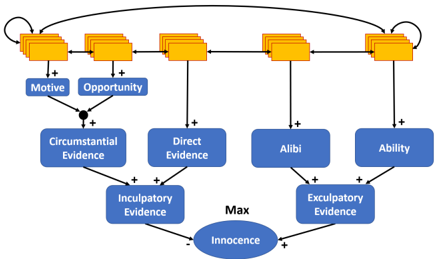
The diagram illustrates a cyclical process for evaluating evidence and determining innocence. It combines process elements (yellow rectangles) with evidence types (blue boxes) connected by directional arrows. The model emphasizes interdependencies between motives, evidence categories, and the final innocence assessment.
### Components/Axes
1. **Process Elements (Yellow Rectangles)**:
- Motive
- Opportunity
- Direct Evidence
- Alibi
- Ability
- These form a closed loop with bidirectional arrows, suggesting continuous interaction.
2. **Evidence Types (Blue Boxes)**:
- Circumstantial Evidence
- Direct Evidence
- Inculpatory Evidence
- Exculpatory Evidence
- Innocence (central node labeled "Max")
3. **Flow Logic**:
- Motive + Opportunity → Circumstantial Evidence
- Circumstantial Evidence + Direct Evidence → Inculpatory Evidence
- Alibi + Ability → Exculpatory Evidence
- Inculpatory Evidence and Exculpatory Evidence → Innocence (via "Max" aggregation)
### Detailed Analysis
- **Cyclical Process**: The yellow rectangles form a self-reinforcing loop, indicating that Motive, Opportunity, Direct Evidence, Alibi, and Ability continuously influence each other.
- **Evidence Aggregation**:
- Inculpatory Evidence receives inputs from both Circumstantial and Direct Evidence.
- Exculpatory Evidence is derived from Alibi and Ability.
- Innocence is determined by the maximum value between Inculpatory and Exculpatory Evidence, suggesting a threshold-based decision model.
- **Directionality**: All arrows point toward Innocence, emphasizing it as the terminal output of the system.
### Key Observations
1. **Interconnected Factors**: Motive and Opportunity directly feed into Circumstantial Evidence, which then amplifies Inculpatory Evidence.
2. **Defense Mechanisms**: Alibi and Ability are positioned as counterbalances to Inculpatory Evidence through Exculpatory Evidence.
3. **Threshold Determination**: The "Max" node implies Innocence is binary (guilty/not guilty) rather than probabilistic, based on the strongest evidence.
### Interpretation
This model represents a simplified legal or investigative framework where:
- **Cyclical Factors**: Motive and Opportunity are foundational to building a case (Inculpatory Evidence).
- **Evidence Balance**: Direct Evidence strengthens the prosecution's case, while Alibi and Ability provide defense mechanisms.
- **Decision Logic**: Innocence is determined by the dominant evidence type, reflecting a "preponderance of evidence" standard. The absence of probabilistic weighting suggests a binary verdict system rather than a nuanced guilt scale.
The diagram abstracts complex evidentiary processes into a deterministic flowchart, prioritizing structural relationships over quantitative analysis. It highlights how defense strategies (Alibi/Ability) must directly counter prosecution evidence (Motive/Opportunity) to influence the innocence determination.