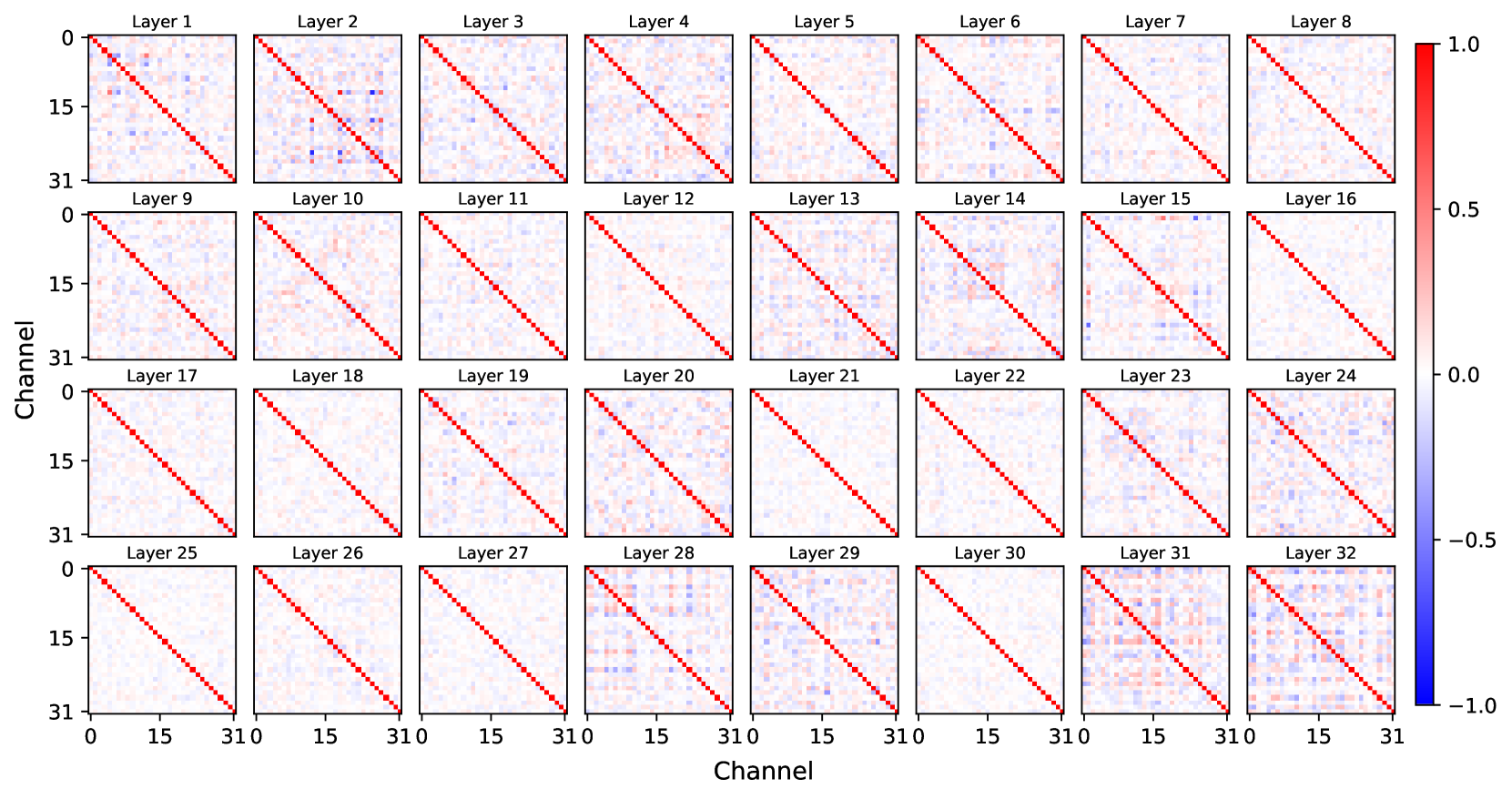
## Heatmap Grid: Correlation Matrices Across 32 Neural Network Layers
### Overview
The image displays a 4x8 grid of 32 heatmaps, each representing a correlation matrix for a specific layer (Layer 1 to Layer 32) of a neural network. Each heatmap visualizes the correlation strength between 32 channels (0–31) within that layer. A red diagonal line dominates all matrices, with off-diagonal elements showing varying intensities of red (positive correlation) and blue (negative correlation). A color scale on the right maps values from -1.0 (blue) to 1.0 (red).
---
### Components/Axes
- **X/Y Axes**: Labeled "Channel" with ticks at 0, 15, and 31. Values range from 0 to 31 for both axes.
- **Legend**: A vertical color bar on the right with a gradient from blue (-1.0) to red (1.0), labeled with numerical values at -1.0, -0.5, 0.0, 0.5, and 1.0.
- **Layer Labels**: Each heatmap is titled "Layer X" (X = 1–32), positioned above its respective matrix.
- **Grid Structure**: 4 rows and 8 columns, with layers ordered sequentially from top-left (Layer 1) to bottom-right (Layer 32).
---
### Detailed Analysis
- **Diagonal Line**: A bold red diagonal line runs from top-left to bottom-right in every heatmap, indicating perfect self-correlation (value = 1.0) for all channels.
- **Off-Diagonal Elements**:
- **Positive Correlations (Red)**: Vary in intensity, with some cells showing strong red (near 1.0) and others lighter red (closer to 0.0).
- **Negative Correlations (Blue)**: Appear as cooler tones, with some cells showing deep blue (near -1.0) and others near-white (closer to 0.0).
- **Symmetry**: Most matrices exhibit approximate symmetry across the diagonal, suggesting mutual correlations between channels.
- **Layer-Specific Patterns**:
- **Early Layers (1–8)**: Diagonals dominate; off-diagonal elements are sparse and low-intensity.
- **Middle Layers (9–24)**: Increased off-diagonal activity, with clusters of red/blue indicating emerging feature interactions.
- **Later Layers (25–32)**: More pronounced structured patterns, with larger blocks of red/blue suggesting hierarchical feature integration.
---
### Key Observations
1. **Universal Diagonal Dominance**: All layers show perfect self-correlation (red diagonal), a common trait in correlation matrices.
2. **Layer Evolution**: Off-diagonal correlations grow stronger and more structured in deeper layers, implying progressive feature abstraction.
3. **Color Consistency**: Red/blue hues align precisely with the legend’s scale, confirming accurate correlation magnitude representation.
4. **Spatial Arrangement**: Layers are ordered sequentially, allowing visual tracking of correlation evolution across the network depth.
---
### Interpretation
This visualization likely represents the progression of channel-wise correlations in a deep neural network. Early layers (1–8) exhibit minimal inter-channel interactions, focusing on basic feature extraction. Middle layers (9–24) show increasing complexity, with emerging correlations suggesting feature combination. Later layers (25–32) display highly structured patterns, indicative of abstract, hierarchical representations. The consistent diagonal dominance across all layers underscores the self-referential nature of channel activations, while off-diagonal variations reveal how features are modulated and integrated through the network. The absence of extreme outliers (e.g., near ±1.0 off-diagonal) suggests balanced correlation distributions, avoiding over-reliance on specific channel pairs.