\n
## Diagram: Chain-of-Thought Reasoning Approaches
### Overview
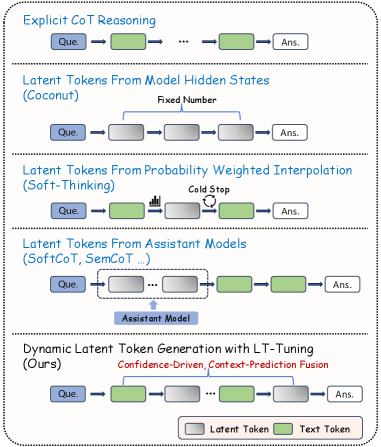
The image is a diagram illustrating five different approaches to Chain-of-Thought (CoT) reasoning in large language models. Each approach is presented as a sequential flow from "Que." (presumably Query) to "Ans." (Answer), with intermediate steps represented by different types of tokens. The diagram visually differentiates between "Latent Tokens" (grey) and "Text Tokens" (green).
### Components/Axes
The diagram is structured into five horizontal sections, each representing a different CoT reasoning method. Each section contains the following elements:
* **Que.** (Query): The starting point of the reasoning process.
* **Arrows:** Representing the flow of information.
* **Tokens:** Representing intermediate reasoning steps. These are either "Latent Tokens" (grey squares) or "Text Tokens" (green rectangles).
* **Ans.** (Answer): The final output of the reasoning process.
* **Titles:** Each section has a title describing the CoT approach.
* **Annotations:** Some sections have additional text annotations describing specific aspects of the method.
* **Legend:** Located at the bottom-right, defining the colors for "Latent Token" and "Text Token".
The five approaches are:
1. Explicit CoT Reasoning
2. Latent Tokens From Model Hidden States (Coconut)
3. Latent Tokens From Probability Weighted Interpolation (Soft-Thinking)
4. Latent Tokens From Assistant Models (SoftCoT, SemCoT ...)
5. Dynamic Latent Token Generation with LT-Tuning (Ours)
### Detailed Analysis or Content Details
Let's analyze each section individually:
1. **Explicit CoT Reasoning:**
* Flow: Que. -> Text Token -> ... -> Text Token -> Ans.
* The flow consists of a series of green "Text Tokens" between the query and the answer. The "..." indicates an unspecified number of intermediate steps.
2. **Latent Tokens From Model Hidden States (Coconut):**
* Flow: Que. -> Latent Token -> Latent Token -> ... -> Latent Token -> Ans.
* Annotation: "Fixed Number" is placed above the latent tokens.
* The flow consists of a series of grey "Latent Tokens" between the query and the answer. The "..." indicates an unspecified number of intermediate steps.
3. **Latent Tokens From Probability Weighted Interpolation (Soft-Thinking):**
* Flow: Que. -> Latent Token -> (Waveform) -> (Circle with question mark) -> Latent Token -> Ans.
* Annotation: "Cold Stop" is placed above the waveform and circle.
* The flow includes a waveform symbol and a circle with a question mark within the latent token sequence.
4. **Latent Tokens From Assistant Models (SoftCoT, SemCoT ...):**
* Flow: Que. -> Latent Token -> Latent Token -> ... -> Latent Token -> Text Token -> Ans.
* Annotation: "Assistant Model" is placed below the latent tokens.
* The flow includes a combination of grey "Latent Tokens" and a final green "Text Token" before the answer.
5. **Dynamic Latent Token Generation with LT-Tuning (Ours):**
* Flow: Que. -> Latent Token -> Latent Token -> ... -> Latent Token -> Text Token -> Ans.
* Annotations: "Confidence-Driven, Context-Prediction Fusion" is placed above the latent tokens.
* The flow consists of a series of grey "Latent Tokens" and a final green "Text Token" before the answer. The "..." indicates an unspecified number of intermediate steps.
### Key Observations
* The primary distinction between the approaches lies in the type of tokens used for intermediate reasoning steps (Text vs. Latent).
* The "Explicit CoT Reasoning" approach uses only text tokens, while the others utilize latent tokens.
* The "Soft-Thinking" approach introduces visual elements (waveform and question mark) within the latent token sequence.
* The "Assistant Models" and "Dynamic Latent Token Generation" approaches combine latent and text tokens.
* The "Ours" approach (Dynamic Latent Token Generation) is highlighted with annotations indicating its key features.
### Interpretation
This diagram presents a comparative overview of different methods for enhancing Chain-of-Thought reasoning in language models. The approaches vary in how they represent and utilize intermediate reasoning steps. The shift from explicit text-based CoT to latent token-based approaches suggests an effort to capture more nuanced and potentially hidden reasoning processes within the model. The inclusion of visual elements in "Soft-Thinking" and the combination of latent and text tokens in the other methods indicate attempts to bridge the gap between internal model representations and human-interpretable reasoning steps. The "Ours" approach, with its emphasis on confidence-driven and context-prediction fusion, likely represents a novel contribution aimed at improving the accuracy and efficiency of latent token generation. The diagram effectively communicates the core concepts and differences between these approaches, providing a valuable visual aid for understanding the evolving landscape of CoT reasoning techniques. The use of "Que." and "Ans." is a simplification, but effectively conveys the input-process-output nature of these methods.