## Diagram: DevOps Pipeline Architecture
### Overview
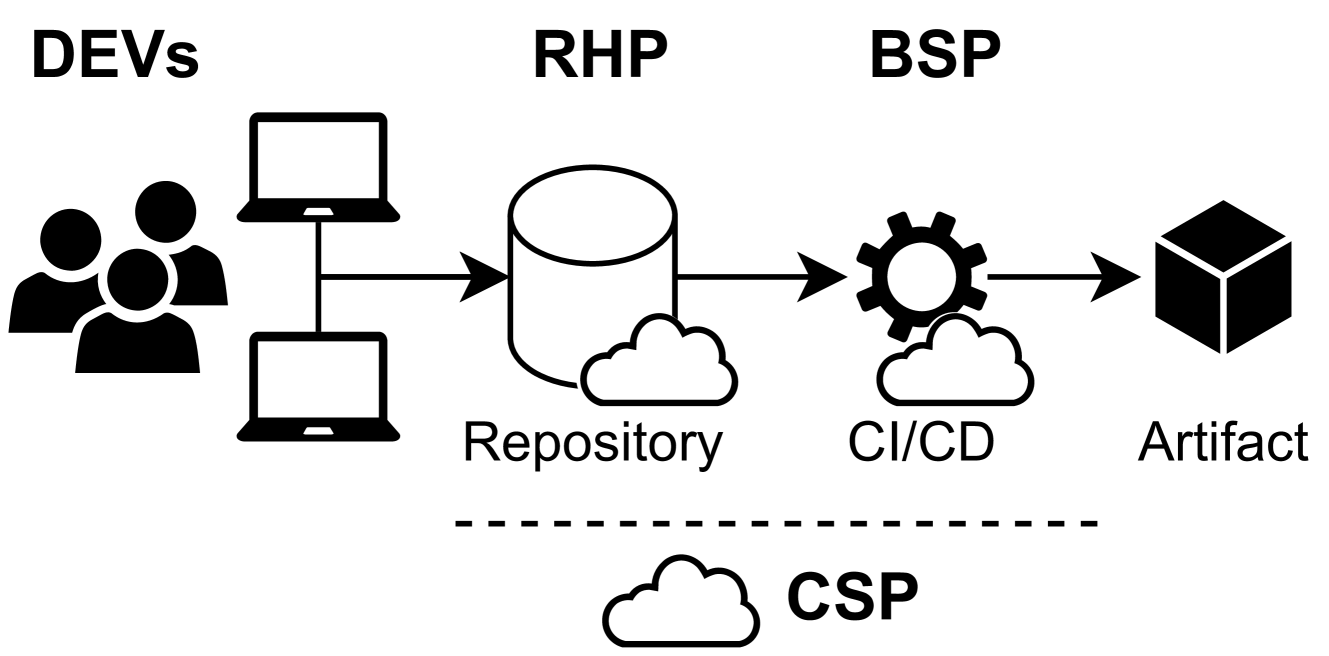
The diagram illustrates a DevOps pipeline workflow, depicting the flow of code artifacts from development to deployment. It uses standardized DevOps icons and directional arrows to represent the progression of software artifacts through various stages.
### Components/Axes
1. **DEVs** (Top-left)
- Represented by three human silhouettes with laptops
- Position: Leftmost section of the diagram
- Function: Code contributors/developers
2. **RHP** (Repository Hosting Platform)
- Icon: Cylinder with cloud base
- Position: Center-left
- Function: Version control repository
3. **CI/CD** (Continuous Integration/Continuous Deployment)
- Icon: Gear mechanism
- Position: Center-right
- Function: Automated build/test/deployment pipeline
4. **BSP** (Build System Platform)
- Position: Between RHP and Artifact
- Function: Artifact generation system
5. **Artifact** (Final Output)
- Icon: Cube with three visible faces
- Position: Far right
- Function: Deployable software package
6. **CSP** (Cloud Service Provider)
- Icon: Cloud with "CSP" label
- Position: Bottom center
- Function: Infrastructure provider
### Flow Direction
- Left-to-right progression: DEVs → RHP → BSP → Artifact
- Vertical connection: RHP ↔ CSP (dashed line)
- All components connected by solid arrows except CSP connection
### Key Observations
1. **Linear Workflow**: Clear sequential progression from code development to deployment
2. **Automation Emphasis**: Gear icon highlights CI/CD automation
3. **Cloud Integration**: CSP positioned as foundational infrastructure
4. **Artifact Standardization**: Cube icon suggests standardized packaging format
### Interpretation
This diagram represents a typical DevOps pipeline architecture where:
- Developers (DEVs) commit code to a version-controlled repository (RHP)
- The repository triggers automated CI/CD processes (gear icon)
- These processes generate deployable artifacts (cube icon)
- The entire pipeline operates on cloud infrastructure (CSP)
- The dashed line between RHP and CSP indicates optional cloud dependency
The architecture emphasizes automation (CI/CD), standardization (artifact cube), and cloud-native deployment. The absence of feedback loops suggests a linear deployment model rather than continuous delivery with rollback capabilities. The cloud provider's central position underscores modern infrastructure-as-code practices.