\n
## Line Chart: Benchmark: OlympiadBench
### Overview
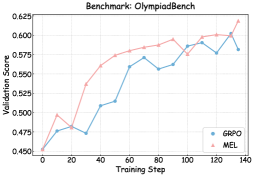
The image displays a line chart comparing the validation score performance of two models, labeled "GAPO" and "MEL," over the course of training steps on a benchmark called "OlympiadBench." The chart shows both models improving over time, with the MEL model consistently achieving a higher validation score after the initial training steps.
### Components/Axes
* **Chart Title:** "Benchmark: OlympiadBench" (centered at the top).
* **Y-Axis:** Labeled "Validation Score." The scale runs from 0.450 to 0.625, with major grid lines and labels at intervals of 0.025 (0.450, 0.475, 0.500, 0.525, 0.550, 0.575, 0.600, 0.625).
* **X-Axis:** Labeled "Training_Step." The scale runs from 0 to 140, with major grid lines and labels at intervals of 20 (0, 20, 40, 60, 80, 100, 120, 140).
* **Legend:** Located in the bottom-right corner of the chart area. It contains two entries:
* A blue line with a circle marker labeled "GAPO".
* A red line with a circle marker labeled "MEL".
* **Data Series:** Two lines plotted on the chart, corresponding to the legend entries.
### Detailed Analysis
**Data Series: GAPO (Blue Line)**
* **Trend:** The line shows an overall upward trend with notable volatility. It experiences a dip early in training before recovering and climbing, with several smaller fluctuations along the way.
* **Approximate Data Points (Training Step, Validation Score):**
* (0, ~0.450)
* (10, ~0.475)
* (20, ~0.465) - *Local minimum*
* (30, ~0.475)
* (40, ~0.500)
* (50, ~0.510)
* (60, ~0.540)
* (70, ~0.560)
* (80, ~0.555)
* (90, ~0.560)
* (100, ~0.575)
* (110, ~0.565)
* (120, ~0.580)
* (130, ~0.570)
* (140, ~0.575)
**Data Series: MEL (Red Line)**
* **Trend:** The line shows a strong, consistent upward trend with less volatility than the GAPO line. After an initial dip, it climbs steadily and maintains a clear performance lead over GAPO for the majority of the training process.
* **Approximate Data Points (Training Step, Validation Score):**
* (0, ~0.475)
* (10, ~0.500)
* (20, ~0.475) - *Local minimum, similar to GAPO*
* (30, ~0.525)
* (40, ~0.550)
* (50, ~0.565)
* (60, ~0.575)
* (70, ~0.585)
* (80, ~0.590)
* (90, ~0.595)
* (100, ~0.590)
* (110, ~0.600)
* (120, ~0.600)
* (130, ~0.605)
* (140, ~0.625) - *Highest point on the chart*
### Key Observations
1. **Performance Gap:** After training step 20, the MEL model (red) establishes and maintains a clear performance advantage over the GAPO model (blue). The gap is most pronounced between steps 40 and 100.
2. **Initial Dip:** Both models experience a performance dip around training step 20, suggesting a common challenge or phase in the early training process on this benchmark.
3. **Volatility vs. Stability:** The GAPO line is more volatile, with sharper peaks and valleys. The MEL line, while not perfectly smooth, demonstrates a more stable and consistent improvement trajectory.
4. **Final Convergence?:** Towards the end of the plotted training (steps 120-140), the GAPO line shows a slight recovery after a dip, while the MEL line continues its strong upward climb, reaching its peak at the final data point. The lines do not appear to converge.
### Interpretation
The data suggests that for the "OlympiadBench" benchmark, the MEL training method or model architecture is more effective and robust than GAPO. MEL not only achieves a higher final validation score (~0.625 vs. ~0.575) but also demonstrates more stable learning dynamics after an initial adjustment period.
The synchronized dip at step 20 is a critical investigative point. It could indicate a specific difficulty in the benchmark dataset encountered at that stage of training, a learning rate schedule effect, or a characteristic of the optimization landscape. The fact that both models recover but then diverge significantly implies that MEL is better equipped to overcome this hurdle and continue scaling its performance.
The chart does not show signs of overfitting (a declining validation score) for either model within the 140 steps, suggesting that performance might continue to improve with further training, particularly for MEL. The primary takeaway is the clear superiority of the MEL approach on this specific task, both in terms of absolute performance and learning stability.