## Diagram: Neural-Symbolic Integration Approaches
### Overview
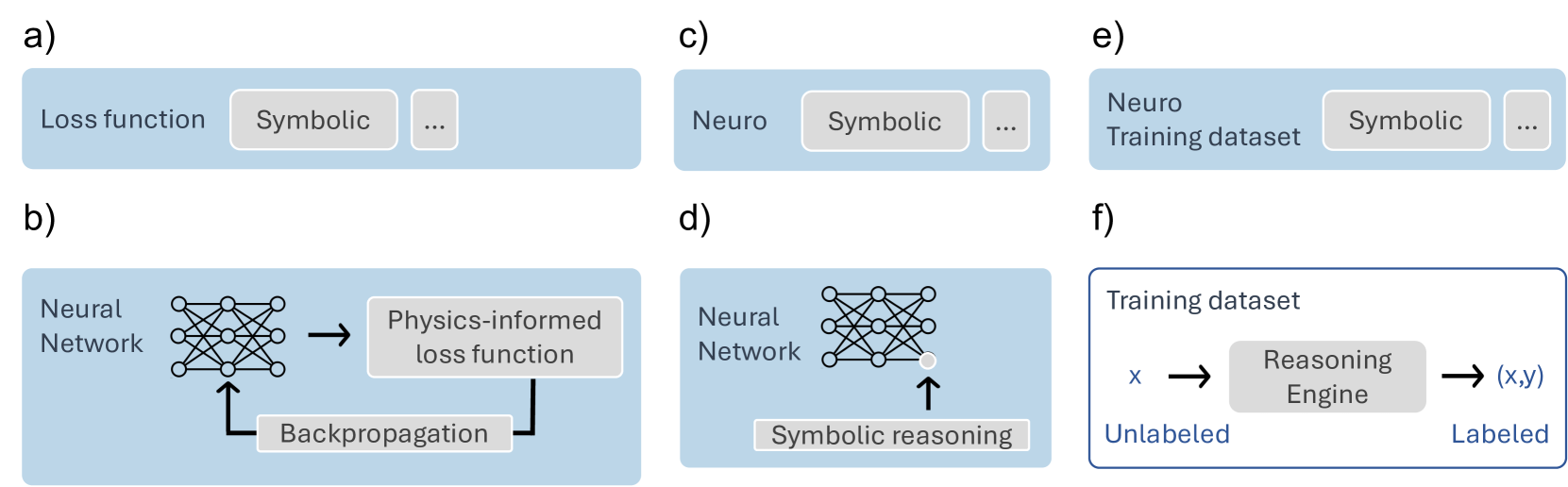
The image presents a series of diagrams illustrating different approaches to integrating neural networks with symbolic reasoning. Each diagram (a-f) represents a distinct method or component within a broader neural-symbolic system.
### Components/Axes
* **Diagrams a, c, e:** These diagrams show high-level components with "Neuro" and "Symbolic" elements.
* **Diagram b:** Shows a neural network connected to a physics-informed loss function with backpropagation.
* **Diagram d:** Shows a neural network being influenced by symbolic reasoning.
* **Diagram f:** Shows a training dataset being processed by a reasoning engine to produce labeled data.
### Detailed Analysis
**a) Loss function:**
* A light blue rounded rectangle contains the text "Loss function".
* To the right, a gray rounded rectangle contains the text "Symbolic".
* Further to the right, there are three dots "...".
**b) Neural Network and Physics-Informed Loss Function:**
* A light blue rounded rectangle contains the text "Neural Network" and a diagram of a neural network.
* An arrow points from the neural network to a gray rounded rectangle containing the text "Physics-informed loss function".
* An arrow points from the neural network to a gray rounded rectangle containing the text "Backpropagation".
**c) Neuro-Symbolic:**
* A light blue rounded rectangle contains the text "Neuro".
* To the right, a gray rounded rectangle contains the text "Symbolic".
* Further to the right, there are three dots "...".
**d) Neural Network and Symbolic Reasoning:**
* A light blue rounded rectangle contains the text "Neural Network" and a diagram of a neural network.
* An upward-pointing arrow originates from a gray rounded rectangle containing the text "Symbolic reasoning" and points towards the neural network.
**e) Neuro-Symbolic Training Dataset:**
* A light blue rounded rectangle contains the text "Neuro Training dataset".
* To the right, a gray rounded rectangle contains the text "Symbolic".
* Further to the right, there are three dots "...".
**f) Training Dataset and Reasoning Engine:**
* A light blue rounded rectangle contains the text "Training dataset".
* An "x" is labeled "Unlabeled".
* An arrow points from "x" to a gray rounded rectangle containing the text "Reasoning Engine".
* An arrow points from the "Reasoning Engine" to "(x,y)" which is labeled "Labeled".
### Key Observations
* The diagrams illustrate different ways in which neural networks and symbolic reasoning can be integrated.
* Some approaches involve using symbolic knowledge to inform the loss function (b), while others use symbolic reasoning to influence the neural network directly (d).
* The training dataset can also be augmented with symbolic information (e, f).
### Interpretation
The image provides a high-level overview of various strategies for combining neural networks and symbolic reasoning. These approaches aim to leverage the strengths of both paradigms: the learning capabilities of neural networks and the reasoning and interpretability of symbolic systems. The diagrams highlight different points of integration, from influencing the loss function to directly incorporating symbolic knowledge into the training data or network architecture. The choice of approach depends on the specific problem and the nature of the available symbolic knowledge.