## Scatter Plots: Top 10 Safety Heads on Undiff Attention and Scaling Continuity
### Overview
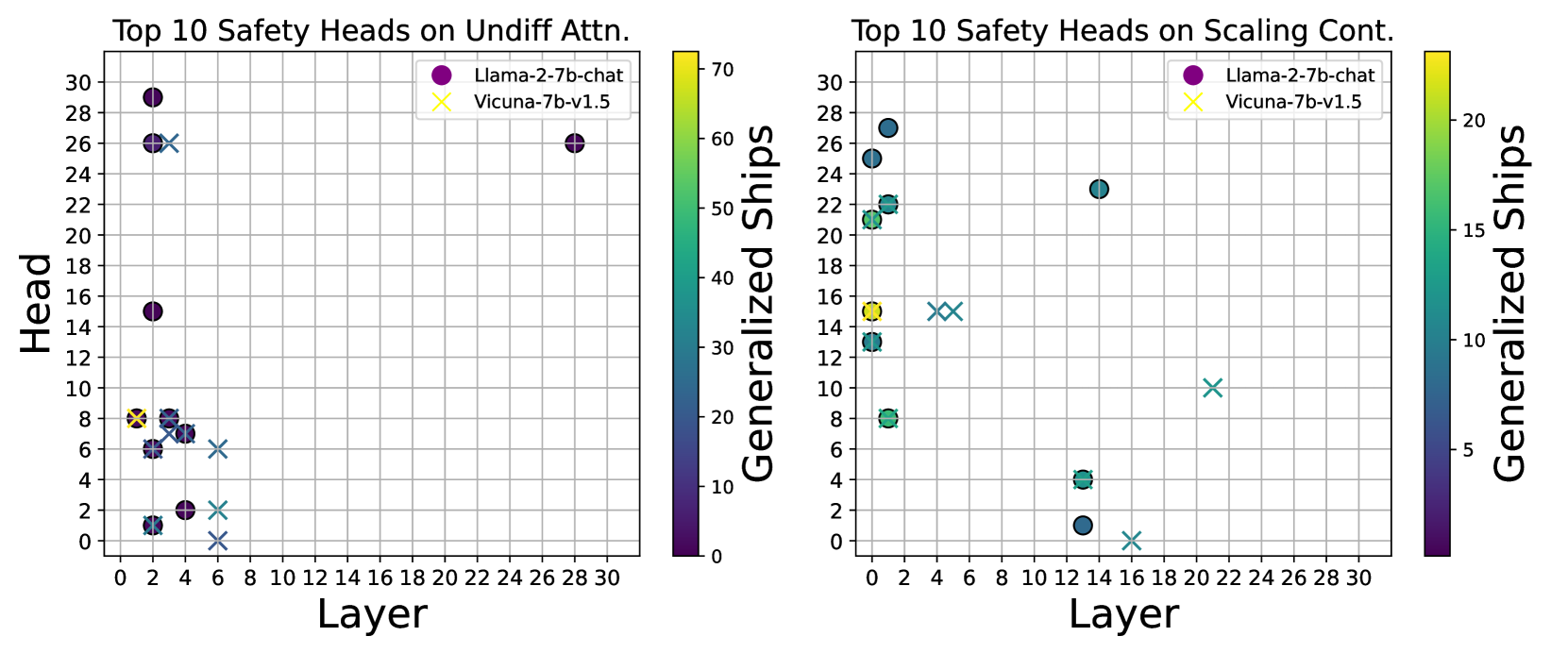
The image contains two side-by-side scatter plots comparing safety head distributions across neural network layers for two models: Llama-2-7b-chat (purple circles) and Vicuna-7b-v1.5 (yellow crosses). The left plot focuses on "Undiff Attention" safety heads, while the right plot examines "Scaling Continuity" safety heads. Both plots use a color gradient ("Generalized Ships") to indicate data point intensity, ranging from 0 (dark purple) to 70 (bright yellow).
---
### Components/Axes
#### Left Plot (Undiff Attention)
- **X-axis**: Layer (0–30, integer increments)
- **Y-axis**: Head (0–30, integer increments)
- **Legend**:
- Purple circles: Llama-2-7b-chat
- Yellow crosses: Vicuna-7b-v1.5
- **Color Bar**: "Generalized Ships" (0–70, darker = lower, brighter = higher)
#### Right Plot (Scaling Continuity)
- **X-axis**: Layer (0–30, integer increments)
- **Y-axis**: Head (0–30, integer increments)
- **Legend**: Same as left plot
- **Color Bar**: Same scale as left plot
---
### Detailed Analysis
#### Left Plot (Undiff Attention)
- **Llama-2-7b-chat** (purple circles):
- Concentrated in upper layers (26–30) with high head numbers (24–28).
- One outlier at layer 2 with head 14.
- Color intensity varies: darker (lower ships) in upper layers, brighter (higher ships) in lower layers.
- **Vicuna-7b-v1.5** (yellow crosses):
- Spread across lower layers (0–6) with heads 0–8.
- One outlier at layer 4 with head 8.
- Color intensity: brighter (higher ships) in lower layers.
#### Right Plot (Scaling Continuity)
- **Llama-2-7b-chat** (purple circles):
- Clustered in middle layers (12–14) with heads 14–16.
- Additional points in upper layers (26–30) with heads 24–26.
- Color intensity: darker (lower ships) in middle layers, brighter in upper layers.
- **Vicuna-7b-v1.5** (yellow crosses):
- Concentrated in lower layers (4–6) with heads 8–10.
- One outlier at layer 20 with head 12.
- Color intensity: brighter (higher ships) in lower layers.
---
### Key Observations
1. **Layer Distribution**:
- Llama-2-7b-chat safety heads dominate **upper layers** in both plots.
- Vicuna-7b-v1.5 safety heads are concentrated in **lower layers** for undiff attention and **middle-lower layers** for scaling continuity.
2. **Head Numbers**:
- Llama-2-7b-chat consistently shows higher head numbers (14–28) compared to Vicuna-7b-v1.5 (0–12).
3. **Color Intensity**:
- Vicuna-7b-v1.5 data points generally exhibit brighter colors (higher "Generalized Ships") in lower layers, suggesting stronger safety signals in these regions.
4. **Outliers**:
- Vicuna-7b-v1.5 has an outlier at layer 20 (head 12) in the scaling continuity plot, deviating from its lower-layer trend.
---
### Interpretation
1. **Model Behavior**:
- Llama-2-7b-chat’s safety heads in upper layers (undiff attention) and middle/upper layers (scaling continuity) may indicate specialized safety mechanisms in later processing stages.
- Vicuna-7b-v1.5’s lower-layer dominance suggests safety features are more active in early computational stages.
2. **Generalized Ships**:
- The color gradient implies that Vicuna-7b-v1.5’s safety signals are more pronounced (higher ships) in lower layers, while Llama-2-7b-chat’s signals are stronger in upper layers.
3. **Anomalies**:
- The Vicuna-7b-v1.5 outlier at layer 20 (scaling continuity) may reflect an unexpected safety mechanism or data artifact.
---
### Conclusion
The plots reveal distinct safety head distributions between the two models, with Llama-2-7b-chat favoring higher layers and Vicuna-7b-v1.5 prioritizing lower layers. The "Generalized Ships" metric highlights differences in safety signal strength across layers, offering insights into model architecture and safety design priorities.