## Diagram: Set Representation
### Overview
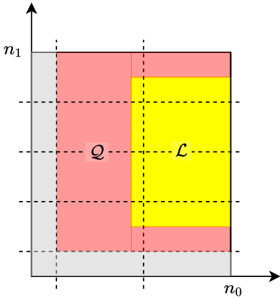
The image is a diagram representing two sets, Q and L, within a larger space defined by axes n0 and n1. The sets are visually distinguished by color (red for Q, yellow for L) and are positioned within a grid-like structure. The diagram illustrates the relationship and overlap between these sets.
### Components/Axes
* **Axes:**
* Horizontal axis: n0
* Vertical axis: n1
* **Sets:**
* Q: Represented by a red area.
* L: Represented by a yellow area.
* **Grid:** Dashed lines forming a grid structure.
* **Background:** Gray area representing the overall space.
### Detailed Analysis
* **Set Q:** The red area representing set Q occupies a significant portion of the space, primarily on the left side. It extends vertically from approximately 0.1 to 1 on the n1 axis and horizontally from approximately 0.1 to 0.6 on the n0 axis.
* **Set L:** The yellow area representing set L is positioned on the right side of the diagram. It extends vertically from approximately 0.3 to 0.9 on the n1 axis and horizontally from approximately 0.6 to 1 on the n0 axis.
* **Overlap:** There is a small region where the red and yellow areas overlap, indicating the intersection of sets Q and L. This overlap occurs approximately between 0.6 and 0.7 on the n0 axis and 0.3 and 0.9 on the n1 axis.
* **Grid:** The dashed grid lines provide a visual reference for the position and extent of the sets. The grid lines are spaced approximately equally along both axes.
### Key Observations
* Sets Q and L have a partial overlap, indicating some common elements.
* Set Q is positioned more towards the left side of the space, while set L is positioned more towards the right.
* The gray background defines the boundaries of the overall space.
### Interpretation
The diagram visually represents the relationship between two sets, Q and L, within a defined space. The overlap between the sets indicates a non-empty intersection, meaning there are elements that belong to both sets. The positioning of the sets relative to the axes and each other provides a spatial understanding of their distribution and relationship within the overall space. The grid helps to visualize the relative sizes and positions of the sets. The diagram is a visual aid to understand set theory concepts.