## Diagram: LLM-Empowered Agent Architecture
### Overview
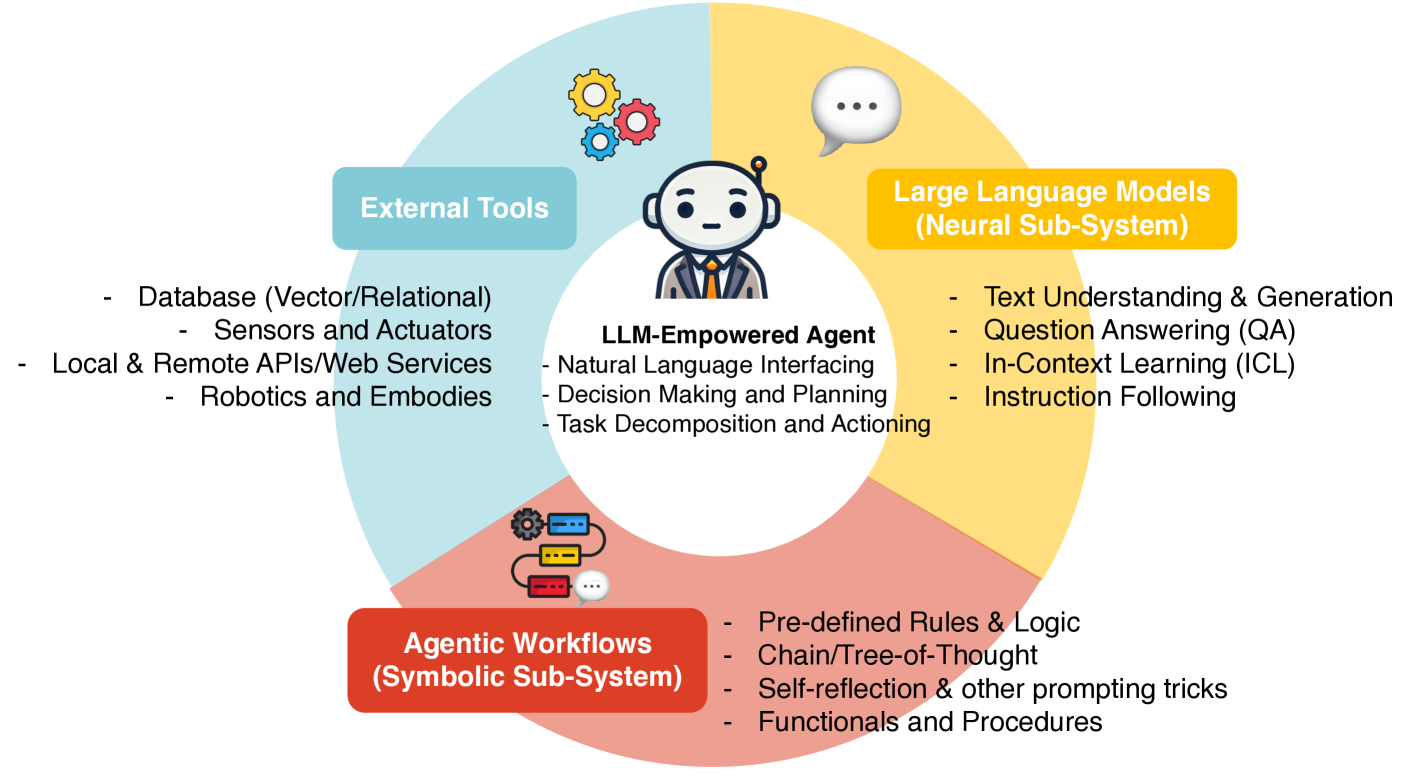
The image is a diagram illustrating the architecture of an LLM-Empowered Agent. It depicts the agent at the center, interacting with three key components: External Tools, Large Language Models (Neural Sub-System), and Agentic Workflows (Symbolic Sub-System). The diagram uses a circular layout to show the relationships between these components.
### Components/Axes
* **Central Element:** LLM-Empowered Agent
* Natural Language Interfacing
* Decision Making and Planning
* Task Decomposition and Actioning
* **Top-Left Quadrant:** External Tools (light blue background)
* Database (Vector/Relational)
* Sensors and Actuators
* Local & Remote APIs/Web Services
* Robotics and Embodies
* **Top-Right Quadrant:** Large Language Models (Neural Sub-System) (yellow background)
* Text Understanding & Generation
* Question Answering (QA)
* In-Context Learning (ICL)
* Instruction Following
* **Bottom Quadrant:** Agentic Workflows (Symbolic Sub-System) (red background)
* Pre-defined Rules & Logic
* Chain/Tree-of-Thought
* Self-reflection & other prompting tricks
* Functionals and Procedures
### Detailed Analysis or ### Content Details
The diagram presents a high-level view of how an LLM-Empowered Agent functions by integrating different components.
* **LLM-Empowered Agent:** This is the central component, responsible for interfacing with natural language, making decisions, planning, and decomposing tasks.
* **External Tools:** These provide the agent with access to external data and functionalities, including databases, sensors, APIs, and robotics.
* **Large Language Models (Neural Sub-System):** This component provides the agent with capabilities for text understanding, generation, question answering, and in-context learning.
* **Agentic Workflows (Symbolic Sub-System):** This component provides the agent with pre-defined rules, logic, and procedures for task execution.
### Key Observations
* The diagram highlights the integration of neural and symbolic sub-systems within the LLM-Empowered Agent architecture.
* The agent interacts with external tools to gather information and perform actions in the real world.
* The agent leverages large language models for natural language understanding and generation.
* The agent utilizes agentic workflows to execute tasks based on pre-defined rules and logic.
### Interpretation
The diagram illustrates a hybrid approach to building intelligent agents, combining the strengths of neural networks (LLMs) and symbolic systems (Agentic Workflows). The LLM-Empowered Agent acts as a central hub, coordinating interactions between external tools, large language models, and agentic workflows to achieve its goals. This architecture enables the agent to understand natural language, make decisions, plan tasks, and execute them effectively. The integration of external tools allows the agent to interact with the real world and access relevant information. The diagram suggests that this architecture is well-suited for building intelligent agents that can perform a wide range of tasks in complex environments.