## Diagram Type: Circular Diagram
### Overview
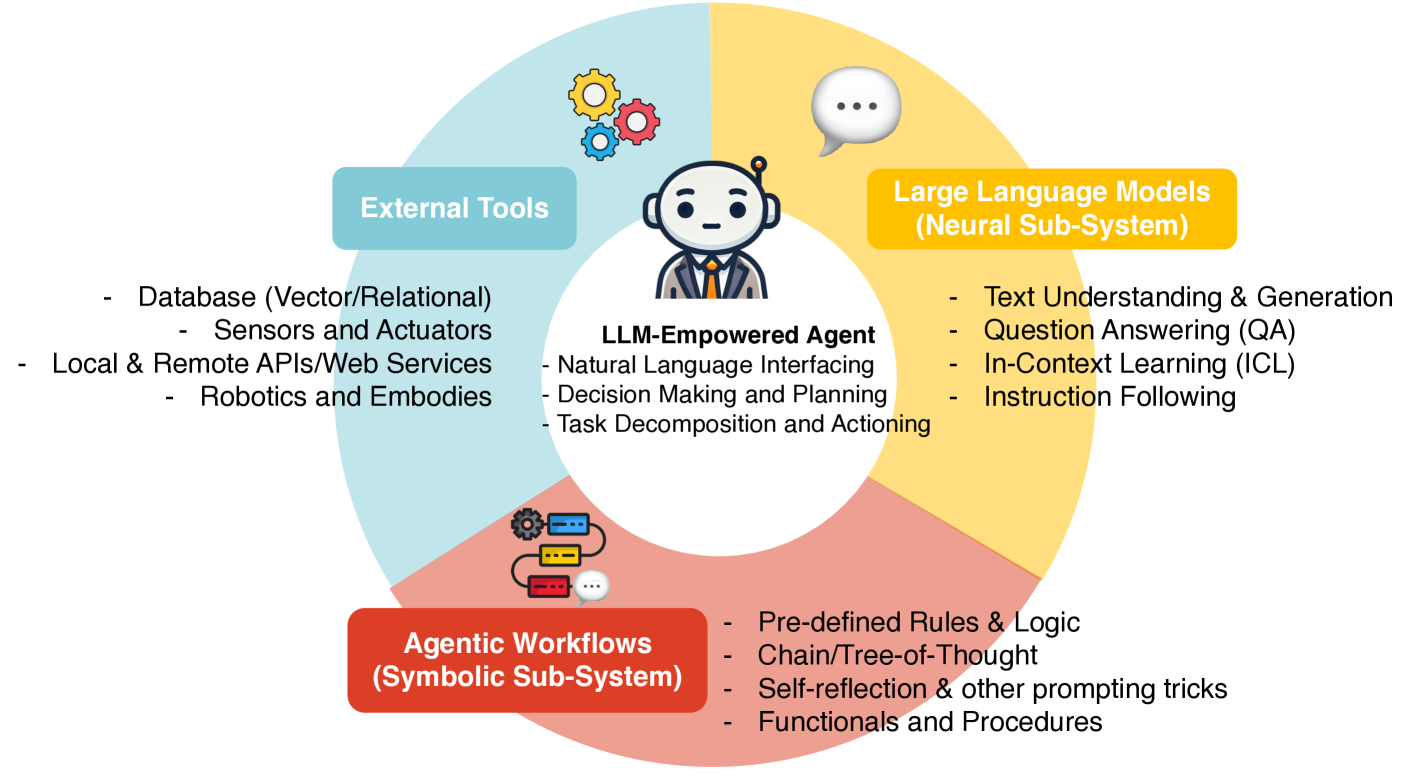
The image is a circular diagram that illustrates the components and relationships between different elements in a system. The diagram is divided into four quadrants, each representing a different aspect of the system.
### Components/Axes
- **External Tools**: This quadrant includes a list of external tools that can be used within the system. The tools are categorized as follows:
- Database (Vector/Relational)
- Sensors and Actuators
- Local & Remote APIs/Web Services
- Robotics and Embodied
- **Large Language Models (LLM)**: This quadrant includes a list of capabilities provided by LLMs. The capabilities are as follows:
- Text Understanding & Generation
- Question Answering (QA)
- In-Context Learning (ICL)
- Instruction Following
- **LLM-Empowered Agent**: This quadrant includes a list of features provided by the LLM-Empowered Agent. The features are as follows:
- Natural Language Interfacing
- Decision Making and Planning
- Task Decomposition and Acting
- **Agentic Workflows (Symbolic Sub-System)**: This quadrant includes a list of functionalities provided by the Agentic Workflows. The functionalities are as follows:
- Pre-defined Rules & Logic
- Chain/Tree-of-Thought
- Self-reflection & other prompting tricks
- Functionals and Procedures
### Detailed Analysis or Content Details
The diagram provides a clear and concise overview of the different components and their relationships within the system. The external tools are listed as a starting point for the system, and the LLMs provide capabilities that can be used to enhance the system's performance. The LLM-Empowered Agent provides features that can be used to interact with the external tools and LLMs, while the Agentic Workflows provide functionalities that can be used to automate tasks and workflows.
### Key Observations
The diagram highlights the importance of external tools and LLMs in the system. The LLMs provide capabilities that can be used to enhance the system's performance, while the LLM-Empowered Agent provides features that can be used to interact with the external tools and LLMs. The Agentic Workflows provide functionalities that can be used to automate tasks and workflows.
### Interpretation
The diagram suggests that the system is designed to be highly flexible and adaptable. The external tools and LLMs provide a range of capabilities that can be used to enhance the system's performance, while the LLM-Empowered Agent provides features that can be used to interact with the external tools and LLMs. The Agentic Workflows provide functionalities that can be used to automate tasks and workflows. Overall, the diagram suggests that the system is designed to be highly efficient and effective.