## Circular Diagram: LLM-Empowered Agent Architecture
### Overview
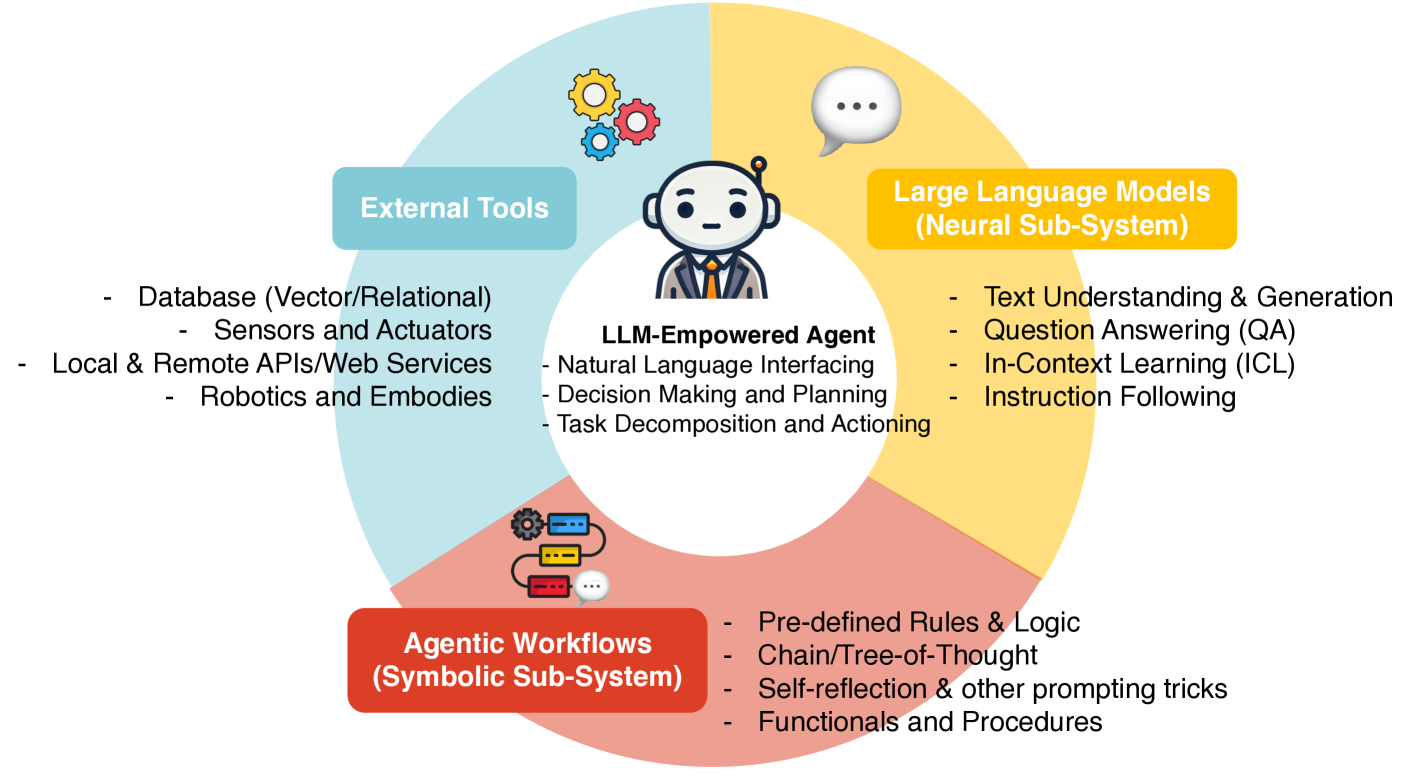
The diagram illustrates a tripartite architecture for an LLM-Empowered Agent, divided into three concentric sections:
1. **External Tools** (blue)
2. **Large Language Models (Neural Sub-System)** (yellow)
3. **Agentic Workflows (Symbolic Sub-System)** (red)
A central white circle labeled "LLM-Empowered Agent" contains core functionalities, surrounded by a legend featuring a robot icon.
---
### Components/Axes
#### Legend
- **Central Icon**: Robot figure in a suit with antenna, symbolizing the agent.
- **Color Coding**:
- Blue = External Tools
- Yellow = Large Language Models (Neural Sub-System)
- Red = Agentic Workflows (Symbolic Sub-System)
#### Main Sections
1. **External Tools (Blue)**
- Sub-components:
- Database (Vector/Relational)
- Sensors and Actuators
- Local & Remote APIs/Web Services
- Robotics and Embodies
2. **Large Language Models (Neural Sub-System) (Yellow)**
- Sub-components:
- Text Understanding & Generation
- Question Answering (QA)
- In-Context Learning (ICL)
- Instruction Following
3. **Agentic Workflows (Symbolic Sub-System) (Red)**
- Sub-components:
- Pre-defined Rules & Logic
- Chain/Tree-of-Thought
- Self-reflection & other prompting tricks
- Functionals and Procedures
#### Core Agent Functions (White Circle)
- Natural Language Interfacing
- Decision Making and Planning
- Task Decomposition and Actioning
---
### Detailed Analysis
#### External Tools (Blue)
- **Database**: Explicitly lists vector and relational databases.
- **Sensors/Actuators**: Implies hardware integration for data collection and physical interaction.
- **APIs/Web Services**: Distinguishes between local and remote connectivity.
- **Robotics/Embodies**: Suggests physical deployment capabilities.
#### Large Language Models (Yellow)
- **Text Understanding/Generation**: Core NLP capabilities.
- **QA/ICL**: Focus on dynamic, context-aware responses.
- **Instruction Following**: Emphasizes adherence to user directives.
#### Agentic Workflows (Red)
- **Pre-defined Rules**: Structured logic for deterministic behavior.
- **Chain/Tree-of-Thought**: Enables complex reasoning via sequential or branching logic.
- **Self-reflection/Prompting**: Meta-cognitive capabilities for iterative improvement.
- **Functionals/Procedures**: Modular execution of tasks.
#### Core Agent Functions
- **Natural Language Interfacing**: Bridges human language with system operations.
- **Decision Making/Planning**: Strategic task allocation.
- **Task Decomposition/Actioning**: Breaks down goals into executable steps.
---
### Key Observations
1. **Modular Design**: Each subsystem (neural, symbolic, external) operates independently but integrates through the central agent.
2. **Color Consistency**: Legend colors (blue/yellow/red) match their respective sections without overlap.
3. **Hierarchical Structure**: Core functions are nested within the agent, while sub-components radiate outward.
4. **Symbiotic Relationships**: Neural and symbolic subsystems complement each other (e.g., LLMs handle ambiguity, workflows enforce logic).
---
### Interpretation
The diagram represents a hybrid AI architecture where:
- **Neural Sub-Systems** (yellow) provide adaptability and contextual understanding.
- **Symbolic Sub-Systems** (red) ensure reliability through rule-based logic.
- **External Tools** (blue) supply real-world data and physical interaction capabilities.
The central agent acts as a mediator, translating between subsystems and executing tasks. This design balances flexibility (via LLMs) with precision (via symbolic workflows), enabling robust, context-aware decision-making. The inclusion of robotics and APIs suggests applications in embodied AI systems requiring both digital and physical interaction.