## Flowchart: NVInfo Data Collection System
### Overview
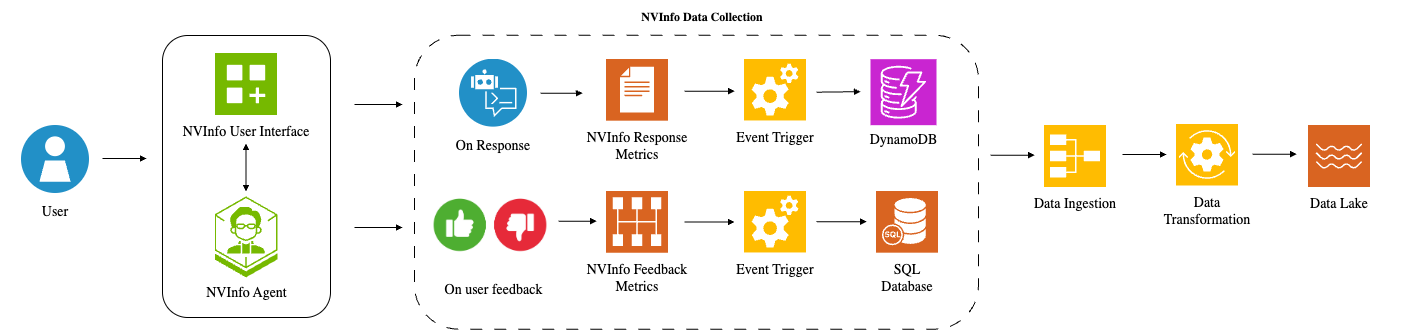
The diagram illustrates a data collection and processing pipeline for an NVInfo system. It shows the flow of data from user interactions through various processing stages to final data storage. The system includes user interfaces, data collection triggers, metric tracking, and database integration components.
### Components/Axes
1. **User Interface Elements**:
- Blue circle with person icon (User)
- Green rectangle with grid/plus sign (NVInfo User Interface)
- Green hexagon with person icon (NVInfo Agent)
2. **Data Collection Paths**:
- **Response Path**:
- Orange paper icon (NVInfo Response Metrics)
- Gear icon (Event Trigger)
- Purple database icon (DynamoDB)
- **Feedback Path**:
- Green thumbs-up icon
- Red thumbs-down icon
- Orange grid icon (NVInfo Feedback Metrics)
- Gear icon (Event Trigger)
- Orange database icon with SQL logo (SQL Database)
3. **Data Processing Pipeline**:
- Orange rectangle (Data Ingestion)
- Gear icon (Data Transformation)
- Orange waves icon (Data Lake)
4. **Legend Colors**:
- Blue: User interface elements
- Green: Agent components
- Orange: Metrics and ingestion components
- Purple: DynamoDB storage
### Detailed Analysis
- **User Interaction Flow**:
1. User interacts with NVInfo User Interface
2. NVInfo Agent processes interactions through two parallel paths:
- **Response Path**:
- Collects NVInfo Response Metrics
- Triggers Event Trigger
- Stores data in DynamoDB
- **Feedback Path**:
- Collects NVInfo Feedback Metrics (via thumbs up/down)
- Triggers Event Trigger
- Stores data in SQL Database
- **Data Processing**:
- All collected data undergoes Data Ingestion
- Data Transformation occurs before final storage
- Final destination is Data Lake
### Key Observations
1. Dual-path architecture for handling different data types (response metrics vs feedback metrics)
2. Event Trigger acts as a central processing node for both paths
3. Separate storage solutions used for different data types (DynamoDB vs SQL Database)
4. Data Transformation stage appears to be a universal processing step before final storage
### Interpretation
This system demonstrates a structured approach to handling user-generated data in an NVInfo application. The separation of response metrics and feedback metrics suggests different data processing requirements for each type. The use of both NoSQL (DynamoDB) and SQL databases indicates varied data structure needs. The Data Transformation stage implies standardization or enrichment processes before final storage in the Data Lake. The architecture emphasizes scalability through modular components and clear data flow separation.