\n
## Code Snippet: Lean 4 Theorem Proofs
### Overview
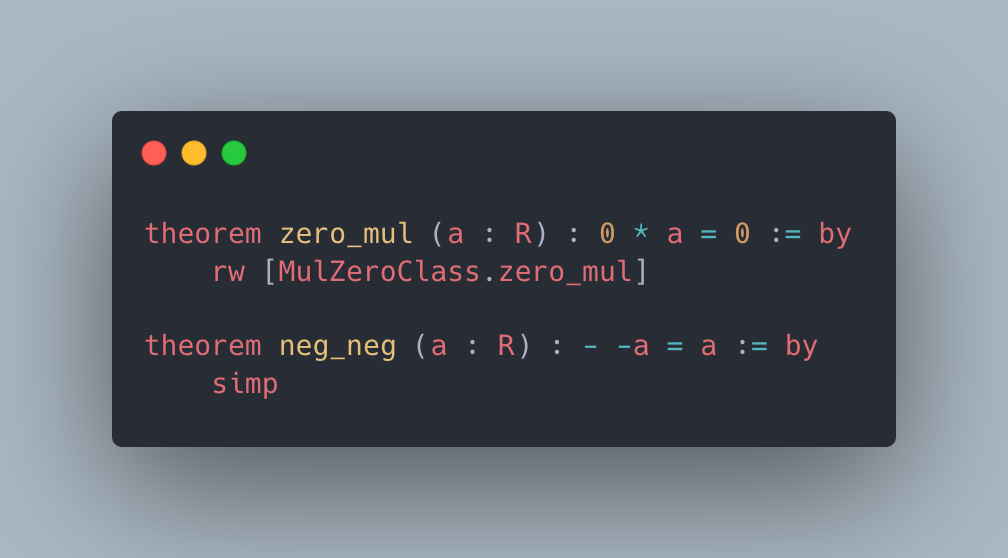
The image displays a code snippet within a stylized window resembling a macOS terminal or code editor. The window has a dark charcoal gray background with rounded corners and a subtle drop shadow, set against a light gray-blue gradient background. The content consists of two formal theorem statements written in the Lean 4 programming language and proof assistant, featuring syntax highlighting.
### Components/Axes
* **Window Frame:** A dark gray (`#2d2d30` approximate) rounded rectangle.
* **Window Controls:** Three circular buttons in the top-left corner, from left to right: red, yellow, and green.
* **Code Area:** The main content area within the window frame.
* **Text & Syntax Highlighting:** The code uses a monospaced font. The syntax highlighting scheme is as follows:
* Keywords (`theorem`, `by`, `rw`, `simp`): Light pink/salmon.
* Theorem names (`zero_mul`, `neg_neg`): Light yellow/gold.
* Variables and types (`a`, `R`): Light blue/cyan.
* Operators and punctuation (`:`, `*`, `=`, `:=`, `[`, `]`, `.`): Light gray/white.
* Proof tactics and class names (`MulZeroClass.zero_mul`): Light pink/salmon for the tactic, with the class path in a lighter shade.
### Detailed Analysis
The code contains two distinct theorem proofs.
**1. Theorem `zero_mul`**
* **Statement:** `theorem zero_mul (a : R) : 0 * a = 0 := by`
* This declares a theorem named `zero_mul`.
* It takes one argument `a` of type `R` (where `R` is presumably a type representing a ring or similar algebraic structure).
* The proposition to be proven is `0 * a = 0` (multiplying any element `a` by zero yields zero).
* **Proof:** `rw [MulZeroClass.zero_mul]`
* The proof is a single tactic: `rw` (rewrite).
* It rewrites the goal using the lemma `MulZeroClass.zero_mul`, which is a standard lemma from Lean's mathlib stating that for any type with a multiplication and a zero element satisfying the `MulZeroClass` axioms, `0 * a = 0`. This indicates the proof is leveraging a pre-existing, more general result.
**2. Theorem `neg_neg`**
* **Statement:** `theorem neg_neg (a : R) : - -a = a := by`
* This declares a theorem named `neg_neg`.
* It takes one argument `a` of type `R`.
* The proposition is `- -a = a` (the negation of the negation of `a` equals `a`).
* **Proof:** `simp`
* The proof uses the `simp` tactic, which is a powerful automated tactic that simplifies expressions by applying a set of known simplification rules (lemmas). In this context, it would use rules defining the properties of negation in the structure `R`.
### Key Observations
* **Language:** The code is written in **Lean 4**, a functional programming language and interactive theorem prover.
* **Context:** The theorems are fundamental properties in abstract algebra. `zero_mul` is an axiom or property of a `MulZeroClass`, and `neg_neg` is a property of an additive inverse in a structure like a group or ring.
* **Proof Style:** The proofs are concise and rely on automation (`simp`) or referencing existing library lemmas (`rw`), which is idiomatic for Lean 4 and mathlib.
* **Visual Design:** The image is a mock-up or presentation graphic, not a raw screenshot. The syntax highlighting is aesthetic and consistent, and the window styling is minimalist and modern.
### Interpretation
This image serves as a visual example of formal mathematical verification in Lean 4. It demonstrates how basic algebraic properties are stated and proven within the system.
* **What it shows:** It captures the essence of "proof by authority" or "proof by definition" in a formal system. The first theorem (`zero_mul`) is proven by directly invoking a more fundamental lemma from a library, showing how complex mathematics is built from a hierarchy of definitions and theorems. The second (`neg_neg`) is proven by a general simplification tactic, showcasing the power of automation for routine algebraic manipulations.
* **Significance:** These theorems, while simple, are foundational. Their formal proof ensures absolute correctness within the logical framework of Lean. The image likely aims to illustrate the syntax, conciseness, and power of the Lean 4 language for formalizing mathematics.
* **Underlying Message:** The clean, highlighted code in a familiar editor window makes advanced formal verification appear accessible and integrated into a modern development workflow. It bridges the gap between abstract mathematical logic and practical software tooling.