TECHNICAL ASSET FINGERPRINT
279b9f30ce0887016c28e415
Click to view fullscreen
Press ESC or click to close
FOUND IN PAPERS
EXPERT: gemini-2.0-flash VERSION 1
RUNTIME: nugit/gemini/gemini-2.0-flash
INTEL_VERIFIED
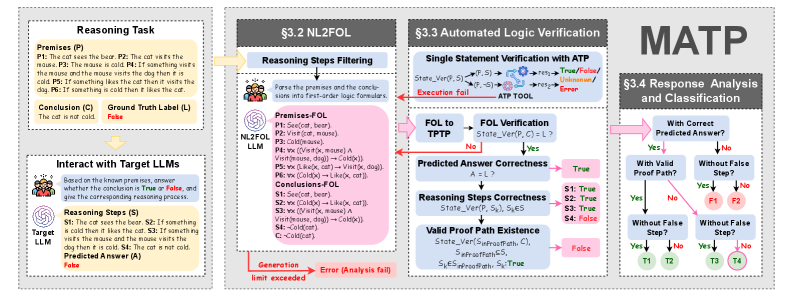
## Flow Diagram: MATP - Reasoning and Verification Process
### Overview
The image presents a flow diagram titled "MATP" which outlines a process for reasoning and verification, likely in the context of natural language processing or automated reasoning systems. The diagram is divided into four main sections: Reasoning Task, NL2FOL (Natural Language to First-Order Logic), Automated Logic Verification, and Response Analysis and Classification. It illustrates the steps involved in converting natural language premises and conclusions into logical formulas, verifying them using an automated theorem prover (ATP), and analyzing the correctness of the predicted answer and reasoning steps.
### Components/Axes
* **Header:** The title "MATP" is located at the top-right of the diagram. Section titles are prefixed with "§" and a number (e.g., "§3.2 NL2FOL").
* **Reasoning Task (Top-Left):**
* Sub-sections: Premises (P), Conclusion (C), Ground Truth Label (L), Interact with Target LLMs, Reasoning Steps (S), Predicted Answer (A).
* Labels: "True" or "False" are used for truth values.
* **§3.2 NL2FOL (Top-Middle):**
* Title: Reasoning Steps Filtering
* Sub-sections: Premises-FOL, Conclusions-FOL
* Component: NL2FOL LLM
* **§3.3 Automated Logic Verification (Top-Right):**
* Sub-sections: Single Statement Verification with ATP, FOL to TPTP, FOL Verification, Predicted Answer Correctness, Reasoning Steps Correctness, Valid Proof Path Existence.
* Components: ATP TOOL
* Labels: "True", "False", "Unknown", "Error", "Yes", "No"
* **§3.4 Response Analysis and Classification (Bottom-Right):**
* Decision points: "With Correct Predicted Answer?", "With Valid Proof Path?", "Without False Step?"
* Outcomes: F1, F2, T1, T2, T3, T4 (likely representing different classifications or states)
* **Arrows:** Arrows indicate the flow of information and control between different stages.
* **Error Handling:** "Generation limit exceeded" and "Error (Analysis fail)" are indicated at the bottom of the NL2FOL section.
### Detailed Analysis or ### Content Details
**1. Reasoning Task (Top-Left):**
* **Premises (P):** A set of six premises (P1-P6) are given in natural language.
* P1: The cat sees the bear.
* P2: The cat visits the mouse.
* P3: The mouse is cold.
* P4: If something visits the mouse and the mouse visits the dog then it is cold.
* P5: If something likes the cat then it visits the dog.
* P6: If something is cold then it likes the cat.
* **Conclusion (C):** The cat is not cold.
* **Ground Truth Label (L):** False.
* **Interact with Target LLMs:** Instructions to answer whether the conclusion is True or False based on the premises.
* **Reasoning Steps (S):** A set of four reasoning steps (S1-S4) are given in natural language.
* S1: The cat sees the bear.
* S2: If something is cold then it likes the cat.
* S3: If something visits the mouse and the mouse visits the dog then it is cold.
* S4: The cat is not cold.
* **Predicted Answer (A):** False.
**2. §3.2 NL2FOL (Top-Middle):**
* **Reasoning Steps Filtering:** The premises and conclusions are parsed into first-order logic formulas.
* **Premises-FOL:** The first-order logic representation of the premises.
* P1: See(cat, bear).
* P2: Visit(cat, mouse).
* P3: Cold(mouse).
* P4: ∀x ((Visit(x, mouse) ∧ Visit(mouse, dog)) → Cold(x)).
* P5: ∀x (Like(x, cat) → Visit(x, dog)).
* P6: ∀x (Cold(x) → Like(x, cat)).
* **Conclusions-FOL:** The first-order logic representation of the conclusions.
* S1: See(cat, bear).
* S2: ∀x (Cold(x) → Like(x, cat)).
* S3: ∀x ((Visit(x, mouse) ∧ Visit(mouse, dog)) → Cold(x)).
* S4: ¬Cold(cat).
* C: ¬Cold(cat).
* **Error Handling:** "Generation limit exceeded" leads to "Error (Analysis fail)".
**3. §3.3 Automated Logic Verification (Top-Right):**
* **Single Statement Verification with ATP:**
* `State_Ver(P, S) -> res1 -> True/False/Unknown/Error`
* `State_Ver(F, S) -> res2 -> Error`
* "Execution fail" leads to "Error".
* **FOL to TPTP:** Conversion of first-order logic to TPTP format.
* **FOL Verification:** `State_Ver(P, C) = L?`
* If "No", the process stops.
* If "Yes", proceeds to the next step.
* **Predicted Answer Correctness:** `A = L?`
* If "True", proceeds to "Reasoning Steps Correctness".
* **Reasoning Steps Correctness:** `State_Ver(P, Sk), Sk ∈ S`
* **Valid Proof Path Existence:** `State_Ver(SinProofPath, C), SinProofPath ∈ S, Sk ∈ SinProofPath: Sk: True`
* If "False", the process stops.
**4. §3.4 Response Analysis and Classification (Bottom-Right):**
* **Decision Points:**
* "With Correct Predicted Answer?" (Yes/No)
* "With Valid Proof Path?" (Yes/No)
* "Without False Step?" (Yes/No)
* **Outcomes:** T1, T2, T3, T4, F1, F2. These outcomes are reached based on the answers to the decision point questions.
### Key Observations
* The diagram illustrates a pipeline for automated reasoning, starting from natural language input and ending with a classification of the response.
* The process involves converting natural language to first-order logic, verifying the logic using an ATP, and analyzing the correctness of the predicted answer and reasoning steps.
* Error handling is included to address cases where generation limits are exceeded or analysis fails.
* The final classification (T1-T4, F1-F2) depends on the correctness of the predicted answer, the validity of the proof path, and the presence of false steps.
### Interpretation
The MATP diagram describes a system for evaluating the reasoning capabilities of a target LLM. The system takes natural language premises and a conclusion, converts them into formal logic, and then uses an automated theorem prover to verify the conclusion. The system also checks the correctness of the reasoning steps provided by the LLM. The final classification (T1-T4, F1-F2) provides a detailed assessment of the LLM's reasoning performance, taking into account both the correctness of the final answer and the validity of the reasoning process. This type of system is valuable for developing and evaluating AI models that can reason logically and provide accurate and reliable answers. The error handling mechanisms suggest that the system is designed to be robust and handle cases where the LLM's reasoning is flawed or incomplete.
DECODING INTELLIGENCE...
EXPERT: gemini-3.1-flash-lite-preview-free VERSION 1
RUNTIME: google-free/gemini-3.1-flash-lite-preview
INTEL_VERIFIED
## Diagram: MATP (Multi-step Automated Theorem Proving/Verification Framework)
### Overview
This image illustrates the **MATP** framework, a multi-stage pipeline designed to evaluate the reasoning capabilities of Large Language Models (LLMs). The process begins with a reasoning task, proceeds through interaction with an LLM, converts natural language reasoning into First-Order Logic (FOL), verifies the logic using Automated Theorem Provers (ATP), and finally classifies the response based on correctness and proof validity.
### Components/Axes
The diagram is organized into four main vertical sections, flowing generally from left to right:
1. **Left Column (Input/Interaction):**
* **Top:** "Reasoning Task" (Premises and Conclusion).
* **Bottom:** "Interact with Target LLMs" (LLM generation of reasoning steps).
2. **Center-Left (§3.2 NL2FOL):**
* "Reasoning Steps Filtering" and "NL2FOL LLM" (Conversion of natural language to logic).
3. **Center-Right (§3.3 Automated Logic Verification):**
* "Single Statement Verification with ATP" and "FOL Verification" (Logic checking).
4. **Right Column (§3.4 Response Analysis and Classification):**
* Decision tree for classifying the LLM's output (T1-T4, F1-F2).
---
### Content Details
#### 1. Reasoning Task & Interaction (Left)
* **Reasoning Task:**
* **Premises (P):**
* P1: The cat sees the bear.
* P2: The cat visits the mouse.
* P3: The mouse visits the dog.
* P4: If something visits the mouse and the mouse visits the dog then it is cold.
* P5: If something likes the cat then it visits the dog.
* P6: If something is cold then it likes the cat.
* **Conclusion (C):** The cat is not cold.
* **Ground Truth Label (L):** False.
* **Interact with Target LLMs:**
* **Instruction:** "Based on the known premises, answer whether the conclusion is True or False, and give the corresponding reasoning process."
* **Reasoning Steps (S):**
* S1: The cat sees the bear.
* S2: If something is cold then it likes the cat.
* S3: If something visits the mouse and the mouse visits the dog then it is cold.
* S4: The cat is not cold.
* **Predicted Answer (A):** False.
#### 2. §3.2 NL2FOL (Center-Left)
* **Process:** "Parse the premises and the conclusions into first-order logic formulas."
* **Premises-FOL:**
* P1: `See(cat, bear)`
* P2: `Visit(cat, mouse)`
* P3: `Visit(mouse, dog)`
* P4: `∀x ((Visit(x, mouse) ∧ Visit(mouse, dog)) → Cold(x))`
* P5: `∀x ((Like(x, cat)) → Visit(x, dog))`
* P6: `∀x ((Cold(x)) → Like(x, cat))`
* **Conclusions-FOL:**
* S1: `See(cat, bear)`
* S2: `∀x ((Cold(x)) → Like(x, cat))`
* S3: `∀x ((Visit(x, mouse) ∧ Visit(mouse, dog)) → Cold(x))`
* S4: `¬Cold(cat)`
* C: `¬Cold(cat)`
#### 3. §3.3 Automated Logic Verification (Center-Right)
* **Single Statement Verification with ATP:**
* `State_Ver(P, S) → res1` (True/False/Unknown/Error)
* `State_Ver(P, -S) → res2`
* "Execution fail" leads to "ATP TOOL".
* **FOL Verification:**
* `State_Ver(P, C) = L?` (Yes/No)
* **Logic Checks:**
* **Predicted Answer Correctness:** `A = L?` (True)
* **Reasoning Steps Correctness:** `State_Ver(P, Sk), Sk ∈ S` (S1: True, S2: True, S3: True, S4: False)
* **Valid Proof Path Existence:** `State_Ver(SinProofPath, C), SinProofPath ⊆ S, Sk ∈ SinProofPath, Sk: True` (Result: False)
#### 4. §3.4 Response Analysis and Classification (Right)
* **Decision Tree:**
* **With Correct Predicted Answer?**
* **Yes:** -> **With Valid Proof Path?**
* Yes -> **T1**
* No -> **Without False Step?**
* Yes -> **T2**
* No -> **T3**
* **No:** -> **Without False Step?**
* Yes -> **F1**
* No -> **F2**
* *Note:* There is a branch labeled "T4" stemming from "Without False Step? -> No" under the "No" (Incorrect Answer) path.
---
### Key Observations
* **Logic Conversion:** The diagram demonstrates a clear translation from natural language (e.g., "The cat is not cold") to formal logic (`¬Cold(cat)`).
* **Verification Logic:** The framework distinguishes between the *correctness of the final answer* and the *correctness of the reasoning steps*.
* **Classification System:** The final output (T1-T4, F1-F2) categorizes the LLM's performance. T-series likely represent "True" (correct answer) and F-series represent "False" (incorrect answer), with sub-classifications based on the validity of the reasoning path (e.g., correct answer with valid proof vs. correct answer with hallucinations/false steps).
* **Error Handling:** The diagram explicitly accounts for "Generation limit exceeded" and "Execution fail" (ATP Tool), indicating robustness in the pipeline.
### Interpretation
This diagram outlines a rigorous evaluation framework for LLM reasoning. It moves beyond simple "accuracy" metrics (did the LLM get the right answer?) to "process" metrics (did the LLM get the right answer *for the right reasons*?).
By converting natural language reasoning steps into First-Order Logic (FOL) and subjecting them to an Automated Theorem Prover (ATP), the system can mathematically verify if the LLM's chain of thought is logically sound. The classification system (T1-T4, F1-F2) is particularly insightful: it allows researchers to identify "lucky guesses" (correct answer, invalid proof path) versus "robust reasoning" (correct answer, valid proof path), which is critical for assessing the reliability of AI models in logical domains.
DECODING INTELLIGENCE...
EXPERT: nemotron-free VERSION 1
RUNTIME: free/nvidia/nemotron-nano-12b-v2-vl:free
INTEL_VERIFIED
## Flowchart: Automated Logical Reasoning and Verification Process
### Overview
The image depicts a multi-stage flowchart for automated logical reasoning and verification. It outlines a process starting with a reasoning task, progressing through formal logic transformation, automated verification, and response analysis. The diagram uses color-coded sections, arrows, and decision nodes to represent workflow and validation criteria.
### Components/Axes
1. **Sections**:
- **Reasoning Task** (Leftmost)
- **§3.2 NL2FOL** (Center-left)
- **§3.3 Automated Logic Verification** (Center-right)
- **§3.4 Response Analysis and Classification** (Rightmost)
2. **Key Elements**:
- **Premises (P1-P6)**: Six initial statements about cats, bears, mice, and dogs.
- **Conclusion (C)**: "The cat is not cold."
- **Ground Truth (L)**: "False" (Conclusion is incorrect).
- **Reasoning Steps (S1-S4)**: Logical deductions derived from premises.
- **FOL (First-Order Logic)**: Formalized version of premises.
- **ATP Tool**: Automated Theorem Prover for verification.
- **TPTP**: Thousands of Problems for Theorem Provers format.
- **Decision Nodes**: Binary outcomes (True/False, Yes/No).
3. **Flow Arrows**:
- Blue arrows indicate progression between sections.
- Red arrows highlight errors or failures.
- Pink arrows denote conditional checks in response analysis.
### Detailed Analysis
#### Reasoning Task
- **Premises**:
- P1: "The cat sees the bear."
- P2: "The cat visits the mouse."
- P3: "The mouse is cold."
- P4: "If something visits the mouse and the mouse is cold, then it likes the cat."
- P5: "If something likes the cat, then it visits the dog."
- P6: "If something is cold, then it likes the cat."
- **Conclusion (C)**: "The cat is not cold."
- **Ground Truth (L)**: "False" (Conclusion contradicts premises).
#### §3.2 NL2FOL (Natural Language to First-Order Logic)
- **Reasoning Steps Filtering**:
- Parses premises and conclusions into FOL.
- Example: "See(cat, bear)" → `See(x, bear)`.
- **FOL Representation**:
- P1: `See(cat, bear)`
- P2: `Visit(cat, mouse)`
- P3: `Cold(mouse)`
- P4: `Visit(x, mouse) ∧ Cold(mouse) → Like(x, cat)`
- P5: `Like(x, cat) → Visit(x, dog)`
- P6: `Cold(x) → Like(x, cat)`
- **Error**: "Generation limit exceeded" (Red arrow indicates failure).
#### §3.3 Automated Logic Verification
- **Single Statement Verification**:
- Uses ATP (Automated Theorem Prover) to validate FOL statements.
- Example: `State_Ver(P, S)` checks premise-conclusion relationships.
- **Outcome**:
- **Execution Fail**: Red arrow indicates ATP tool failure.
- **FOL to TPTP**: Converts FOL into TPTP format for verification.
- **Valid Proof Path**:
- Checks if a logical path exists from premises to conclusion (`State_Ver(P, C) = L`).
#### §3.4 Response Analysis and Classification
- **Decision Tree**:
1. **With Correct Predicted Answer?**
- **Yes**: Proceeds to proof path validation.
- **No**: Classifies as incorrect.
2. **With Valid Proof Path?**
- **Yes**: Further checks for false steps.
- **No**: Classifies as invalid.
3. **Without False Step?**
- **Yes**: Classifies as "T1" (True with valid proof).
- **No**: Classifies as "T4" (False with invalid proof).
### Key Observations
1. **Logical Contradiction**: The conclusion "The cat is not cold" directly contradicts premise P3 ("The mouse is cold") and P6 ("If something is cold, then it likes the cat"), which implies the cat should be cold.
2. **FOL Transformation**: Premises are converted into formal logic to enable automated verification.
3. **ATP Tool Limitations**: The red "Execution fail" arrow suggests the ATP tool could not verify the FOL statements.
4. **Classification Complexity**: The final classification depends on three nested conditions (correctness, proof path validity, and absence of false steps).
### Interpretation
This flowchart illustrates a structured approach to verifying logical reasoning using automated tools. The process begins with natural language premises, transforms them into formal logic (FOL), and uses an ATP tool to validate conclusions. The red "Execution fail" indicates a critical failure in the verification stage, suggesting the FOL statements may be unsolvable or the ATP tool lacks capability. The final classification system (T1-T4) emphasizes the importance of both correctness and logical coherence, highlighting that even a "correct" answer may be invalid if derived through flawed reasoning. The diagram underscores the challenges of automated reasoning, including handling logical contradictions and ensuring proof path integrity.
DECODING INTELLIGENCE...