## Diagram: MATP (Multi-step Automated Theorem Proving/Verification Framework)
### Overview
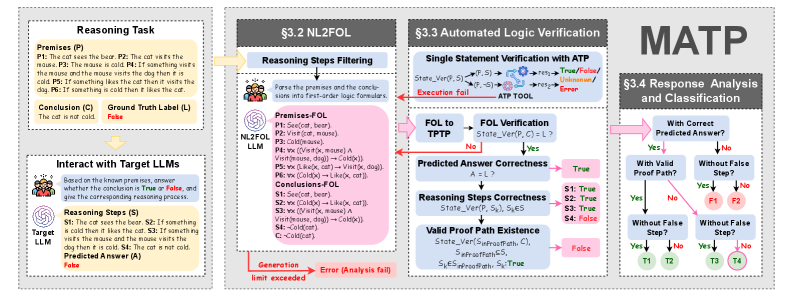
This image illustrates the **MATP** framework, a multi-stage pipeline designed to evaluate the reasoning capabilities of Large Language Models (LLMs). The process begins with a reasoning task, proceeds through interaction with an LLM, converts natural language reasoning into First-Order Logic (FOL), verifies the logic using Automated Theorem Provers (ATP), and finally classifies the response based on correctness and proof validity.
### Components/Axes
The diagram is organized into four main vertical sections, flowing generally from left to right:
1. **Left Column (Input/Interaction):**
* **Top:** "Reasoning Task" (Premises and Conclusion).
* **Bottom:** "Interact with Target LLMs" (LLM generation of reasoning steps).
2. **Center-Left (§3.2 NL2FOL):**
* "Reasoning Steps Filtering" and "NL2FOL LLM" (Conversion of natural language to logic).
3. **Center-Right (§3.3 Automated Logic Verification):**
* "Single Statement Verification with ATP" and "FOL Verification" (Logic checking).
4. **Right Column (§3.4 Response Analysis and Classification):**
* Decision tree for classifying the LLM's output (T1-T4, F1-F2).
---
### Content Details
#### 1. Reasoning Task & Interaction (Left)
* **Reasoning Task:**
* **Premises (P):**
* P1: The cat sees the bear.
* P2: The cat visits the mouse.
* P3: The mouse visits the dog.
* P4: If something visits the mouse and the mouse visits the dog then it is cold.
* P5: If something likes the cat then it visits the dog.
* P6: If something is cold then it likes the cat.
* **Conclusion (C):** The cat is not cold.
* **Ground Truth Label (L):** False.
* **Interact with Target LLMs:**
* **Instruction:** "Based on the known premises, answer whether the conclusion is True or False, and give the corresponding reasoning process."
* **Reasoning Steps (S):**
* S1: The cat sees the bear.
* S2: If something is cold then it likes the cat.
* S3: If something visits the mouse and the mouse visits the dog then it is cold.
* S4: The cat is not cold.
* **Predicted Answer (A):** False.
#### 2. §3.2 NL2FOL (Center-Left)
* **Process:** "Parse the premises and the conclusions into first-order logic formulas."
* **Premises-FOL:**
* P1: `See(cat, bear)`
* P2: `Visit(cat, mouse)`
* P3: `Visit(mouse, dog)`
* P4: `∀x ((Visit(x, mouse) ∧ Visit(mouse, dog)) → Cold(x))`
* P5: `∀x ((Like(x, cat)) → Visit(x, dog))`
* P6: `∀x ((Cold(x)) → Like(x, cat))`
* **Conclusions-FOL:**
* S1: `See(cat, bear)`
* S2: `∀x ((Cold(x)) → Like(x, cat))`
* S3: `∀x ((Visit(x, mouse) ∧ Visit(mouse, dog)) → Cold(x))`
* S4: `¬Cold(cat)`
* C: `¬Cold(cat)`
#### 3. §3.3 Automated Logic Verification (Center-Right)
* **Single Statement Verification with ATP:**
* `State_Ver(P, S) → res1` (True/False/Unknown/Error)
* `State_Ver(P, -S) → res2`
* "Execution fail" leads to "ATP TOOL".
* **FOL Verification:**
* `State_Ver(P, C) = L?` (Yes/No)
* **Logic Checks:**
* **Predicted Answer Correctness:** `A = L?` (True)
* **Reasoning Steps Correctness:** `State_Ver(P, Sk), Sk ∈ S` (S1: True, S2: True, S3: True, S4: False)
* **Valid Proof Path Existence:** `State_Ver(SinProofPath, C), SinProofPath ⊆ S, Sk ∈ SinProofPath, Sk: True` (Result: False)
#### 4. §3.4 Response Analysis and Classification (Right)
* **Decision Tree:**
* **With Correct Predicted Answer?**
* **Yes:** -> **With Valid Proof Path?**
* Yes -> **T1**
* No -> **Without False Step?**
* Yes -> **T2**
* No -> **T3**
* **No:** -> **Without False Step?**
* Yes -> **F1**
* No -> **F2**
* *Note:* There is a branch labeled "T4" stemming from "Without False Step? -> No" under the "No" (Incorrect Answer) path.
---
### Key Observations
* **Logic Conversion:** The diagram demonstrates a clear translation from natural language (e.g., "The cat is not cold") to formal logic (`¬Cold(cat)`).
* **Verification Logic:** The framework distinguishes between the *correctness of the final answer* and the *correctness of the reasoning steps*.
* **Classification System:** The final output (T1-T4, F1-F2) categorizes the LLM's performance. T-series likely represent "True" (correct answer) and F-series represent "False" (incorrect answer), with sub-classifications based on the validity of the reasoning path (e.g., correct answer with valid proof vs. correct answer with hallucinations/false steps).
* **Error Handling:** The diagram explicitly accounts for "Generation limit exceeded" and "Execution fail" (ATP Tool), indicating robustness in the pipeline.
### Interpretation
This diagram outlines a rigorous evaluation framework for LLM reasoning. It moves beyond simple "accuracy" metrics (did the LLM get the right answer?) to "process" metrics (did the LLM get the right answer *for the right reasons*?).
By converting natural language reasoning steps into First-Order Logic (FOL) and subjecting them to an Automated Theorem Prover (ATP), the system can mathematically verify if the LLM's chain of thought is logically sound. The classification system (T1-T4, F1-F2) is particularly insightful: it allows researchers to identify "lucky guesses" (correct answer, invalid proof path) versus "robust reasoning" (correct answer, valid proof path), which is critical for assessing the reliability of AI models in logical domains.