## Flowchart: Automated Logical Reasoning and Verification Process
### Overview
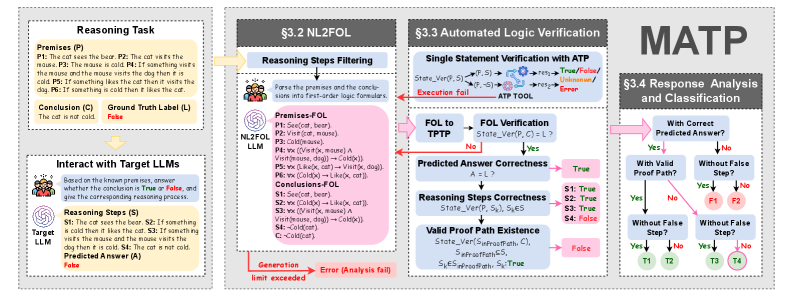
The image depicts a multi-stage flowchart for automated logical reasoning and verification. It outlines a process starting with a reasoning task, progressing through formal logic transformation, automated verification, and response analysis. The diagram uses color-coded sections, arrows, and decision nodes to represent workflow and validation criteria.
### Components/Axes
1. **Sections**:
- **Reasoning Task** (Leftmost)
- **§3.2 NL2FOL** (Center-left)
- **§3.3 Automated Logic Verification** (Center-right)
- **§3.4 Response Analysis and Classification** (Rightmost)
2. **Key Elements**:
- **Premises (P1-P6)**: Six initial statements about cats, bears, mice, and dogs.
- **Conclusion (C)**: "The cat is not cold."
- **Ground Truth (L)**: "False" (Conclusion is incorrect).
- **Reasoning Steps (S1-S4)**: Logical deductions derived from premises.
- **FOL (First-Order Logic)**: Formalized version of premises.
- **ATP Tool**: Automated Theorem Prover for verification.
- **TPTP**: Thousands of Problems for Theorem Provers format.
- **Decision Nodes**: Binary outcomes (True/False, Yes/No).
3. **Flow Arrows**:
- Blue arrows indicate progression between sections.
- Red arrows highlight errors or failures.
- Pink arrows denote conditional checks in response analysis.
### Detailed Analysis
#### Reasoning Task
- **Premises**:
- P1: "The cat sees the bear."
- P2: "The cat visits the mouse."
- P3: "The mouse is cold."
- P4: "If something visits the mouse and the mouse is cold, then it likes the cat."
- P5: "If something likes the cat, then it visits the dog."
- P6: "If something is cold, then it likes the cat."
- **Conclusion (C)**: "The cat is not cold."
- **Ground Truth (L)**: "False" (Conclusion contradicts premises).
#### §3.2 NL2FOL (Natural Language to First-Order Logic)
- **Reasoning Steps Filtering**:
- Parses premises and conclusions into FOL.
- Example: "See(cat, bear)" → `See(x, bear)`.
- **FOL Representation**:
- P1: `See(cat, bear)`
- P2: `Visit(cat, mouse)`
- P3: `Cold(mouse)`
- P4: `Visit(x, mouse) ∧ Cold(mouse) → Like(x, cat)`
- P5: `Like(x, cat) → Visit(x, dog)`
- P6: `Cold(x) → Like(x, cat)`
- **Error**: "Generation limit exceeded" (Red arrow indicates failure).
#### §3.3 Automated Logic Verification
- **Single Statement Verification**:
- Uses ATP (Automated Theorem Prover) to validate FOL statements.
- Example: `State_Ver(P, S)` checks premise-conclusion relationships.
- **Outcome**:
- **Execution Fail**: Red arrow indicates ATP tool failure.
- **FOL to TPTP**: Converts FOL into TPTP format for verification.
- **Valid Proof Path**:
- Checks if a logical path exists from premises to conclusion (`State_Ver(P, C) = L`).
#### §3.4 Response Analysis and Classification
- **Decision Tree**:
1. **With Correct Predicted Answer?**
- **Yes**: Proceeds to proof path validation.
- **No**: Classifies as incorrect.
2. **With Valid Proof Path?**
- **Yes**: Further checks for false steps.
- **No**: Classifies as invalid.
3. **Without False Step?**
- **Yes**: Classifies as "T1" (True with valid proof).
- **No**: Classifies as "T4" (False with invalid proof).
### Key Observations
1. **Logical Contradiction**: The conclusion "The cat is not cold" directly contradicts premise P3 ("The mouse is cold") and P6 ("If something is cold, then it likes the cat"), which implies the cat should be cold.
2. **FOL Transformation**: Premises are converted into formal logic to enable automated verification.
3. **ATP Tool Limitations**: The red "Execution fail" arrow suggests the ATP tool could not verify the FOL statements.
4. **Classification Complexity**: The final classification depends on three nested conditions (correctness, proof path validity, and absence of false steps).
### Interpretation
This flowchart illustrates a structured approach to verifying logical reasoning using automated tools. The process begins with natural language premises, transforms them into formal logic (FOL), and uses an ATP tool to validate conclusions. The red "Execution fail" indicates a critical failure in the verification stage, suggesting the FOL statements may be unsolvable or the ATP tool lacks capability. The final classification system (T1-T4) emphasizes the importance of both correctness and logical coherence, highlighting that even a "correct" answer may be invalid if derived through flawed reasoning. The diagram underscores the challenges of automated reasoning, including handling logical contradictions and ensuring proof path integrity.