## Line Chart: Accuracy vs. Sample Size
### Overview
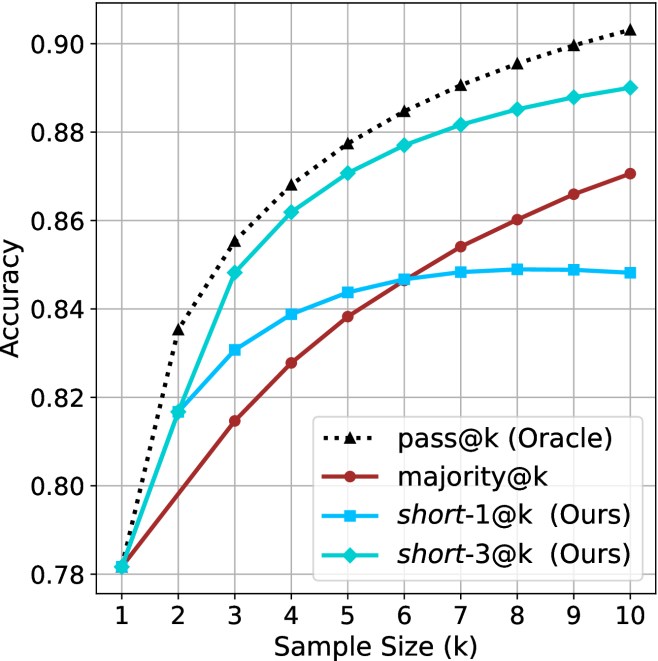
This image presents a line chart illustrating the relationship between accuracy and sample size (k) for four different methods: pass@k (Oracle), majority@k, short-1@k (Ours), and short-3@k (Ours). The chart displays how accuracy changes as the sample size increases from 1 to 10.
### Components/Axes
* **X-axis:** Sample Size (k), ranging from 1 to 10.
* **Y-axis:** Accuracy, ranging from 0.78 to 0.90.
* **Data Series:**
* pass@k (Oracle) - represented by a dotted black line.
* majority@k - represented by a solid maroon line.
* short-1@k (Ours) - represented by a solid blue line.
* short-3@k (Ours) - represented by a solid teal line.
* **Legend:** Located in the center-right of the chart, listing the data series and their corresponding colors.
### Detailed Analysis
Here's a breakdown of each data series and their trends:
* **pass@k (Oracle):** This line starts at approximately 0.78 at k=1 and steadily increases, reaching approximately 0.90 at k=10. The line exhibits a consistently upward slope, indicating a strong positive correlation between sample size and accuracy.
* k=1: Accuracy ≈ 0.78
* k=2: Accuracy ≈ 0.83
* k=3: Accuracy ≈ 0.86
* k=4: Accuracy ≈ 0.88
* k=5: Accuracy ≈ 0.89
* k=6: Accuracy ≈ 0.89
* k=7: Accuracy ≈ 0.89
* k=8: Accuracy ≈ 0.89
* k=9: Accuracy ≈ 0.90
* k=10: Accuracy ≈ 0.90
* **majority@k:** This line begins at approximately 0.78 at k=1 and increases more slowly than pass@k, reaching approximately 0.87 at k=10. The slope is less steep than pass@k, suggesting a weaker correlation.
* k=1: Accuracy ≈ 0.78
* k=2: Accuracy ≈ 0.80
* k=3: Accuracy ≈ 0.82
* k=4: Accuracy ≈ 0.83
* k=5: Accuracy ≈ 0.84
* k=6: Accuracy ≈ 0.85
* k=7: Accuracy ≈ 0.86
* k=8: Accuracy ≈ 0.86
* k=9: Accuracy ≈ 0.87
* k=10: Accuracy ≈ 0.87
* **short-1@k (Ours):** This line starts at approximately 0.78 at k=1 and increases at a moderate rate, reaching approximately 0.85 at k=10. The slope is between pass@k and majority@k.
* k=1: Accuracy ≈ 0.78
* k=2: Accuracy ≈ 0.81
* k=3: Accuracy ≈ 0.83
* k=4: Accuracy ≈ 0.84
* k=5: Accuracy ≈ 0.84
* k=6: Accuracy ≈ 0.84
* k=7: Accuracy ≈ 0.85
* k=8: Accuracy ≈ 0.85
* k=9: Accuracy ≈ 0.85
* k=10: Accuracy ≈ 0.85
* **short-3@k (Ours):** This line starts at approximately 0.78 at k=1 and increases rapidly initially, then plateaus, reaching approximately 0.88 at k=10. It initially outperforms short-1@k but converges towards a similar accuracy level as k increases.
* k=1: Accuracy ≈ 0.78
* k=2: Accuracy ≈ 0.82
* k=3: Accuracy ≈ 0.85
* k=4: Accuracy ≈ 0.86
* k=5: Accuracy ≈ 0.87
* k=6: Accuracy ≈ 0.88
* k=7: Accuracy ≈ 0.88
* k=8: Accuracy ≈ 0.88
* k=9: Accuracy ≈ 0.88
* k=10: Accuracy ≈ 0.88
### Key Observations
* The "pass@k (Oracle)" method consistently achieves the highest accuracy across all sample sizes.
* The "short-3@k (Ours)" method initially shows promising results, but its accuracy plateaus as the sample size increases.
* The "majority@k" method exhibits the slowest increase in accuracy with increasing sample size.
* All methods start with a similar accuracy at k=1.
### Interpretation
The chart demonstrates the impact of sample size on the accuracy of different methods. The "pass@k (Oracle)" method, likely representing an ideal or perfect scenario, serves as an upper bound on achievable accuracy. The "Ours" methods (short-1@k and short-3@k) represent practical approaches that attempt to approximate the performance of the Oracle method. The plateauing of "short-3@k" suggests diminishing returns with larger sample sizes, potentially due to limitations in the method's ability to effectively utilize additional data. The slower improvement of "majority@k" indicates that it may be less sensitive to sample size or less effective at leveraging the available information. The data suggests that increasing the sample size generally improves accuracy, but the extent of improvement varies depending on the method used. The "Ours" methods offer a trade-off between performance and computational cost, as they do not require the perfect knowledge assumed by the "Oracle" method.