## Network Diagram: Network of Strong Connections: high-weight equation-equation
### Overview
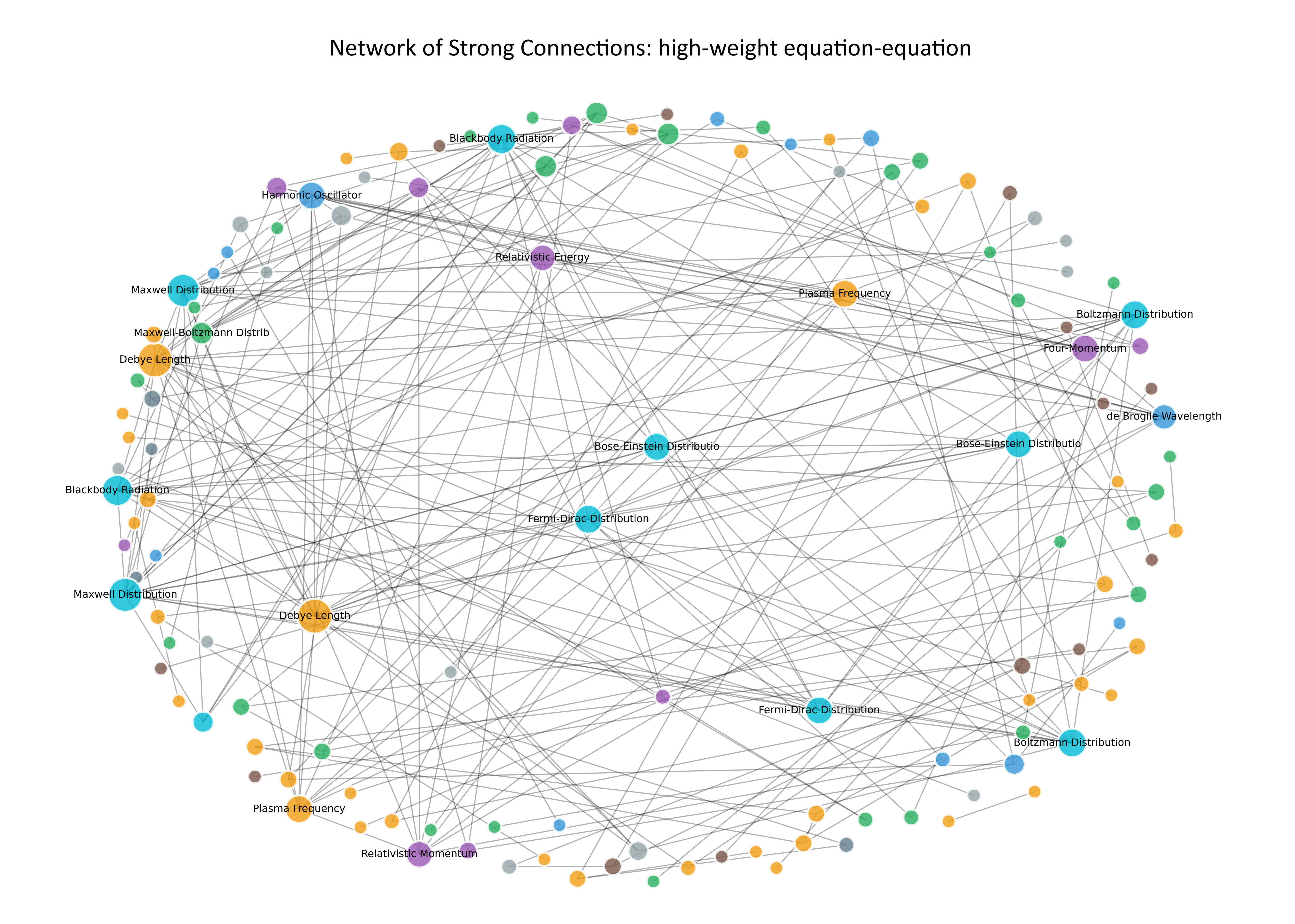
The image depicts a network diagram illustrating interconnected nodes representing physical and mathematical concepts. Nodes are color-coded to denote categories (e.g., distributions, equations), with edges (black lines) showing relationships between them. The diagram emphasizes high-weight connections, suggesting prioritized or dominant interactions.
### Components/Axes
- **Legend**: Located on the right side of the diagram, with four color categories:
- **Blue**: Maxwell Distribution
- **Green**: Boltzmann Distribution
- **Yellow**: Debye Length
- **Purple**: Relativistic Energy
- **Nodes**: Labeled with terms such as "Maxwell Distribution," "Boltzmann Distribution," "Debye Length," "Relativistic Energy," "Blackbody Radiation," "Fermi-Dirac Distribution," and others (see full list below).
- **Edges**: Black lines connecting nodes, with no explicit directionality or thickness variations.
- **Title**: Centered at the top: "Network of Strong Connections: high-weight equation-equation."
### Detailed Analysis
#### Node Distribution
- **Maxwell Distribution** (blue): Dominates the left side of the diagram, with multiple nodes (e.g., "Maxwell-Boltzmann Distribution," "Maxwell-Boltzmann Distrib").
- **Boltzmann Distribution** (green): Concentrated on the right side, with nodes like "Boltzmann Distribution" and "de Broglie Wavelength."
- **Debye Length** (yellow): Clustered at the bottom, with nodes such as "Debye Length" and "Debye Length."
- **Relativistic Energy** (purple): Central placement, with nodes like "Relativistic Energy" and "Relativistic Momentum."
- **Other Nodes**: Include "Blackbody Radiation," "Fermi-Dirac Distribution," "Bose-Einstein Distribution," "Plasma Frequency," and "Four-Momentum."
#### Edge Patterns
- Edges connect nodes across categories, indicating relationships (e.g., Maxwell-Boltzmann links to Boltzmann and Debye Length).
- Central nodes (e.g., "Relativistic Energy," "Debye Length") have the highest connectivity, acting as hubs.
- No explicit edge weights or labels are visible.
### Key Observations
1. **Central Hubs**: Nodes like "Relativistic Energy" and "Debye Length" are highly connected, suggesting their foundational role in the network.
2. **Category Clustering**: Nodes within the same category (e.g., Maxwell, Boltzmann) are grouped spatially but connected to multiple categories.
3. **High-Weight Connections**: The title implies prioritized links, though no numerical weights are provided. Visual density of edges near hubs may imply stronger connections.
4. **Color Consistency**: All nodes in a category share the same color, with no exceptions observed.
### Interpretation
The diagram represents a conceptual or mathematical framework where physical distributions (e.g., Maxwell, Boltzmann) and equations (e.g., Debye Length, Relativistic Energy) are interrelated. The central hubs ("Relativistic Energy," "Debye Length") likely serve as core principles linking diverse phenomena. The network's structure suggests a system where energy, distribution, and length scales are deeply interconnected, possibly in plasma physics, statistical mechanics, or relativistic systems. The absence of numerical data limits quantitative analysis, but the visual emphasis on hubs and cross-category connections highlights the importance of these relationships in the modeled system.