## Diagram: Question Answering Decoding Process
### Overview
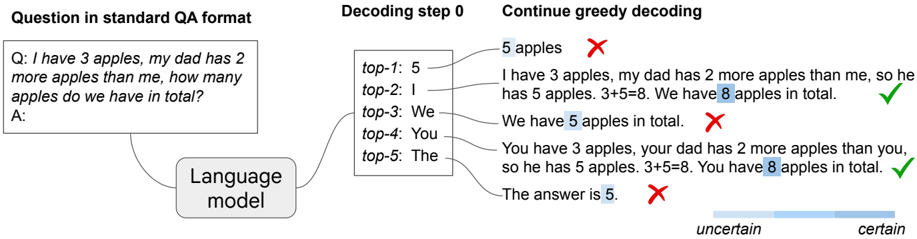
The image illustrates the decoding process of a question-answering (QA) system. It shows how a language model processes a question and generates possible answers, with a greedy decoding approach. The diagram highlights the initial decoding step and the continuation of the greedy decoding process, indicating the model's confidence in each generated answer.
### Components/Axes
* **Header:** "Question in standard QA format", "Decoding step 0", "Continue greedy decoding"
* **Question Box:** Contains the question: "Q: I have 3 apples, my dad has 2 more apples than me, how many apples do we have in total? A:"
* **Language Model Box:** Labeled "Language model"
* **Decoding Step 0 Box:** Contains the top 5 predicted tokens: "top-1: 5", "top-2: I", "top-3: We", "top-4: You", "top-5: The"
* **Greedy Decoding Outputs:** A list of sentences generated by the model, each marked with either a green checkmark (correct) or a red "X" (incorrect).
* **Confidence Bar:** A horizontal bar labeled "uncertain" on the left and "certain" on the right, with a gradient from light to dark blue indicating increasing confidence.
### Detailed Analysis or ### Content Details
1. **Question:** The question presented is "Q: I have 3 apples, my dad has 2 more apples than me, how many apples do we have in total? A:"
2. **Language Model:** A "Language model" block is connected to both the question and the "Decoding step 0" box, indicating its role in processing the question and generating initial predictions.
3. **Decoding Step 0:** The "Decoding step 0" box shows the top 5 predicted tokens:
* top-1: "5"
* top-2: "I"
* top-3: "We"
* top-4: "You"
* top-5: "The"
4. **Continue Greedy Decoding:** This section shows the results of continuing the decoding process using a greedy approach. Each generated sentence is evaluated for correctness.
* "5 apples" - Marked with a red "X" (incorrect).
* "I have 3 apples, my dad has 2 more apples than me, so he has 5 apples. 3+5=8. We have 8 apples in total." - Marked with a green checkmark (correct). The number "8" is highlighted in blue.
* "We have 5 apples in total." - Marked with a red "X" (incorrect). The number "5" is highlighted in blue.
* "You have 3 apples, your dad has 2 more apples than you, so he has 5 apples. 3+5=8. You have 8 apples in total." - Marked with a green checkmark (correct). The number "8" is highlighted in blue.
* "The answer is 5." - Marked with a red "X" (incorrect). The number "5" is highlighted in blue.
5. **Confidence Bar:** The confidence bar indicates the model's certainty in its predictions, ranging from "uncertain" to "certain".
### Key Observations
* The language model initially predicts single tokens ("5", "I", "We", "You", "The").
* The greedy decoding process generates complete sentences based on these initial tokens.
* The model correctly generates two valid answers, but also produces incorrect answers.
* The correct answers involve calculating the total number of apples (3 + 2 + 3 = 8).
### Interpretation
The diagram illustrates a common approach to question answering using language models. The model generates possible answers by iteratively predicting the next token in the sequence. The greedy decoding strategy selects the most likely token at each step, which can lead to both correct and incorrect answers. The confidence bar suggests that the model can have varying degrees of certainty in its predictions. The example highlights the importance of evaluating the generated answers to ensure accuracy. The model's ability to generate both correct and incorrect answers suggests that further refinement or a different decoding strategy (e.g., beam search) might be necessary to improve performance.