## Line Graph: Gradient Updates vs. Dimension
### Overview
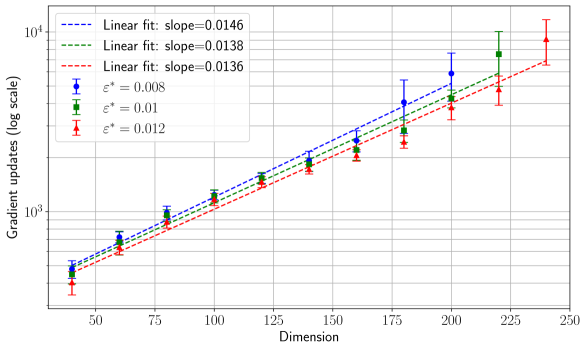
The image is a line graph depicting the relationship between "Gradient updates (log scale)" and "Dimension" for three distinct linear fits and corresponding data series. The y-axis uses a logarithmic scale, and the x-axis ranges from 50 to 250. Three linear fits (blue, green, red dashed lines) and three data series (blue circles, green squares, red triangles) are plotted, each associated with specific slope values and ε* parameters.
---
### Components/Axes
- **X-axis (Dimension)**: Labeled "Dimension," with values ranging from 50 to 250 in increments of 25.
- **Y-axis (Gradient updates)**: Labeled "Gradient updates (log scale)," with values spanning $10^3$ to $10^4$.
- **Legend**: Located in the top-left corner, containing:
- **Blue dashed line**: "Linear fit: slope=0.0146"
- **Green dashed line**: "Linear fit: slope=0.0138"
- **Red dashed line**: "Linear fit: slope=0.0136"
- **Data Series**:
- **Blue circles**: ε* = 0.008
- **Green squares**: ε* = 0.01
- **Red triangles**: ε* = 0.012
- **Error Bars**: Vertical lines attached to data points, indicating uncertainty.
---
### Detailed Analysis
1. **Linear Fits**:
- **Blue line (slope=0.0146)**: Steepest slope, indicating the highest rate of increase in gradient updates with dimension.
- **Green line (slope=0.0138)**: Intermediate slope.
- **Red line (slope=0.0136)**: Shallowest slope, suggesting the slowest growth rate.
2. **Data Series**:
- **ε* = 0.008 (blue circles)**: Data points align closely with the blue dashed line, with error bars increasing slightly as dimension grows.
- **ε* = 0.01 (green squares)**: Data points follow the green dashed line, with error bars showing moderate variability.
- **ε* = 0.012 (red triangles)**: Data points track the red dashed line, with larger error bars at higher dimensions.
3. **Trends**:
- All three lines exhibit a positive, linear relationship between dimension and gradient updates on a logarithmic scale.
- The blue line (highest slope) grows fastest, while the red line (lowest slope) grows slowest.
- Error bars increase in size for all data series as dimension increases, suggesting greater uncertainty at higher dimensions.
---
### Key Observations
- **Slope Consistency**: The linear fits (dashed lines) closely match their respective data series (solid markers), confirming the validity of the linear approximations.
- **Error Bar Patterns**: Larger error bars at higher dimensions (e.g., 200–250) may indicate measurement limitations or non-linear behavior at extreme values.
- **ε* Correlation**: Higher ε* values (0.012) correspond to slower growth rates (red line), while lower ε* (0.008) align with faster growth (blue line).
---
### Interpretation
The graph demonstrates that gradient updates scale linearly with dimension for three distinct ε* values, with the rate of scaling governed by the slope of the linear fit. The blue line (ε* = 0.008) exhibits the steepest growth, suggesting that smaller ε* values amplify the impact of dimension on gradient updates. Conversely, larger ε* values (e.g., 0.012) result in slower scaling, as seen in the red line. The increasing error bars at higher dimensions imply potential challenges in maintaining precision or stability in high-dimensional systems. This trend could reflect computational constraints or theoretical limits in gradient-based optimization methods.