## Box Plot: Number of Goals by Agent Type
### Overview
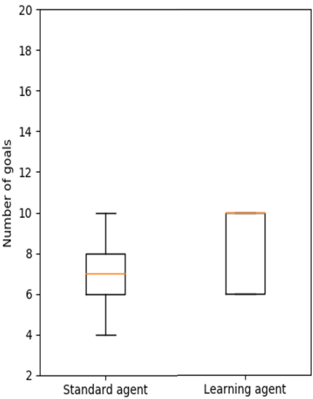
The image is a vertical box plot comparing the distribution of the "Number of goals" achieved by two distinct agent types: a "Standard agent" and a "Learning agent." The chart is presented on a white background with a simple, clean aesthetic.
### Components/Axes
* **Chart Type:** Box-and-whisker plot (box plot).
* **Y-Axis (Vertical):**
* **Label:** "Number of goals"
* **Scale:** Linear, ranging from 2 to 20.
* **Major Tick Marks:** At intervals of 2 (2, 4, 6, 8, 10, 12, 14, 16, 18, 20).
* **X-Axis (Horizontal):**
* **Categories:** Two discrete categories are labeled below their respective box plots.
* **Left Category:** "Standard agent"
* **Right Category:** "Learning agent"
* **Plot Elements (Legend Implied by Color/Style):**
* **Orange Horizontal Line:** Represents the **median** (50th percentile) of the data.
* **Black Box:** Represents the **Interquartile Range (IQR)**, spanning from the 25th percentile (Q1, bottom of box) to the 75th percentile (Q3, top of box).
* **Black "Whiskers":** Extend from the box to the minimum and maximum data points within 1.5 * IQR from Q1 and Q3, respectively. Points beyond this range would typically be plotted as outliers (none are visible here).
### Detailed Analysis
**1. Standard Agent (Left Box Plot):**
* **Median (Orange Line):** Approximately **7**.
* **Interquartile Range (Black Box):**
* **Q1 (25th Percentile, Bottom of Box):** Approximately **6**.
* **Q3 (75th Percentile, Top of Box):** Approximately **8**.
* **IQR Height:** ~2 units.
* **Whiskers:**
* **Minimum (Lower Whisker End):** Approximately **4**.
* **Maximum (Upper Whisker End):** Approximately **10**.
* **Visual Trend:** The distribution is centered around 7 goals, with the middle 50% of data falling between 6 and 8 goals. The full range of typical data (excluding outliers) spans from 4 to 10 goals.
**2. Learning Agent (Right Box Plot):**
* **Median (Orange Line):** Approximately **10**.
* **Interquartile Range (Black Box):**
* **Q1 (25th Percentile, Bottom of Box):** Approximately **6**.
* **Q3 (75th Percentile, Top of Box):** Approximately **10**.
* **IQR Height:** ~4 units.
* **Whiskers:**
* **Minimum (Lower Whisker End):** Approximately **6**.
* **Maximum (Upper Whisker End):** The upper whisker is not visible. This indicates that the maximum value within the 1.5*IQR range is equal to Q3 (10), or that the data is capped at 10 for the upper half of the distribution.
* **Visual Trend:** The distribution is skewed. The median is at the top of the box (Q3), indicating that at least 50% of the data points are at or below 10 goals, and at least 25% are at or above 10 goals. The lower 50% of the data is spread between 6 and 10 goals.
### Key Observations
1. **Higher Central Tendency for Learning Agent:** The median number of goals for the Learning agent (10) is significantly higher than that of the Standard agent (7).
2. **Different Distribution Shapes:**
* The Standard agent's distribution is relatively symmetric around its median.
* The Learning agent's distribution is negatively skewed (left-skewed), with the median coinciding with the third quartile (Q3). This suggests a concentration of higher values.
3. **Overlap in Lower Ranges:** Both agents have a similar lower quartile (Q1 ≈ 6), indicating that the worst 25% of performances for both agents are comparable.
4. **Greater Upper-Range Performance for Learning Agent:** The Learning agent's interquartile range extends to 10, which is the maximum value for the Standard agent's typical range. This shows the Learning agent consistently achieves higher goal counts in its upper 75% of results.
5. **No Visible Outliers:** Neither plot shows individual points beyond the whiskers, suggesting all data points fall within the calculated expected range.
### Interpretation
The data suggests a clear performance difference between the two agent types in the context of achieving goals.
* **The Learning agent demonstrates superior median performance,** achieving approximately 43% more goals at the median level (10 vs. 7) compared to the Standard agent.
* **The Learning agent shows a "ceiling effect" or high consistency at the top end.** The fact that its median equals its 75th percentile (Q3) and the upper whisker is absent implies that a substantial portion (at least 25%) of its runs achieve the maximum observed value of 10 goals, and no run in the typical range exceeds this. This could indicate a performance cap in the experimental setup or that the agent reliably reaches a high-performance plateau.
* **The Standard agent has a more predictable, symmetric spread** of outcomes, centered on a lower goal count.
* **The similar lower bounds (Q1 and minimum)** suggest that both agents have a comparable "worst-case" scenario, failing to achieve more than 4-6 goals in their poorest performances.
**Conclusion:** The "Learning agent" is not only more effective on average (higher median) but also more reliably achieves higher goal counts, with its lower 25% of results matching the Standard agent's lower 25%. The Standard agent's performance is more variable around a lower mean. This visualization strongly supports the claim that the Learning agent architecture improves goal-achievement outcomes over the Standard agent in this measured context.