## Flowchart: Information Retrieval and Response Generation System
### Overview
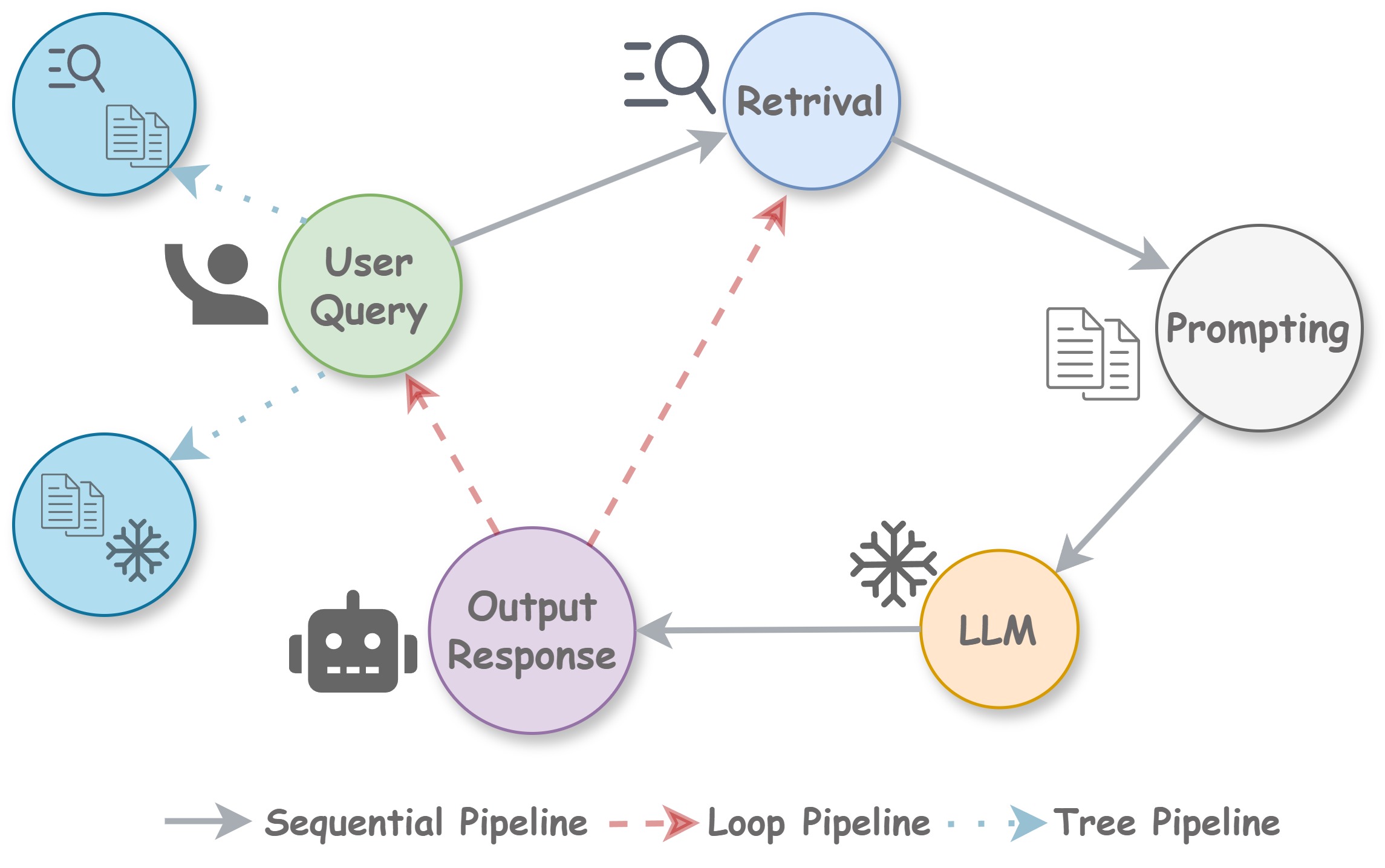
The diagram illustrates a multi-stage process for handling user queries through information retrieval, prompting, and language model (LLM) interaction. It includes three pipeline types (sequential, loop, tree) represented by different arrow styles.
### Components/Axes
**Nodes (Process Stages):**
1. **User Query** (Green circle with person icon) - Top-left
2. **Retrieval** (Blue circle with search icon) - Center-top
3. **Prompting** (Gray circle with document icon) - Right-center
4. **LLM** (Yellow circle with robot icon) - Bottom-right
5. **Output Response** (Purple circle with robot icon) - Bottom-center
**Arrows (Pipeline Types):**
- **Sequential Pipeline** (Solid gray arrows)
- **Loop Pipeline** (Dashed red arrows)
- **Tree Pipeline** (Dotted blue arrows)
**Legend Position:** Bottom of diagram, clearly labeling arrow types
### Detailed Analysis
1. **User Query** (Green) initiates the process, connected via:
- Sequential pipeline (solid gray) to **Retrieval**
- Loop pipeline (dashed red) back to itself (self-loop)
2. **Retrieval** (Blue) connects to:
- Sequential pipeline to **Prompting**
- Loop pipeline back to **User Query**
3. **Prompting** (Gray) connects to:
- Tree pipeline (dotted blue) to **LLM**
- Sequential pipeline to **Output Response**
4. **LLM** (Yellow) connects via:
- Sequential pipeline to **Output Response**
5. **Output Response** (Purple) has no outgoing connections
### Key Observations
- The system features three distinct pipeline architectures:
- **Sequential Flow**: Main path from User Query → Retrieval → Prompting → LLM → Output Response
- **Loop Mechanism**: Allows iterative refinement between User Query ↔ Retrieval and Retrieval ↔ User Query
- **Branching Path**: Prompting → LLM represents a decision point with potential parallel processing
- No numerical data points present; the diagram focuses on process flow rather than quantitative metrics
### Interpretation
This flowchart represents a hybrid information processing system combining:
1. **Iterative Refinement**: The loop pipeline between User Query and Retrieval suggests a feedback mechanism for query optimization
2. **Parallel Processing**: The tree pipeline from Prompting to LLM indicates potential for concurrent model interactions
3. **Linear Execution**: The sequential pipeline forms the primary execution path through the system
The architecture implies a balance between:
- **Efficiency** (through sequential processing)
- **Adaptability** (via loop-based query refinement)
- **Complexity Handling** (through tree-based model interactions)
The absence of quantitative metrics suggests this is a conceptual workflow rather than a performance benchmark. The system design prioritizes flexibility in handling different query types and processing requirements.