\n
## Problem Solving Analysis: Rainfall, Mosquitoes, and Bats
### Overview
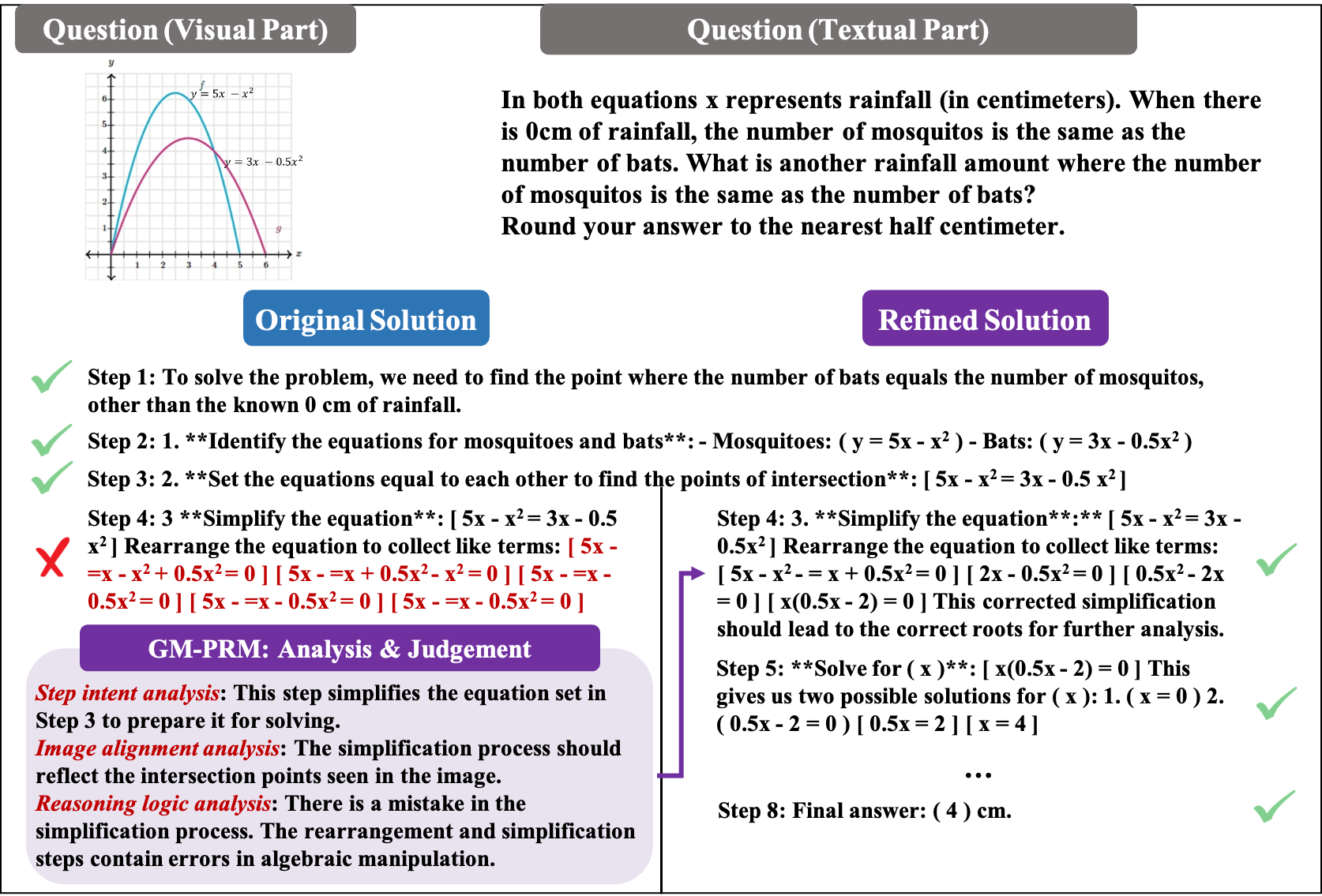
The image presents a problem involving two equations representing rainfall and the populations of mosquitoes and bats. It shows a visual representation of the equations as graphs, an original attempted solution, a refined solution, and a section for analysis and judgement. The problem asks for the rainfall amount where the mosquito and bat populations are equal, beyond the known 0cm point.
### Components/Axes
* **Graph:**
* X-axis: Labeled "x" with markings from -5 to 5 in increments of 1.
* Y-axis: Labeled "y" with markings from -5 to 10 in increments of 1.
* Equation 1 (Mosquitoes): y = 5x - x² (represented by a solid blue line)
* Equation 2 (Bats): y = 3x - 0.5x² (represented by a solid orange line)
* **Textual Problem Statement:** Describes the scenario and the question.
* **Original Solution:** A step-by-step solution attempt, marked with checkmarks for completed steps.
* **Refined Solution:** A corrected step-by-step solution, also marked with checkmarks.
* **GP-MR: Analysis & Judgement:** A section providing analysis of the solution process.
### Detailed Analysis or Content Details
**1. Graph Analysis:**
* The blue line (mosquitoes) starts at (0,0), rises to a maximum around x=2.5, and then decreases.
* The orange line (bats) starts at (0,0), rises to a maximum around x=3, and then decreases.
* The lines intersect at approximately x=0 and x=4.
**2. Textual Problem Statement:**
"In both equations x represents rainfall (in centimeters). When there is 0cm of rainfall, the number of mosquitoes is the same as the number of bats. What is another rainfall amount where the number of mosquitoes is the same as the number of bats? Round your answer to the nearest half centimeter."
**3. Original Solution:**
* Step 1: "To solve the problem, we need to find the point where the number of bats equals the number of mosquitoes, other than the known 0 cm of rainfall."
* Step 2: 1. **Identify the equations for mosquitoes and bats**:: Mosquitoes: (y = 5x - x²) - Bats: (y = 3x - 0.5x²)
* Step 3: 2. **Set the equations equal to each other to find the points of intersection**: [5x - x² = 3x - 0.5x²]
* Step 4: 3. **Simplify the equation**: [5x - x² = 3x - 0.5x²] Rearrange to collect like terms: [5x - x² + 0.5x² = 0] [5x - 0.5x² - x² = 0] [5x - x - 0.5x² = 0] [5x - x - 0.5x = 0]
* Step 4: 3. **Simplify the equation**: [5x - x² = 3x - 0.5x²] Rearrange to collect like terms: [5x - x² + 0.5x² = 0] [5x - 0.5x² - x² = 0] [5x - x - 0.5x² = 0] [5x - x - 0.5x = 0]
**4. Refined Solution:**
* Step 4: 3. **Simplify the equation**: [5x - x² = 3x - 0.5x²] Rearrange to collect like terms: [5x - x² - 3x + 0.5x² = 0] [2x - 0.5x² = 0] [0.5x(4 - x) = 0] This corrected simplification should lead to the correct roots for further analysis.
* Step 5: **Solve for x**: [0.5x(4 - x) = 0] This gives us two possible solutions for x: (1) x = 0 (2) (0.5x = 2) -> 0.5x = 2 -> x = 4
* Step 8: Final answer: (4) cm.
**5. GP-MR: Analysis & Judgement:**
* Step intent analysis: This step simplifies the equation set in Step 3 to prepare it for solving.
* Image alignment analysis: The simplification process should reflect the intersection points seen in the image.
* Reasoning logic analysis: There is a mistake in the simplification process. The rearrangement and simplification steps contain errors in algebraic manipulation.
### Key Observations
* The original solution contains algebraic errors in simplifying the equation, leading to an incorrect path.
* The refined solution correctly simplifies the equation and finds the intersection point at x = 4.
* The graph visually confirms the intersection points at approximately x = 0 and x = 4.
* The analysis section correctly identifies the error in the original solution.
### Interpretation
The image demonstrates a problem-solving process involving the intersection of two quadratic equations. The visual representation (graph) provides a valuable check for the algebraic solution. The "GP-MR" section highlights the importance of careful algebraic manipulation and error detection. The refined solution showcases a correct approach to solving the problem, leading to the answer of 4 cm, which corresponds to the second intersection point observed on the graph. The problem illustrates a real-world application of quadratic equations, modeling the relationship between rainfall and population sizes. The error in the original solution emphasizes the need for rigorous verification of each step in the problem-solving process. The analysis section provides a meta-cognitive layer, demonstrating how to evaluate and correct one's own work.