\n
## Diagram: Communication Models
### Overview
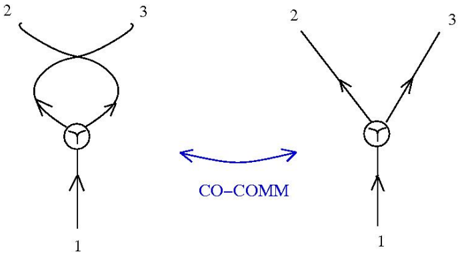
The image presents two diagrams illustrating different communication models. The diagram on the left depicts a circular, feedback-oriented model, while the diagram on the right shows a linear, one-way communication flow. A bidirectional arrow labeled "CO-COMM" connects the two diagrams, suggesting a relationship or transition between the two models.
### Components/Axes
The diagrams utilize numbered lines (1, 2, and 3) to represent communication elements. Each diagram features a central node represented by a circle with a 'Y' shape inside, likely symbolizing a communicator or source. Arrows indicate the direction of communication flow. The label "CO-COMM" is positioned centrally between the two diagrams.
### Detailed Analysis or Content Details
**Left Diagram (Circular Model):**
* **Line 1:** An upward-pointing arrow originates from below the central node.
* **Line 2:** A curved line originates from the top-left of the central node, looping around and intersecting with Line 3.
* **Line 3:** A curved line originates from the top-right of the central node, looping around and intersecting with Line 2.
* The intersection of Lines 2 and 3 forms a closed loop, indicating feedback. Arrows within the loop suggest a continuous flow of information.
**Right Diagram (Linear Model):**
* **Line 1:** An upward-pointing arrow originates from below the central node.
* **Line 2:** A straight line extends upwards and to the left from the central node.
* **Line 3:** A straight line extends upwards and to the right from the central node.
* The lines 2 and 3 diverge from the central node, indicating a one-way flow of information.
**Central Label:**
* "CO-COMM" – This label is written in all caps and is positioned horizontally between the two diagrams.
### Key Observations
The left diagram emphasizes a cyclical communication process with feedback, while the right diagram illustrates a linear, one-way communication process. The "CO-COMM" label suggests a connection or potential transition between these two models. The diagrams are simple and schematic, focusing on the flow of communication rather than specific content.
### Interpretation
The diagrams likely represent contrasting models of communication. The left diagram, with its circular flow and feedback loop, could represent a more interactive or collaborative communication model. The right diagram, with its linear flow, could represent a more traditional, one-way communication model (e.g., a lecture or broadcast). The "CO-COMM" label might indicate "co-communication" or a combined communication approach, suggesting that communication can move between these two models depending on the context. The diagrams are abstract and do not provide specific data points, but they offer a visual representation of different communication dynamics. The 'Y' shape within the central node could represent the branching of communication channels or the multiple roles of a communicator. The lack of further context makes a definitive interpretation challenging, but the diagrams clearly highlight the difference between feedback-driven and linear communication processes.