## Diagram: Tree Structure of Logical Derivation
### Overview
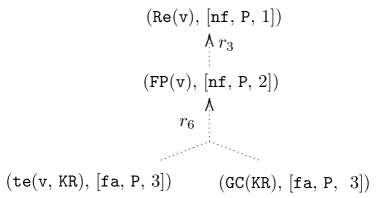
The image depicts a tree diagram representing a logical derivation. It shows the steps and components involved in deriving a conclusion from initial premises. The diagram uses labels and annotations to indicate the logical operations and the flow of reasoning.
### Components/Axes
* **Nodes:** The nodes in the tree represent logical statements or expressions. Each node is labeled with a term and a list of attributes.
* **Edges:** The edges, represented by dotted lines, indicate the derivation steps. Each edge is labeled with a rule number.
* **Labels:**
* `(Re(v), [nf, P, 1])`: Represents a real-valued variable 'v' with attributes 'nf', 'P', and '1'. Located at the top of the diagram.
* `(FP(v), [nf, P, 2])`: Represents a floating-point variable 'v' with attributes 'nf', 'P', and '2'. Located in the middle of the diagram.
* `(te(v, KR), [fa, P, 3])`: Represents a term 'te' involving 'v' and 'KR' with attributes 'fa', 'P', and '3'. Located at the bottom-left of the diagram.
* `(GC(KR), [fa, P, 3])`: Represents a term 'GC' involving 'KR' with attributes 'fa', 'P', and '3'. Located at the bottom-right of the diagram.
* **Rules:**
* `r3`: The rule applied to derive `(FP(v), [nf, P, 2])` from `(Re(v), [nf, P, 1])`.
* `r6`: The rule applied to derive `(te(v, KR), [fa, P, 3])` and `(GC(KR), [fa, P, 3])` from `(FP(v), [nf, P, 2])`.
### Detailed Analysis
The diagram shows a derivation process that starts with a real-valued variable `Re(v)` and proceeds through a floating-point representation `FP(v)` to two terms `te(v, KR)` and `GC(KR)`. The rules `r3` and `r6` represent the logical steps in this derivation.
### Key Observations
* The derivation starts with a real-valued variable and ends with two terms.
* The attributes associated with each node change as the derivation progresses.
* The rules `r3` and `r6` are crucial for understanding the logical steps involved.
### Interpretation
The diagram illustrates a logical derivation process, possibly within a formal system or programming language. It shows how a real-valued variable can be transformed into other terms through specific rules. The attributes associated with each node likely represent properties or constraints relevant to the derivation. The diagram provides a visual representation of the logical flow and the transformations applied at each step.